Why Conservatives have hope

Conservatives who pay attention to media polls are praying for a turnout advantage based on older voters and firmly committed supporters.  And supporters of other stripes will want to head into the weekend with their eyes wide open.  I’m sure complacency is not an issue for anyone.

I’m not sure this praying cat is Conservative, but who doesn’t like a praying cat?

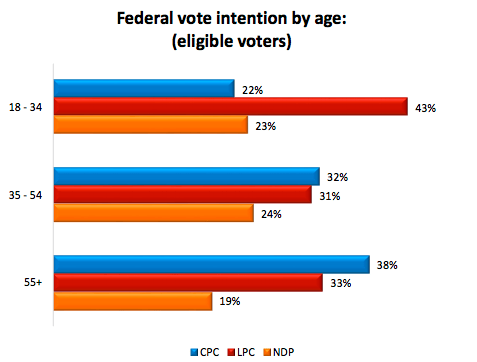
Today’s Angus Reid Institute (ARI) – hint, older people more likely to vote:

Screen Shot 2015-10-16 at 2.11.29 PM

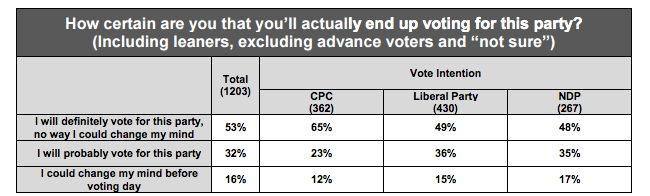
Then there’s this:

Screen Shot 2015-10-16 at 2.25.51 PM

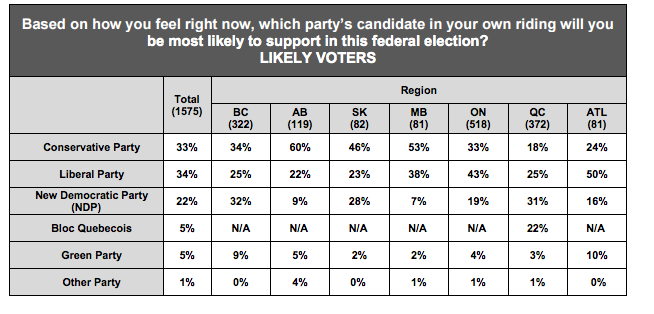
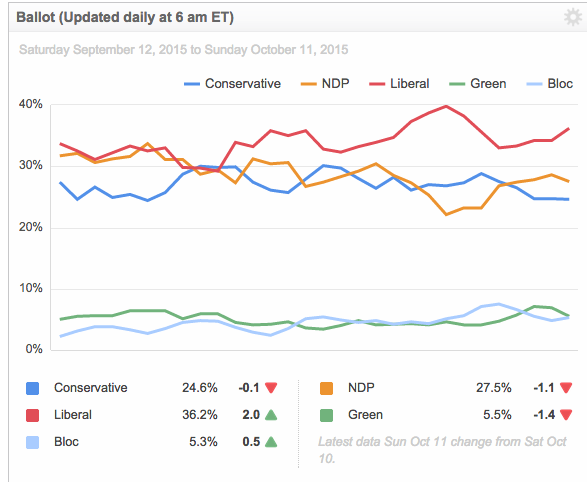
ARI looks specifically at likely voters, shrinking Liberal lead from 35-31 to 34-33:

Screen Shot 2015-10-16 at 2.14.37 PM

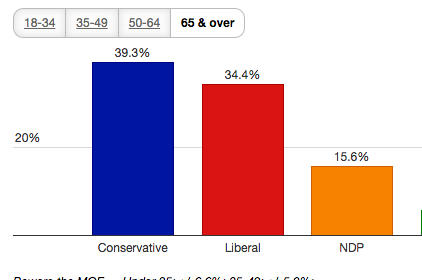
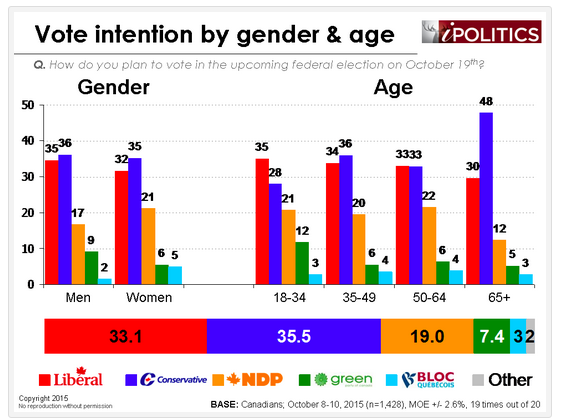
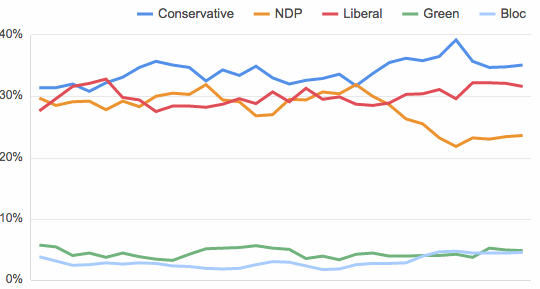
Today’s EKOS (65 and over):

Screen Shot 2015-10-16 at 2.12.36 PM

Ekos has overall race at 34 Lib, 33 CPC.

Is there a Liberal surge?  Nanos has six point Liberal lead and Liberal strength among seniors.  Mainstreet is predicting a Liberal majority.  Innovative also has a big red spread.

Ekos and ARI provide counter-evidence to suggest the CPC are far from dead and buried.  Not in majority territory (I don’t think we have a David Cameron surprise here) but still in the hunt for a plurality.

Pick your poison.

Reasons to second guess polls

The latest polls give plenty of fodder to suggest that there is a Liberal surge overtaking the race.  There are a number of supportable points on this:

  • Nightly poll tracking by Nanos has been reinforced by Innovative and Ekos.  The narrative is that the Liberals are pulling away from the Conservatives with the NDP far behind.
  • The “not ready” line of attack has been embraced by the Liberals; they have played it differently than “just visiting” and “not a leader” attacks from previous campaigns.
  • The heat of the anti-Harper passion is far beyond that what has been seen in previous elections.  Various poll metrics (eg. “time for a change”) suggest voters are ready for a new government.
  • Advance voting turnout is high which could mean higher overall turnout favouring the Opposition.

What could possibly go wrong betting on a horse race?

Yet, there is that gnawing feeling that there could be another polling surprise just around the bend.

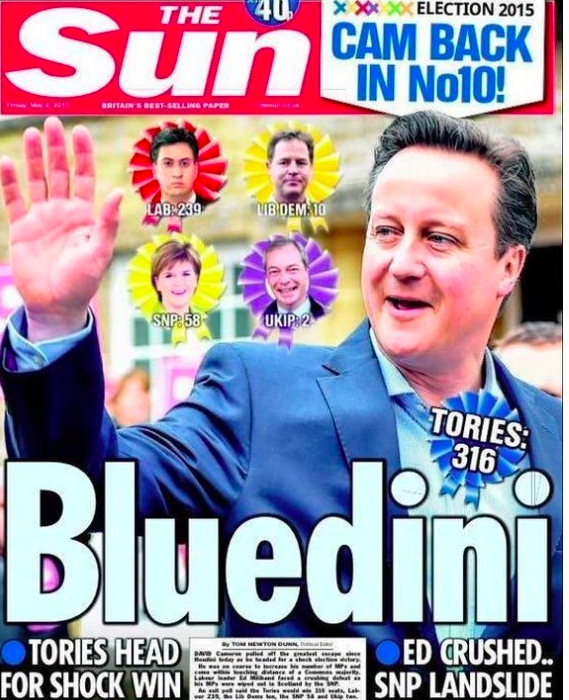
Look at the UK election last May.  Screen Shot 2015-10-12 at 11.08.00 PMThe intensity of British media coverage and polling exceeded that of the Canadian election yet no one saw a Conservative majority coming.  Even famed predictor Nate Silver blew it badly.  When BBC forecasted a majority moments after polls closed – based on results from exit polls – pundits were absolutely gobsmacked.  Not only that, two of the party leaders were caught with their pants down by their ankles and resigned by morning.  The prime minister (“Bluedini”) was likely as surprised but had the winning strategy on his side.  (Exit polls were based on interviews with voters immediately after they voted, not pre-voting surveys)

Yes, there is the litany of Canadian surprises too.  Mainly favouring incumbents – Christy Clark, Alison Redford, Greg Selinger, Dalton McGuinty, and Kathleen Wynne to name some plus Jean Charest who just missed re-election when pollsters had him in third.  Remember Doug Ford?  The final polls in the Toronto mayor’s race had him dead and buried but he only lost by 6.5%.  Overall, it’s certainly not a sterling track record.  I’m speaking about media polls here.  Sure, some parties have got it wrong too, but clearly some (the winners) are getting it right.

But they called it in Alberta, right?  A quick check from the 308 poll aggregator site shows that most pollsters (not all) overstated NDP support and understated PC support.  It didn’t matter since the NDP won handily.  But in a close election, some of the pollsters were off by a considerable margin when you look at the NDP-PC difference.  The poll aggregator had that gap at 20 points (it was 13%).  That’s a big difference in a close election and an error of similar magnitude in this election would lead to a different outcome.

Screen Shot 2015-10-12 at 10.23.41 PM

Three things I’m watching

  1.  The engagement level of voters

Last week, I wrote about Greg Lyle’s extensive research.  He updated his research this week with a research deck of over 100 pages.  There is enough data here to keep Wikileaks busy for a month.  Overall, his survey reported a 35-30-24 race (Lib – CPC – NDP).

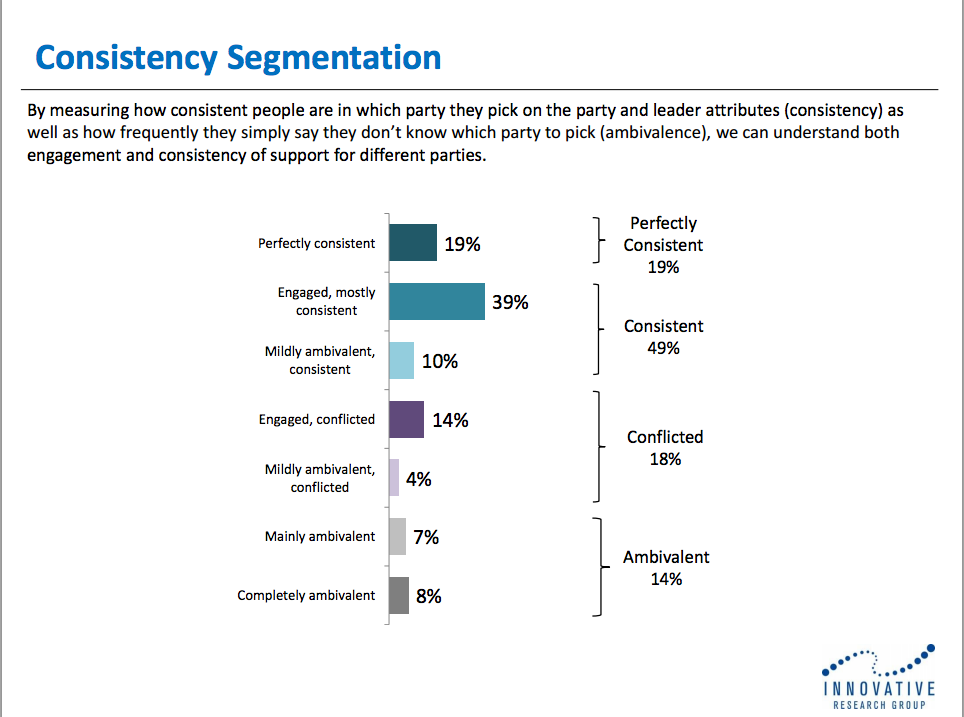
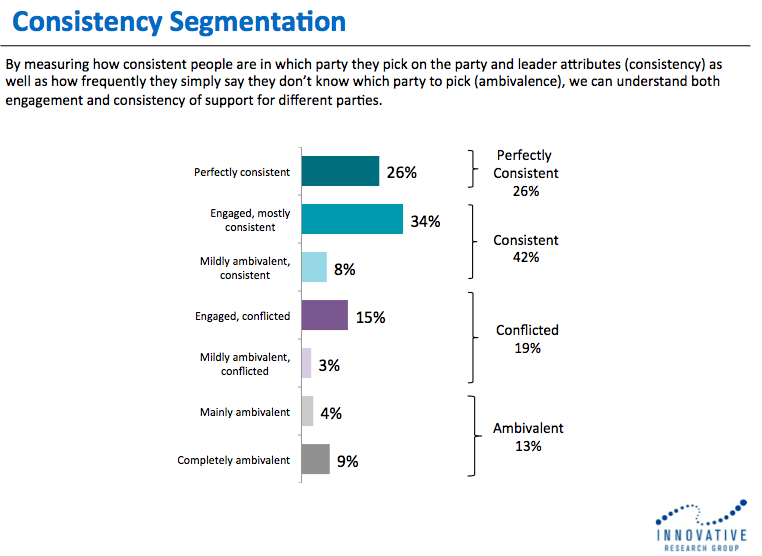
Screen Shot 2015-10-12 at 10.30.49 PMGreg has built a respondent profile based on consistency versus ambivalence.  If the respondents have a consistent pattern to their responses, they are at the ‘consistent’ end of the scale.  If they answer “don’t know” to a lot of questions, they are on the ‘ambivalent’ end of the scale.  Conflicted respondents are in the middle.

About 15% of respondents are ambivalent.  Most will not vote.The ‘perfectly consistent’ are primed to vote.

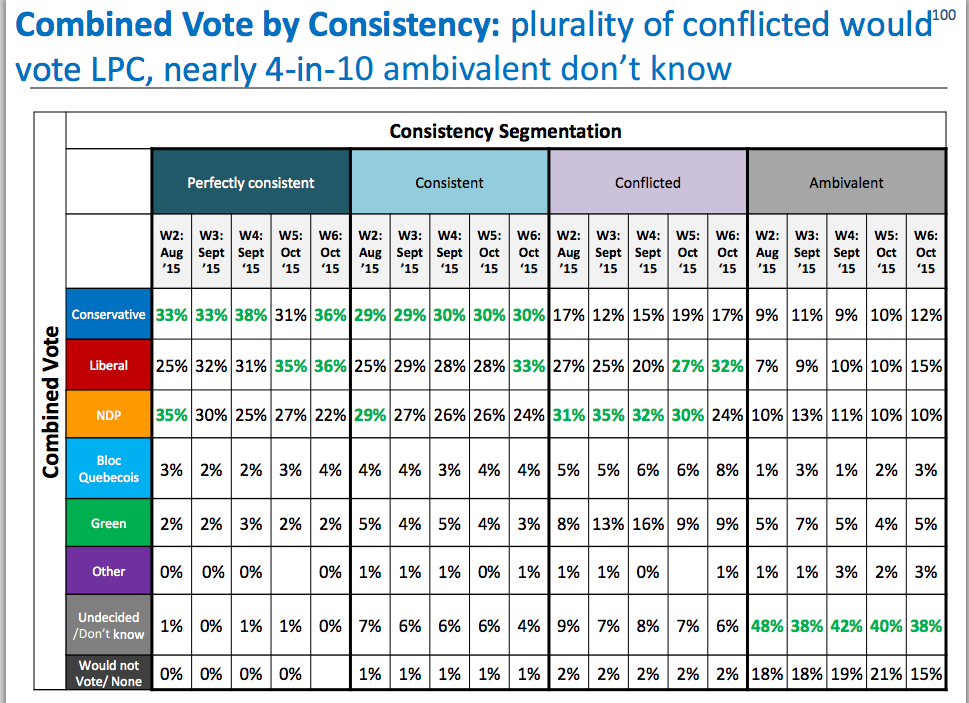
This week, Greg posted the vote results by each of these clusters.  Bearing in mind the Liberals had an overall five-point lead on the CPC, here’s how that broke down among the consistency segmentation:

Screen Shot 2015-10-12 at 10.30.25 PM

The race is tied among the ‘perfectly consistent’.  I would throw out the 15% of ambivalent respondents, which shaves a fraction off the Liberal lead.  Among the 18% of ‘conflicted’ voters, the Liberals have a substantial lead over CPC, which appears to be based on NDP switchers (hence the fact they are ‘conflicted’). These respondents are a lot more likely to vote than ‘ambivalent’ but less likely than consistent voters.

Therefore, the Liberals have more work to do to mobilize this voter group in order to realize a five-point win.

         2.  Inconsistencies between pollsters in age and gender

There has traditionally been a gender split with the Conservatives doing better among men and the Liberals doing better among women.  Ekos, which had the Conservatives ahead two points, shows the Conservatives leading among women.

Screen Shot 2015-10-12 at 10.46.40 PM

Meanwhile, Nanos in the field at the same time, has the Liberals with an 11.6% lead among women.  That’s a pretty big gap between pollsters.

nanos female
Is Ekos overestimating CPC support through a blip in female support, or is Nanos overestimating Liberal support among males (below).  Nanos has shown a consistent Liberal uptick.

Screen Shot 2015-10-12 at 10.44.51 PM

Oh, and did you see the Ekos age split?  48-30 for CPC among seniors.  Nanos has the Liberals with a 1.5% lead among plus 60 voters.  Again, another big difference.  Who’s right?  I dunno.

        3.  Regional races

There is considerable variance in the regional horse race numbers, especially in Ontario and Quebec.

In Ontario, it is either a death-duel between the Blues and the Reds OR it’s the Reds walking away.

In Quebec, it is either a four-way collision or the NDP retain enough support to win the majority of seats, keeping it in national contention.  When you see numbers like this, the party above 30% can harvest a lot of seats.  The difference in Quebec between 27% and 32% could be 40 seats.  The latest poll findings are inconclusive, to say the least.

308 Leger Nanos IRG Forum ARI
NDP 30% 28% 33% 29% 25% 31%
LIB 27% 28% 29% 26% 29% 24%
CPC 19% 20% 14% 19% 22% 17%
BLOC 21% 23% 23% 22% 21% 27%

Finally, there are the usual warnings:

  • 10-second Tories (in BC, we called them 10-second Socreds).  Voters that decide in the final analysis to hold their nose and vote for the incumbent.
  • “Cranky won’t says” – the 6-8% of voters who won’t and don’t cooperate on surveys are a statistical wildcard.
  • The final weekend – voters have a sixth sense that is not entirely detectable.  The Redford win in 2012 manifested from an unease about Wildrose in the final week.  A combination of not-likely voters, strategic voters, and strange bedfellows changed the game.
  • Advance and special votes – Perhaps up to 20% of votes are already in the bag.  Who do they favour? Will the winner on October 19th lose the overall election?

I’m not forecasting anything here – only caution.  It is clear that the Liberals have won the campaign thus far.  They started with low expectations and have exceeded them, and have to this point eclipsed the NDP in the ‘primary’ that established which party had the best chance to defeat the Conservatives.

Having said that, if I was a Liberal strategist, I would be tempering my grassroots’ naturally-occurring public-poll-based-optimism with Eeyore-like gloom and insist they are still running from behind.  I wouldn’t want to be like the gobsmacked Brit who couldn’t read the tea leaves – even at tea time.  If I was a CPC strategist, I wouldn’t assume the poll numbers will necessarily improve – it is going to be a gruelling week but a plurality is very much possible if they have a strong finish, particularly with the likeliest of voters.  If I was an NDP strategist, I would move mountains to move vote in Quebec.  If they lose Quebec, all is lost.

Ultimately, the great thing about campaigns is that it’s up to the voters.  The strategic voting organizations, the media outlets, and the pundits are not inside the voting booth.  It’s between the voters and the names on the ballot.  And that is the greatest variable – voters just damn well choose who they want to, sometimes with surprising results.

Wakey wakey. This election may be baked by Monday.

Wakey wakey.  It’s almost 10/09… time to vote.  Advance polls open October 9-12.

More and more voters are setting their alarm clocks to vote in advance polls.

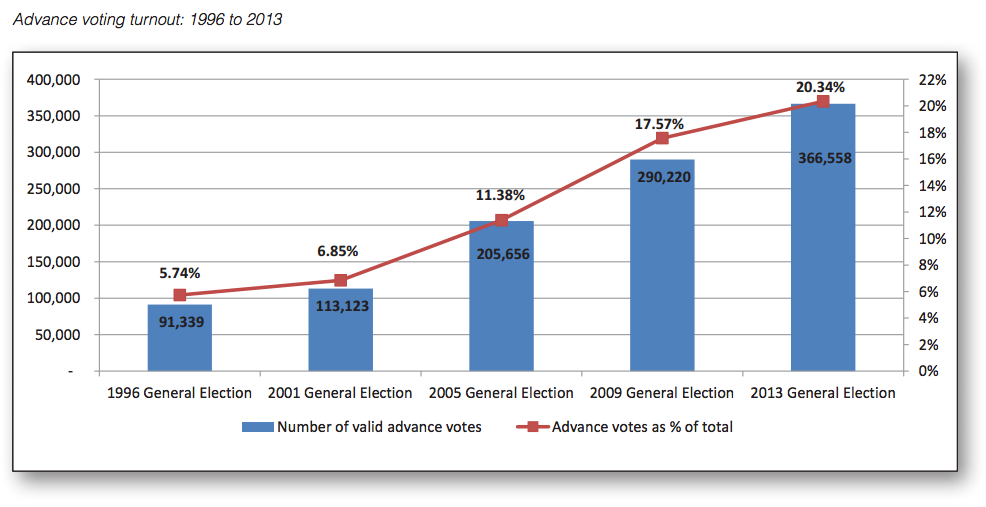
In BC’s 2013 election, advance voting rose to over 20% of all votes cast.  A sharp rise over five successive elections when only 5.74% voted in advance (1996).

Screen Shot 2015-10-07 at 9.31.03 PM

In Alberta, advance voting jumped from 14% to 16% from 2012 to 2015.  Why are people voting earlier?  Convenience? Increased efforts by political parties to lock up the votes?

It’s kind of a thing with older people.  Elections Canada also reports a rising trend of advance voting between 2004-2011.   Those keenest to vote early are age groups that are the likeliest to vote.  Federally, 5% of 18-24s voted early compared to 17% of 65-74s.  After that morning coffee at Tim Horton’s, why not round up the pals and go vote?

Screen Shot 2015-10-07 at 9.30.42 PM

So, older people are keen to vote early and they are keen to vote often.  My estimate – back of envelope – is that over three-fifths of advance voters are beyond age 55.

An interesting strategic issue is at play.  If advance voters are disproportionately older – even moreso than overall turnout stats – then the voting population on Election Day (October 19) will be more balanced by age.

The voters heading to the advance voting stations this weekend – once they vote – they are done.   The advertising and media that bombards them in next 24-96 hours will have done its work – one way or another – and those votes will be locked up.  Maybe it will be 20% of the electorate, like BC, but whatever the amount, it will be well over a million voters.

Of the remaining voters, younger voters will be more important proportionally, so will messaging be tweaked?  We’ll have to see.

Political parties are more sophisticated than ever in mobilizing voters.  Social media will play an increasing role this time.  Canadian political parties are learning from mobilization techniques that have proven highly successful south of the 49th where early voting is an even bigger thing.

The recent polls are unclear who’s really winning this election.  Is it a clear Conservative lead as some suggest or a tight Liberal lead as others purport?  And what about Quebec voters – will they show up en masse for advance polls or wait and see?  The Conservatives will look to put a stranglehold on the race by encouraging the Grey March to the polls.  The Liberals will try compete among seniors in the advance poll, thereby undermining what should be a Conservative edge.  Either way, the votes cast by turkey time will be a huge advantage for the party with momentum heading into a long, political weekend.

Carving up the Nanos results four ways

Heading into Thanksgiving weekend, Canadians will be carving up poll results.

One pollster in this campaign has provided daily results – Nanos Research.  No pollster is infallible – quite the opposite – but Nanos does provide a body of work to observe trends.

I decided to look at four aspects of Nanos’ work: the national race, regional races, age, and gender.

On methodology, unlike a lot of other pollsters, these are live telephone interviews.  The sample includes land lines and cell phones.  The data is weighted but the weights are not unreasonable.  Nanos completes 400 interviews per night and reports a rolling three-day result (n=1200) each day, which smooths out the bumps if there are anomalies.  Once you break the data down into subsets, margins of error rise, so bear that in mind.  Overall, it’s a robust program.  Larger sample sizes would be ideal, but beggars can’t be choosers.

The charts below are from Nanos’ interactive data portal (unless otherwise stated) and each chart represents the last 30-days of polling.

1.  National Race – Liberals winning the Anti-Harper Primary

The story of the past week has been that the Liberals are winning the Anti-Harper primary- they are winning the battle as to which opposition party has the best chance of unseating the Conservatives.
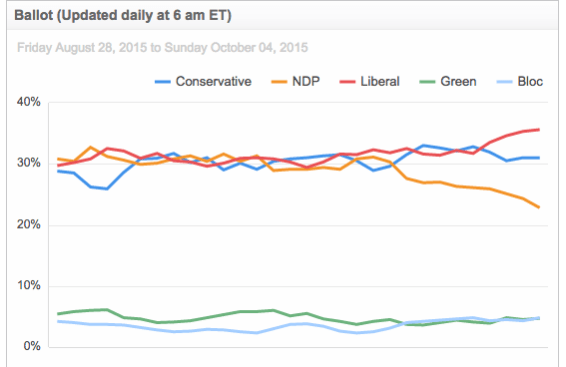
Nanos 30 waves national

The Liberal and NDP votes begun to diverge around September 25, when Nanos reported results at 32% Liberal and 30% NDP.  Now, it is 36% Liberal and 23% NDP.  That’s an 11-point difference in a week.

Take a look at the 2011 election:
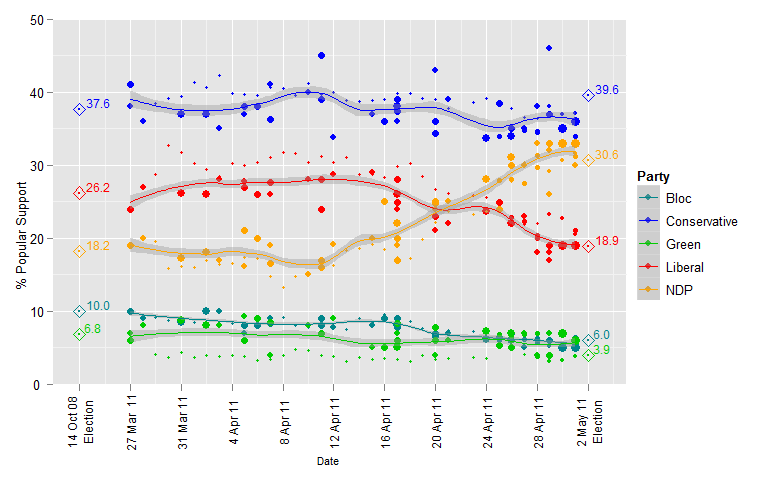
This graph, borrowed from Wikipedia’s 2011 federal election write-up, shows a similar phenomena where the two parties diverged, but that time it was the NDP on the rise and the Ignatieff Liberals in free-fall.  That divergence started about 16 days before Election Day.

      2.  The Regions – Fortress NDP is under attack, Binary race in Ontario

The NDP’s flagging national numbers derive in part from their deterioration in Quebec.  The story here is 10-point drop since September 25th, and a fall of 20 points since September 9th.  The Liberals are posed to gain seats by simply holding ground, while the Bloc have doubled their vote since September 25th.  With 59 of 75 seats in 2011, the NDP is counting on repeating its success and, until recently, it looked like it would, until Prime Minister Harper injected the niqab issue into the campaign.
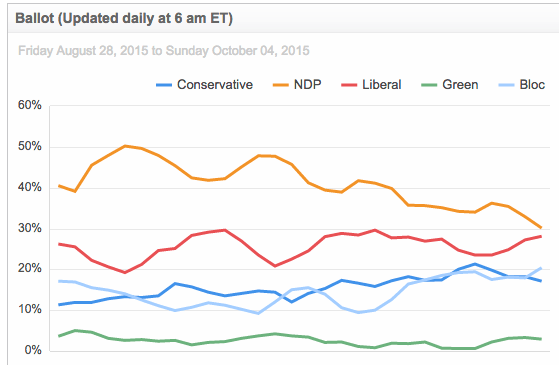
Quebec 30 waves

While Quebec sorts itself out, the NDP are many lengths behind in Ontario:

Ontario 30 waves

Where 7 points separated the Liberals and NDP on September 25th, the gap is now 22 points (41 to 19).  This is a two-race in Ontario between the Liberals and Conservatives, with Liberal hopes of gaining the keys to 24 Sussex contingent upon pulling away and racking up a major seat differential here.

BC continues to be a key battleground.  The BC sample size is smaller and more volatile.  With only 180 interviews, the margin-of-error is plus/minus 7.3%, 19 times out of 20.  The key takeaway is that there is a three-way battle.  My view is that the Conservatives appear low right now and likely have more strength.  If the Liberals hang in to garner 30% on Election Day in BC, then they will score a significant increase in seats, from the two they have today to upwards of 10-12.  When there is so much volatility, outliers can get elected.
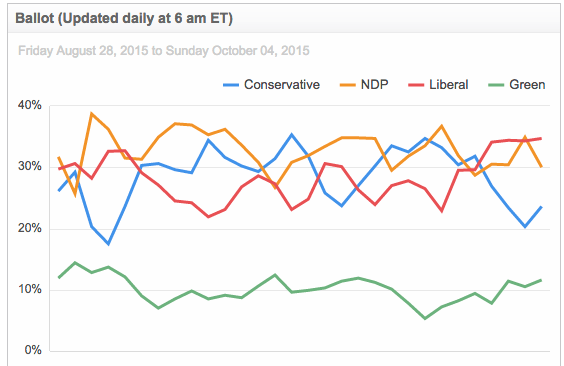
BC 30 waves

The Prairies continue to look strong for the Conservatives; the Atlantic very strong for the Liberals.  The dynamism of the race is in the three largest provinces.

    3.   Women going Red, Men going Blue, Orange going nowhere

Since September 25th, the Liberals have been gaining among women at the expense of the NDP, doubling their lead over the NDP from 9 points to 18 points.  This trend started a week earlier after relative a period of parity between the parties.
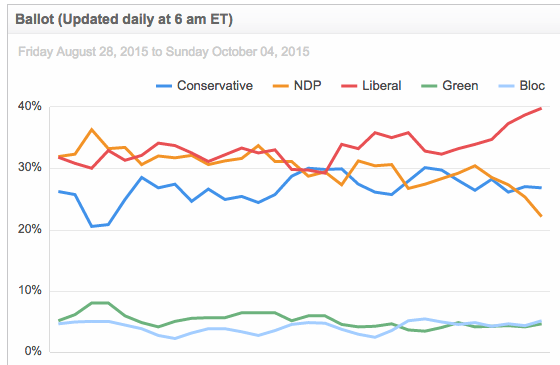
Female 30 waves

Nanos’ numbers indicate that men have been leaving the NDP, bumping up Conservative numbers somewhat.  Whether that is a move directly from Orange to Blue, or a bumping effect involving the Liberals and Bloc is hard to say.  The Conservatives had a 4-point edge over the NDP among men on September 25th and are now at 11-points.

Male 30 waves

     4.  Red-Blue fight among 50 plus voters

I’m less bullish looking at age groups because of sample sizes, but we’ll take a look at the two oldest cohorts.

50-59 year old voters show a decided divergence between Liberal and NDP.  We’ll see if this holds up or if it’s an anomaly.  Given high turnout of plus 50 voters, this is significant.
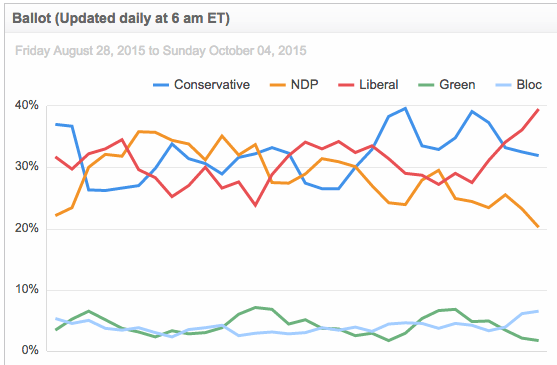
50 to 59 30 waves

And with 60 plus voters, the Conservatives are on top while the NDP are far behind.
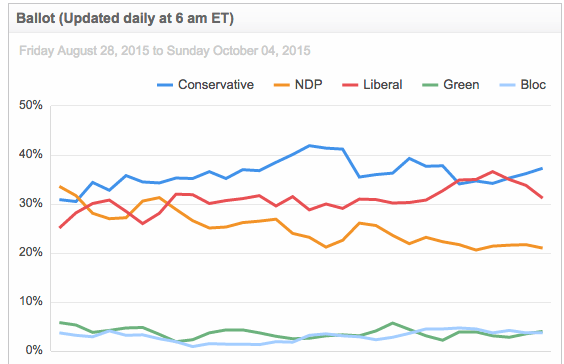
60 plus Nanos 30 waves

And now the caveats

That’s a lot to hang on one pollster’s work.  Doubtlessly, other opinions will come forward this week.  Only Nanos shows a 5 point Liberal lead and Nanos is only pollster who has reported from the weekend (by the way, weekend results can be a little flakey sometimes, in my opinion).  Innovative and Leger showed Liberal leads of two points last week, while Angus Reid Institute and Forum showed clear Conservative leads last week.  Different pollsters, different methodologies (Innovative – online, ARI – online; Forum – IVR).

Then there is turnout.  That the Liberals are performing well in the polls among 50 plus voters is significant.   Turnout increases significantly with age, peaking in the 65-74 year old age group.  (See my post on The Grey March).  Liberal strength vis a vis the Conservatives in the 50-59 age group is a bit surprising and is a category to watch.

I have also raised the possibility of sample skew given that a proportion of respondents simply won’t say who they will vote for.  They could be weighted toward one party, against the grain of the overall results.

This election is far from over.  Disruption could occur over the Trans Pacific Partnership or any other issue that comes along.  But this is a critical week for a couple of reasons:

  • Advance voting starts October 9th.  Possibly one-fifth of all votes will be in the box by Thanksgiving Monday.  The parties that are trending up this week will lock in positive results.
  • Thanksgiving interregnum.  Families are getting together this long weekend where politics may be on the menu.  Decisions can be made that will be hard to change in the final week.

The Nanos results speak to a major challenge for the NDP.  They will need to rally their own troops while winning back market share.  The inevitable grumbling by party activists is likely happening as they watch the daily seepage of their poll numbers.  So far, they are keeping a lid on dissent.  A lot can change in 24-hours and they need to find an issue that turns the momentum on its head … or hope for a Liberal and/or Conservative gaffe.

The Liberal concern would be that they are peaking and cannot sustain the growth.  Justin’s performance on the campaign trail has been lauded, benefiting from the low expectations his rivals created for him.  He needs to beat the stuffing out of the NDP heading into Thanksgiving weekend, so to speak, and set up the definitive Red-Blue showdown next week.

Harper is not in a bad place.  Ontario is competitive, they may gain ground in Quebec, and may still recover most of their seats in BC.  They need to pull away with older voters.  What they cannot control are NDP voters deciding to flee to the Liberals to stop them.

The Grey March

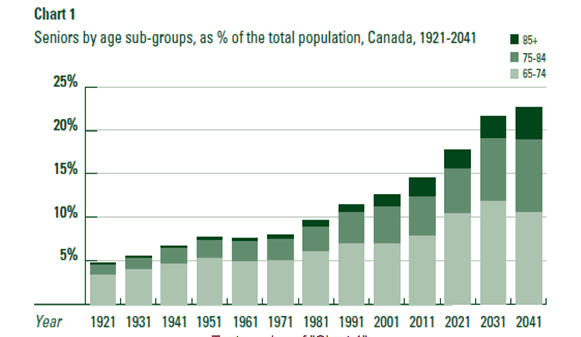
Canada’s legion of Grey voters are growing and are a bigger slice of the pie with each passing election.  We saw in the Lower Mainland transit referendum that voting is a contact sport for grandma and grandpa.

Screen Shot 2015-09-30 at 8.43.05 AM

Two polls released earlier this week show that a Grey March may be afoot.

Abacus:

60 years plus:

  • 41% CPC
  • 26% NDP
  • 24% LIB

IPSOS:

55 years plus:

  • 41% CPC
  • 26% LIB
  • 25% NDP

In both cases, older voters are returning to the Conservatives.  We all know old people vote at a higher rate, so … election in the bag?  Not so fast.

The Abacus poll shows the Liberals neck and neck with the Conservatives in the 30-59 age group (NDP close behind), while IPSOS shows a considerable Liberal lead in the 35-54 group.

IPSOS has the Conservatives lagging in the 18-34s (which rings true) while Abacus has a 3-way split in the 18-29s (that would be surprising).

Where were seniors and soon-to-be seniors a few weeks ago?

Among 60 plus, Abacus found a 7 pt Conservative lead over the Liberals between September 9th -11th; they’ve stretched that lead to 15 points over NDP and 17 points over the Liberals.

IPSOS had the Conservatives and NDP tied among 55+ (33% each) between September 4th -8th.  Now it’s a 16 pt Conservative lead.  That’s a huge swing.

Part of the story of the BC election surprise was the underlying turnout advantage of the BC Liberals.  The age demographic numbers seem familiar in this election except that it’s a three-way fight and the Conservatives do not have enough of a lead among older voters to compensate for weakness among younger voters.

Looking at the Abacus data, and crunching it against the overall number of voters in each age group multiplied by Elections Canada turnout estimates by age group, I find that the Conservatives have an extra bump of 1.5%, pushing them to 33.5% from 32%.  Compared to a few weeks ago, the Conservative war room is probably feeling pretty good about things.   Better not get too cocky about it though.  This race is still very competitive and they haven’t reached Joe Clark territory yet (35.9%).

To win, the Liberals and the NDP need to slow down the Grey March.  These Freedom 55 voters have a turnout rate of around 70%.

Let’s climb down from this scenario and exhale.  Nineteen days is a lot of time in a campaign and we have seen what the last nineteen days have done to the NDP.  Anything can happen and there are things opposition parties can do to divert the march.  Moreover, this analysis is putting a lot of stock into two polls – there are countless others.

Looking ahead, three dynamics on the Grey March:

  1. At 41% among the Grey, the Conservatives are still well below the level of support they had in the last election among this group.  Arresting Conservative growth will thwart their ability to have a decisive win.  Turning it back, will result in a change in government.
  2. What’s the message for seniors?  The Conservatives are dropping messages into this category with precision and it appears to be working.   Opposition advertising will need to be revisited.  Will Justin be able to polarize the debate to drive NDP seniors over to Liberal? Or is at matter of Justin appealing to small ‘l’ liberal seniors who are parking with the Conservatives until they decide on Justin’s readiness?  The NDP have had a stronger appeal with seniors leading into the election than the Liberals but are seeing it ebb away.  Seniors remain consumers of newspapers and TV news – wooing them is not a social media campaign.
  3. In so much as there is a generational advantage with younger voters, effective turnout strategies will be critical.  In other words, if you are going to lose with seniors, you better turn out younger voters.  A very hard thing to do and, in the context of limited resources, arguably yields a poor return.  It would be better to just not lose with seniors!

Did I say there were 19 days left in the campaign?  Oops.  An increasing amount of voters are utilizing advance polls, with seniors being the keenest to vote early.  This election will be over for many voters well before the 19th.

Keep an eye on the Grey March.  The age breaks in these surveys should be focusing the minds of all campaigns and serve as a wake-up call to opposition parties about where this election could be headed.  They’ve fallen … but they still have time to get up.

Power Point Polling Palooza with Professor Greg Lyle

I started off the week with a Monday am breakfast presentation of poll numbers from Greg Lyle of Innovative Research Group.  No doubt, all Canadians will be dining out on poll numbers for the next three weeks.  We’ll be stuffed like Thanksgiving turkey.

I worked with Greg on two occasions: with the BC Liberals from 1994-1996 where we triumphed by winning the popular vote, and from 2005-2010 when I was an associate with Innovative.  As I have grown accustomed, Greg – or ‘Professor Lyle’ if you will – came loaded with a blizzard of line graphs, stacked columns, and pie charts.  It was Power Point Palooza.  Political geeks like me go to these breakfasts instead of Burning Man.

You can’t walk down the street without running into a pollster these days.  But few pollsters dig into the numbers like Greg and share those insights with the public. Sure, you can get some version of the horserace on your next newscast, but Greg is asking – as the horses are in the 5th of 8 furlongs – what are the track conditions?  What are they feeding the horses?  What is the performance of the jockey?  Does the horse have the stamina to finish?  Should the horse be sent to the glue factory?  I’ve had a lot of ‘winning bets’ in the fifth furlong only to see my horse fade down the stretch.  Greg is focused on why the voters are responding the way they do.  That’s interesting stuff.

Here are three slides from his presentation and why they matter:

  1.  The Liberal – NDP Primary

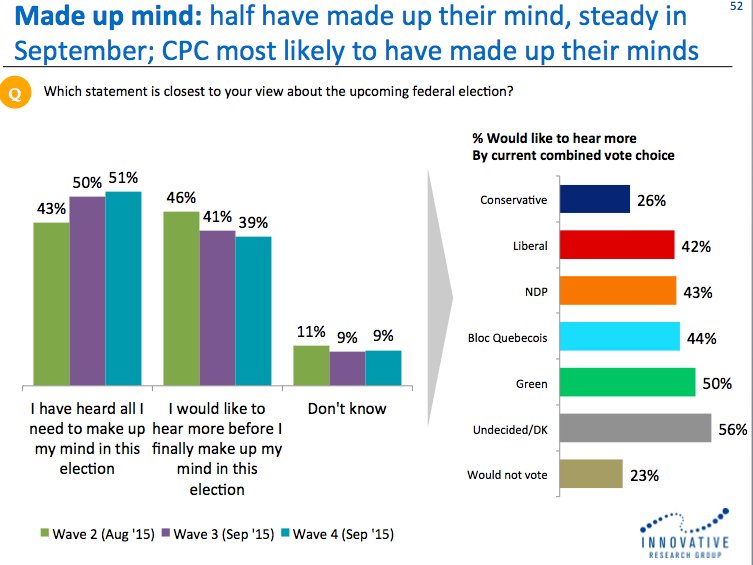
Is this a general election yet, or just a primary between the Liberals and the NDP as to which will be in the runoff with the Conservatives?  Greg asks who’s made up their mind versus who would like to hear more.

Mind made up

Only 26% of Conservatives would like to hear more while 42% of Liberals and 43% of NDP are open, not to mention 44% of the Bloc and 50% of the Greens.  As a succession of recent polls show (Nanos, Abacus, Innovative), the NDP are struggling to stay with the Liberals, in part because they are shedding support in Quebec and slipping behind in Ontario.  The key to 24 Sussex Drive for either Justin Trudeau or Thomas Mulcair is to win the primary and the research shows minds are still open.  However, it’s not a closed primary.  Some of those votes are open to the Conservatives too.

             2.  The shifting support among values clusters

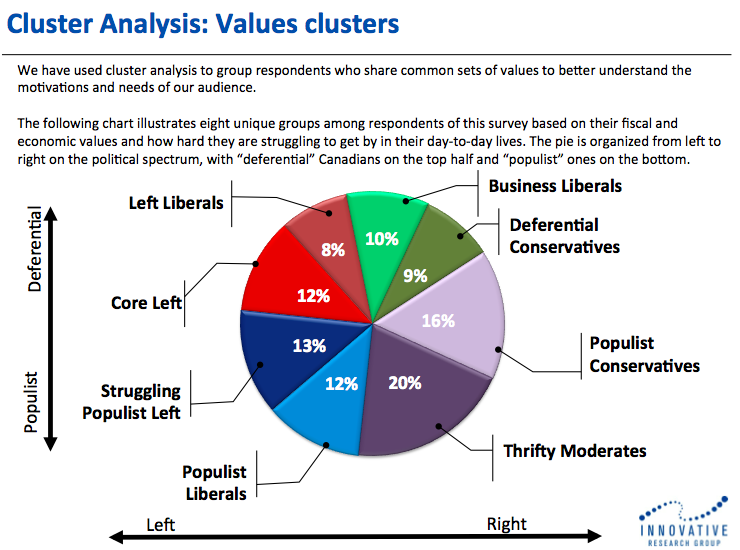
Greg’s research shows party support by values clusters measured on a two-dimensional scale: by left-right axis and a populism axis.  Populism is measured (my colloquial explanation) by whether one defers to experts or one puts more stock in the common sense of regular people.  You might say it’s Starbucks vs. Tim Horton’s.

values

What Greg found is that, since July,  the Liberals have been poaching the most support from the NDP among Core Left  and Left Liberals.  Liberals have also gained from the Conservatives among Business Liberals (centrist, non-populist – think Paul Martin) while the Conservatives have gained support from Liberals among Deferential Conservatives (conservative, non-populist – think Joe Clark).

Here are the numbers for these clusters:

Cluster July NDP Sept NDP July LIB Sept LIB July CPC Sept CPC
Core Left 59% 41% 28% 35% 3% 6%
Left Liberals 38% 27% 29% 40% 14% 16%
Business Liberals 23% 21% 30% 37% 30% 26%
Deferential Conservatives 16% 15% 22% 15% 52% 58%

Thus, you have some voters returning to natural homes, but you also have some lefties migrating to the Liberals too.

Interestingly, it is the non-populist voters that are the most volatile, according to Greg’s research, while the populist voters have not moved as much.    I expected the opposite to be true, but an explanation may be that populists have decided and moved on and “the Starbucks crowd” are debating their vote before they make it.

With regard to the ‘primary’ discussed in my first point, there is movement among NDP and Liberal voters, but there is a flow from Liberal and NDP to Conservative too.  The Conservative growth potential is not very high, but they only need a few points to make a huge difference.  One populist cluster that did show some movement was Populist Conservatives which saw a swing of 7-8 points from the NDP to the Conservatives (think Vancouver Island loggers or Kootenay miners as an example of a Populist Conservative).

See the full value clusters deck which includes how each values cluster is constructed and defined.

             3.  The Consistent versus the Ambivalent

I am highly interested in who is actually going to vote.  As I posted recently on the Lower Mainland transit plebiscite, there is usually a strong age correlation that peaks in the 65-74 age group.  Greg’s research offers an insightful analysis based on consistency versus ambivalence.

Essentially, he has analyzed the answers of individual respondents within the survey and categorized people based on who is consistent on responses, who is conflicted, and to what degree they are wishy-washy (eg. respond ‘don’t know’ to a lot of questions, undecided on vote).

Ambivalence


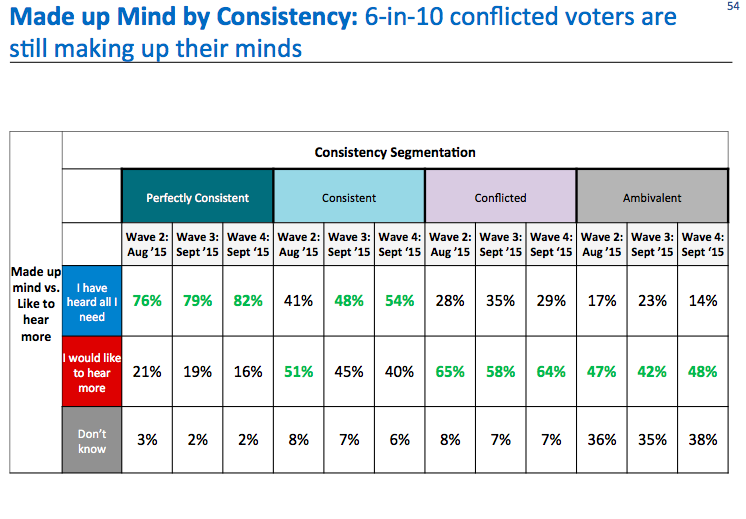
About a quarter of those polled are perfectly consistent and likely have a plan to vote.  About 13% are, well, out-to-lunch and will likely not vote (in my opinion).  That leaves about 60% of voters who are on a continuum of mainly consistent to mainly ambivalent, and within that continuum, they are the ones that are more likely to say they would like to hear more.

Ambiv 2

In the consistent-conflicted range, “would like to hear more” ranges from 45%-65%.  This reflects a lot of the Lib-NDP switchers.

But my starting point on this topic is who is going to vote?  Perhaps Greg will show these consistency segments by vote as whoever has the most ‘consistent’ supporters compared to ‘ambivalent’ supporters will have a turnout advantage.

In any event, analyzing survey responses to design such a segmentation is pretty cool.


In conclusion, a lot of polling is being digested in this election.  It’s good to see work that goes deep and is publicly available.  This is different than what political parties are likely doing internally, but if you’re in the peanut gallery, and you’re watching a horserace, then you can dig into it while mixing your metaphors, and see how it all turns out on October 19th.


Over 50% shades of grey in Transit vote turnout

Elections BC released voting information from the transit referendum, er, plebiscite.

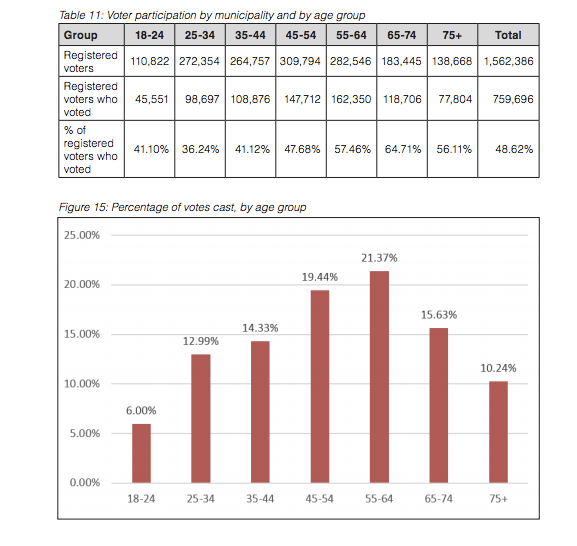
The published turnout rate ranges from a low of 36.24% among 25-34 year olds to 64.71% among 65-74 year olds.  This is consistent with the 2013 provincial election in terms of older people voting at a higher rate than younger people.

Why are 18-24s voting at a higher rate than 25-34s?  They’re not.  Turnout rate is based on % of registered voters but fewer 18-24s are registered to vote.  Base it on actual population and you will see a lower number.  Turnout typically peaks at 65-74 age then declines post 75, though still high relative to under 50 crowd.

Screen Shot 2015-09-22 at 4.15.26 PM

It’s interesting to see the share of voters from each age group – this is more important.  Over 47% of the transit vote was over age of 55.  They are punching above their census weight while the opposite is true of younger voters.  About one-third of voters were under age of 44.

Bear this in mind when reading the polls.  Parties or candidates with high support in 18-34s may not sustain that support on Election Day while parties with strong support among plus 55s can surprise.  Where have I heard that before?