Can Trump still win?

It’s hard to imagine a worse stretch for Donald Trump than what has transpired since the DNC Convention.  In my most recent blog post, I raised the spectre of a Trump presidency based on a 7-point lead in the USC-LA Times rolling-track poll.  I went on CKNW 98 with Michael Smyth and talked about the importance of not underestimating Trump’s chances.  The threat might almost seem to many like a moot point now.  That’s a dangerous assumption.  I still believe that Trump can win – it’s not likely that he will win, but he could win.  Despite his egregious campaigning, his poll numbers could be a lot worse.

Screen Shot 2016-08-06 at 1.52.24 PM.png

The USC-LA Times poll has a big sample (over 2000) and runs on a rolling track so that there’s fresh interviews every night, with the most recent night replacing the results from 7 days previous.  Compared to other polls, this polls has been among the most friendly to Trump (other polls have Clinton up, on average, 7 points).  Right now, USC-LA Times has the race tied whereas Trump had opened a seven point lead following the RNC Convention.

Perhaps the USC-LA Times has a built -in skew, which can happen in online panels, but what it does tell us is the trend and who has moved the hardest toward Clinton.  In that respect, the answer is resoundingly women.

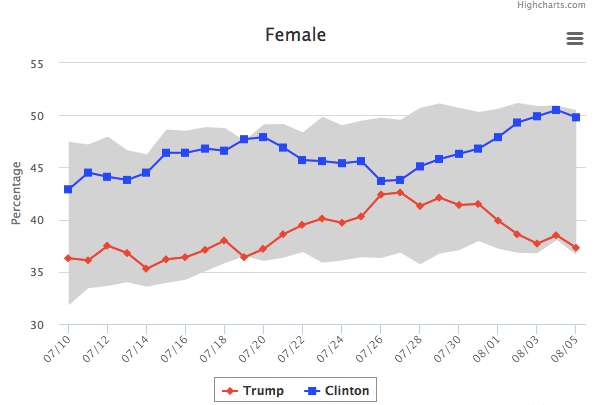
Chart 1: Female voters

Since July 26, Clinton has broadened her lead among women from one point to thirteen (50-37).
Screen Shot 2016-08-06 at 12.31.18 PM.png

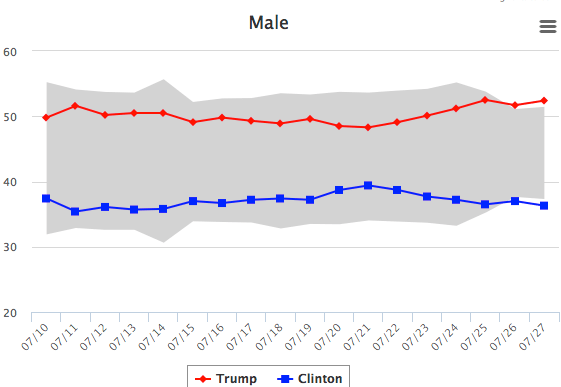
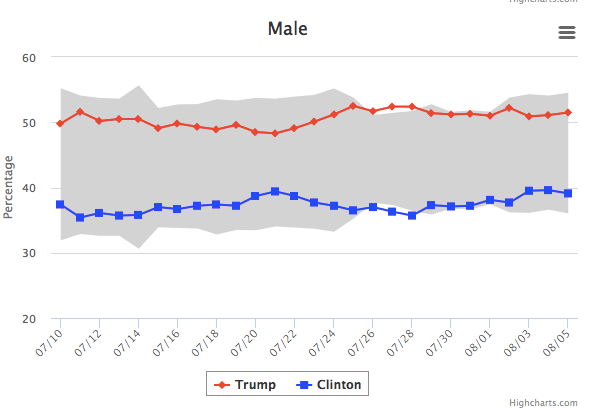
Chart 2: Male voters

Despite Trump’s self-inflicted bad press, his support is remarkably resilient among men.  In fact, he hasn’t lost any support since July 26, holding at 52%.  Clinton has moved up from 37% to 39%.
Screen Shot 2016-08-06 at 12.33.30 PM.png

Trump’s support among white voters is also largely unchanged.  He’s down about one point since July 26 while Clinton is up 2.  Trump couldn’t do any worse with African-Americans so he’s constant there, getting absolutely blown out.  Hispanics and “Other ethnicity” (not White, African-American, or Hispanic) have shown movement away from him.

Chart 3:  Hispanic voters

Clinton has broadened her lead from 52%-36% to 59%-31%.  That’s a twelve point gain.

Screen Shot 2016-08-06 at 12.40.15 PM.png

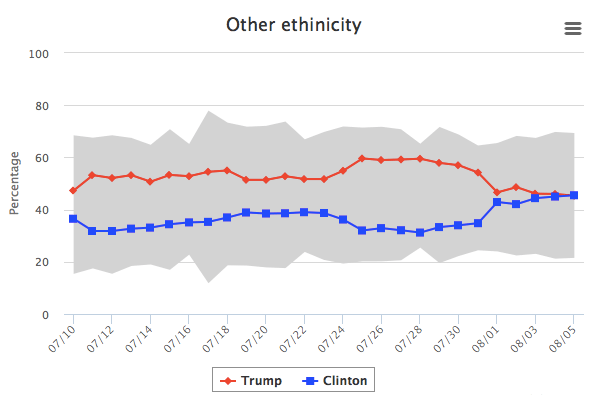
Chart 4: Other Ethnicity

Trump had a sizeable lead on July 26 among this group but Clinton has now closed the gap, moving the numbers from 59% – 33% to a dead heat at 46% each.  One can easily speculate that the controversy with the family of the Muslim-American war hero precipitated this change.
Screen Shot 2016-08-06 at 12.42.58 PM.png

So how could Trump still win?

Narrow geographic pathway.  Trump must hold all of Romney’s states (a tall order) and win Florida, Ohio, and either Pennsylvania or Michigan.  He has been neck and neck in Florida and Ohio, and further behind in the latter two.  He’s banking on his message of economic alienation working among traditional Democratic voters.  It was going to be a narrow pathway for any Republican – Rubio, Cruz, Bush, Kasich or anyone else.

Clinton’s unpopularity.  As poorly as Trump has seemed to perform in the past ten days, Americans are not crazy about Hillary Clinton either.  Certainly, she has had an upswing, particularly with women, but she remains a juicy target for the Republicans.

Time.  Trump has lots of it.  Three months is a political eternity.  If he continues to death spiral, some speculate he might not even make it to November.  I wouldn’t rule it out, but the more likely scenario is that he regroups.

Stabilize.  Just a little less craziness would be a big momentum builder for the campaign.  Expectations are now so low for the Trump campaign that a solid week of on-message performance may completely change the narrative.  There are so many media cycles between now and November, and so much thirst by the cable news networks for content, that you could get the media to run with almost anything.

Clinton is in a much stronger position in terms of discipline, money, infrastructure, and the breadth of her coalition.  Yet Trump remains in striking distance.

So can Trump still win?  Yes.  We can look to countless examples of conventional wisdom being upended whether it was Justin Trudeau’s shocking majority government win only 60 days after he was in third place, the Brexit results, or the rise of Trump himself. He still has strong support among white voters and men.  The Democrats cannot afford to take their foot off the Trump campaign’s throat until it’s over.  Polls schmolls – you never know until the votes are cast.


Trumping Clinton: 7 days of momentum

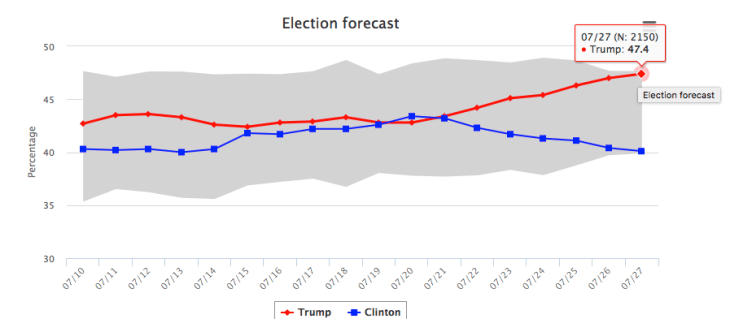
USC is running a rolling track poll where they interview 300-400 people a day (online) right through to Election Day.  This is a serious poll with serious methodology.  The numbers shown daily represent seven days of tracking. Each day, the daily results from 7 days ago drop off and the current day is added, making it a rolling track.  This smooths results and shows more of a trendline rather than sudden shifts.  So, if there is a big move, it might not become fully apparent for several days.

For the past 7 days, Donald Trump’s support has increased to, now, a 7 point lead.  This includes several days now of the Democratic National Convention.  Trump certainly had an RNC  Convention bounce but yet to see a Dem bounce.

Chart 1: Election forecast (n=2150)

Screen Shot 2016-07-28 at 10.58.20 AM.png

Some Democratic pundits have cautioned against “bedwetting”.  Yes, it’s July.  There’s a long way to go.

The issue the Democrats have to confront, however, is that Trump can win.  There has been a lot of commentary about how it’s impossible for Trump to win because of lack of support among Hispanics, Blacks, women, etc.  However, he is crushing it with whites and males.


Here is a breakdown of the numbers to show how Trump is rising:

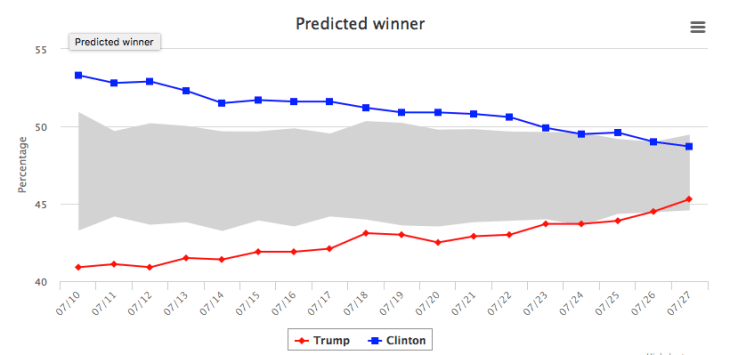
Chart 2: Predicted Winner

While Hillary Clinton is still seen as the likely winner by 49% to 45%, that gap has narrowed from 13 points to 4 points in the past 17 days.  More Americans are believing in the possibility of a Trump presidency – will that help or hurt Trump?

Screen Shot 2016-07-28 at 9.31.21 AM.png

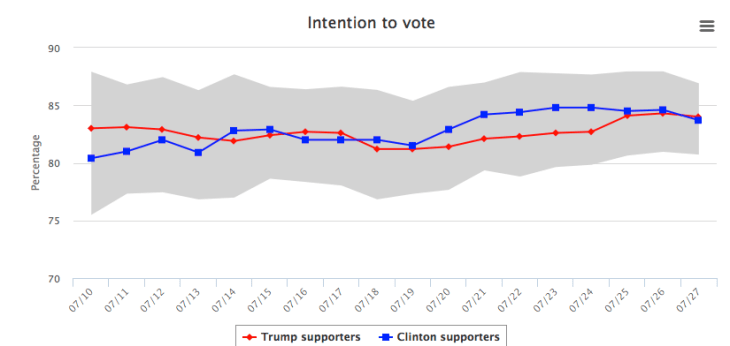
Chart 3: Intention to Vote

Trump and Clinton supporters are virtually tied when it comes to whether they intend to vote.  They have leapfrogged on this.  Trump’s turnout numbers are likely helped because he has strong support among older voters; Clinton’s turnout numbers are likely helped because Trump is highly polarizing and antagonizing.

Screen Shot 2016-07-28 at 9.33.17 AM.png

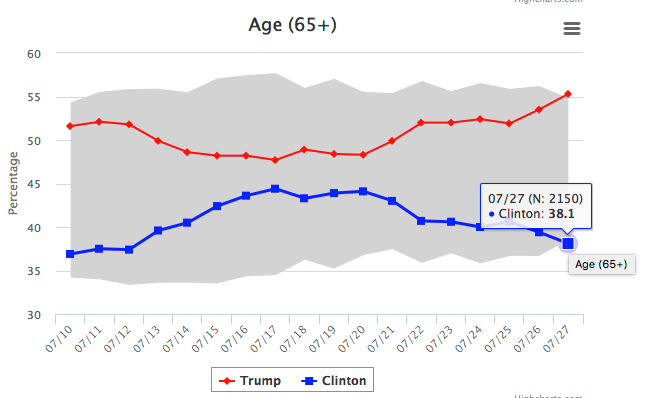
Chart 4: Seniors 

Trump has a big lead (55% to 38%), and seniors typically vote at a higher rate.  Trump leads 18-34s too, right now.

Screen Shot 2016-07-28 at 9.36.31 AM.png

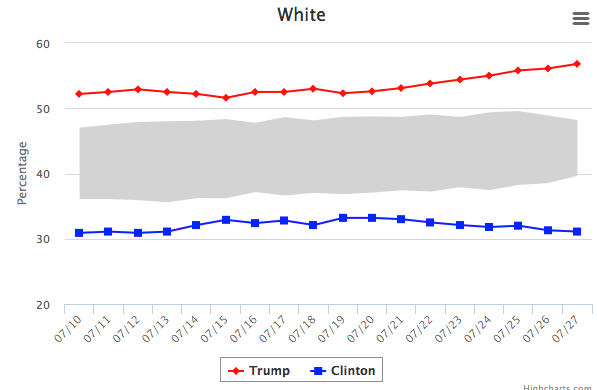
Chart 5: Whites

Trump leads white Americans 57% to 31%.  African-American voters are 81% to 4% for Clinton.  Hispanics, though, are reported at 50% to 37% for Clinton.  This is where one might wonder if the poll has a large enough, or representative, sample of Hispanic voters.  Or maybe that’s reality – are gender and age are ‘trumping’ race among Hispanics?

Screen Shot 2016-07-28 at 9.38.08 AM.png

Chart 6: Men

Trump leads Clinton by 17 points among men (53% – 36%) while Clinton has a two-point lead among women.

Screen Shot 2016-07-28 at 10.47.19 AM.png

What does it all mean?

Trump can win.  If you can rack up a 7 point lead, you can obviously win.  Even if this poll is inaccurate, other polls are showing Trump is leading.  Even though Hillary has a small lead in Ohio, Trump has a small lead in Florida.

The challenge for Democrats is to approach the race for what it is – a very unconventional campaign.  Trump is attracting voters who are very anti-establishment including alienated Democrats.  How many more examples do we need to see – Rob Ford, Brexit, Jeremy Corbyn, Bernie Sanders, and Trump himself – to understand that there is a very large constituency for those who tap into the vein of frustration, resentment, and anxiety?

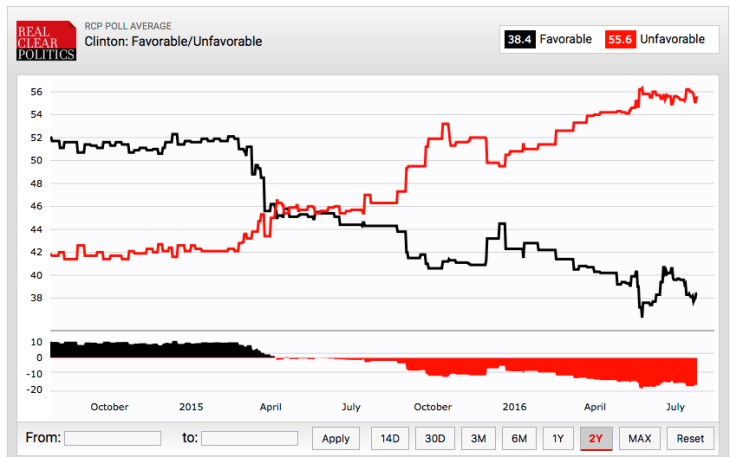
This rise in Trump support may be short-term.  It may be illusory.  It may be overstated.  But it proves that Clinton is no shoo-in.   The presidential campaign has been very unkind to her personal popularity and favourables.  Bernie Sanders did a lot to soften her support and drive votes away.  She has gone from a plus 10% to minus 17% in two years.  At her peak back in 2008, she had 69% favourable rating.

Chart 7: Hillary Clinton’s favourables over past two years.

Screen Shot 2016-07-28 at 10.54.39 AM.png


So, the first thing Democrats have to face is that they have a problem.  Now, deal with it.  If the DNC Convention does not move the dial, then it’s time for Plan B, whatever that is.


The insurgencies of Donald Trump, Bernie Sanders, and Jeremy Corbyn

You wouldn’t necessarily think that Donald Trump and Bernie Sanders have much in common, let alone Donald Trump and presumptive UK Labour leader Jeremy Corbyn.

Their politics are miles apart; kilometres in the case of Corbyn.  But whether it is on this side of the Atlantic or in the Olde Country, voters are going in the opposite direction of their ruling class – at least for now.

I was in the process of linking these three candidacies in what I believed was an original thought when Roger Cohen of the NY Times nailed it.  Says Cohen: “This is a season of radical discontent.  People believe the system is rigged.”  In Corbyn’s case, “He’s against everything Tony Blair stood for”.  On Sanders: “his suspicion of all things ‘feel good’ are part of his attraction”.  And “Trump’s ‘deal with it’, is the phrase du jour”.  In all cases, these three candidacies are thumbing their nose at party apparatchiks, media elites, and the winds of prevailing conventional wisdoms that flutter in the stale air until the next gust of change comes along.

Where I do disagree with Cohen is his belief that Corbyn’s leadership will be a “disaster”.  It may very well be, but just because the elites don’t like it, doesn’t mean he’s destined to fail.  Leaders have won against the grain of their caucus (Christy Clark), the party establishment (Jimmy Carter) or against a larger, like-minded rival (Preston Manning) and left their mark as they stabilized their support and moved forward.

Here’s a simple rule of arithmetic.  There are more outsiders than insiders.  There are more people who don’t feel they are part of the ‘elite’ than those who do.  When the outsiders move, they can upend the conventional wisdom.    Trump, Sanders, and Corbyn are giving voice to outsiders right now.  Everytime someone in the ‘ruling class’ decry the implications of their election, as Tony Blair and Gordon Brown have done, they embolden the insurgents.  Often time, these insurgencies give way to incoherence and a lack of discipline.  But they have accomplished one thing already, they have shaken up their parties in a way that no one saw coming.