First Nations representation: following in Len Marchand’s footsteps

In 1968, Len Marchand became the first “Status Indian” to be elected to the Parliament of Canada, from the riding of Kamloops.  He went on to become the first to be a member of the federal cabinet as well.

Screen Shot 2018-04-20 at 2.57.05 PMOnly eight years before, Len – along with all Status Indians – was ‘granted’ the right to vote by the Parliament of Canada.

1960.  Can you believe that?  That’s not that long ago.

Prime Minister John Diefenbaker was in power.  His government took action where previous Liberal and Conservative governments had not.

An agronomist by training, Len’s political activism led him to elected office in 1968, 1972, and 1974 as a Liberal.  He was swept out in 1979 when the Liberals were defeated.  He was the last federal Grit to be elected from the BC Interior.  We’ll see if that changes tonight.

To my knowledge, Len was the last First Nations person to be elected from BC as well.  41 years ago. (note: I’m distinguishing First Nations from Metis)

This election, there are First Nations candidates that could take a seat in Parliament from BC.  Here’s a list of all aboriginal candidates in Canada for each party.

Jody Wilson-Raybould stands an excellent chance of being elected from the riding of Vancouver-Granville.  A lawyer, former Crown Prosecutor, and former Regional Chief for Assembly of First Nations.

Trent Derrick of the NDP appears to have a solid chance at the riding of Cariboo-Prince George.  The NDP have two other First Nations candidates – Carleen Thomas in North Vancouver and Kathi Dickie in PG-Peace River-Northern Rockies.  Thomas and Dickie are longshots to win.

The issue of why there are not more First Nations elected from BC to the Parliament of Canada and the BC Legislative Assembly is a topic for a future blog post, one that I intend to take on properly after the election.  Len and others have done a lot of work in this area and, this election, there is increased advocacy from indigenous groups compared to previous elections.

When one looks at the career of Len Marchand, you realize the tremendous potential for First Nations perspective to inform federal and provincial decision-making.  While this insight is presented in other forums and bilaterally from First Nations to government, having that insight on the floor of the House, in the caucus room, and at the cabinet table is something that would strengthen our parliamentary institutions.

Postscript:

Len’s book “Breaking Trail” is a great political bio and record of an era of politics from the 1960s through the 1990s.

To predict, or not to predict …

Let’s start my election prediction with a little bit of Hamlet:

Now whether it be
Bestial oblivion, or some craven scruple
Of thinking too precisely on th’ event—
A thought which, quarter’d, hath but one part wisdom
And ever three parts coward—I do not know
Why yet I live to say this thing’s to do,
Sith I have cause, and will, and strength, and means
To do’t.

In other words, I’m pretty sure I am overthinking this election!

I have written about many aspects of polling over the course of this election and will apply them to what we may see tonight.

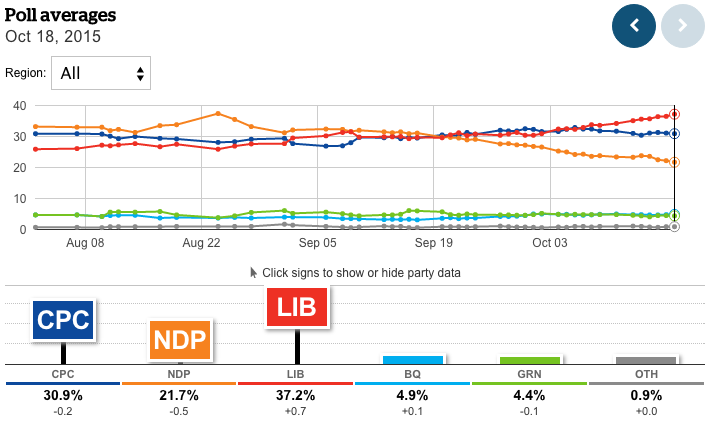
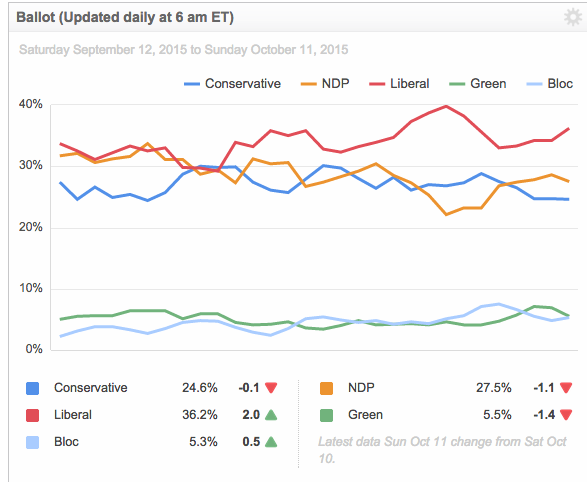
I’m going to borrow from the poll aggregator 308 to show the trends in this election and the aggregated outcome.  The Liberals separated from the NDP around September 20th and never looked back while the Conservatives held steady but never able to grow their market share (according to the polls).

Screen Shot 2015-10-19 at 10.48.24 AM

Polls schmolls.  They are often wrong.  Even the blended numbers provided by the aggregators  have been wrong time and again.

Here are factors I apply to these numbers:

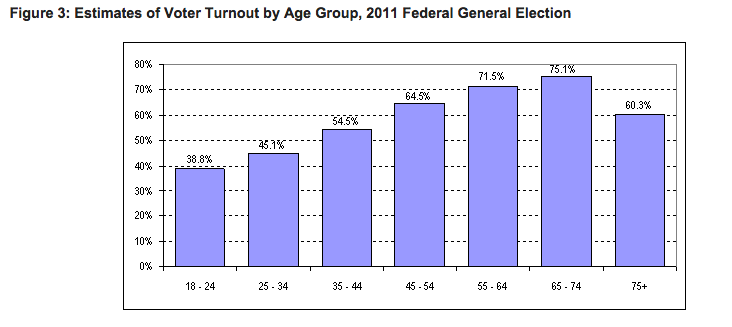
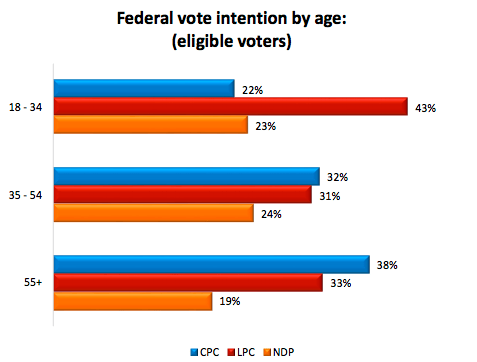
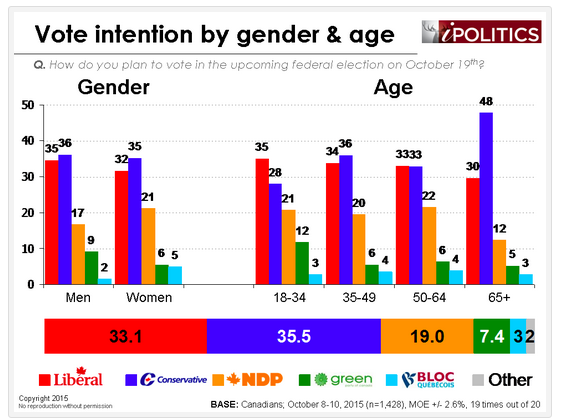
  • Turnout by age – older people vote at a higher level.  This is a traditional Conservative advantage.  Some polls (EKOS, ANGUS REID INSTITUTE) show an age advantage, but others (NANOS) are showing the Liberals with big gains among seniors.  Moreover, with increased voter turnout, which is likely to happen this election, the proportion of seniors as an overall share of the electorate will likely drop.  It will still be significant and have the highest turnout rate, but the gap between seniors and younger voters won’t be as dramatic.

Screen Shot 2015-10-19 at 10.56.07 AM

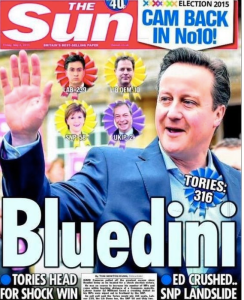
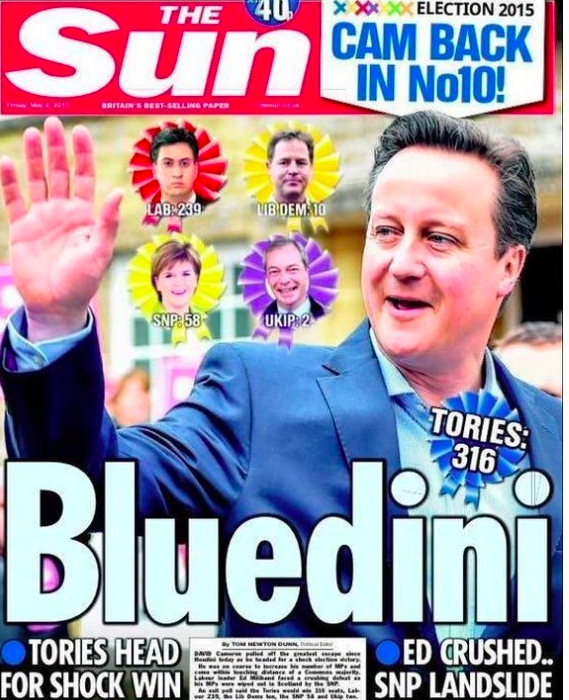
  • Shy ConservativesScreen Shot 2015-10-12 at 11.08.00 PMwe saw this in spades in the UK where no one detected a David Cameron majority.  All the polls suggested ‘Hung Parliament’ yet the Cameron Conservatives triumphed in stunning fashion.  Part of this may relate to “won’t says” – the estimated 8% of voters who just won’t cooperate on surveys when asked the ballot question.  My view is that they probably skew Conservative.  There is also a theory that people stick with the incumbent and “hold their nose” if they are fearful of the alternative.  In BC, we used to call them “10 second Socreds”.
  • Cultural Bias – My view is that media polling does not accurately reflect Canada’s diverse multicultural population.  Those who struggle with English are much less likely to cooperate in a telephone, IVR, or online panel.  In fact, online panels are the least representative, culturally speaking, unless they are done in-language.  There can be major differences in perspective culturally and they, ideally, should be reflected in polling.  I wrote about this recently with regard to the Chinese-Canadian community.  In BC, Chinese make up about 10% of provincial electorate and about 20% in Metro Vancouver – a huge factor.  My view is that the under-representation of Chinese in BC likely means Conservative support is under-represented.  I have seen no data in this election that tells us what’s going on in this community specifically.
  • Ambivalent respondents –

    Some survey respondents really don’t have a clue… and some still use flip phones!

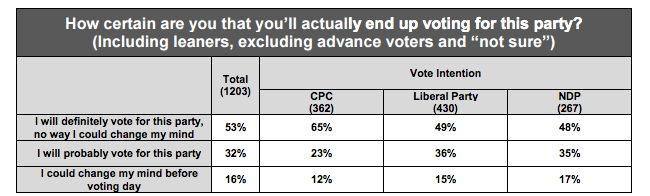
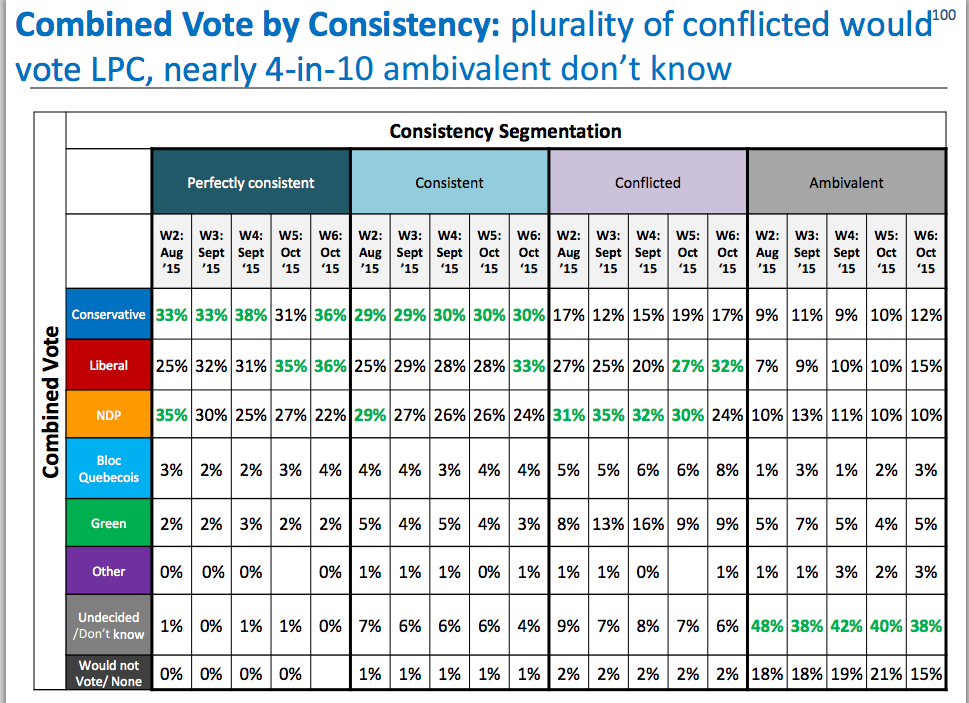
    Innovative Research Group has done interesting research on those who answer survey questions.  There is a continuum between strongly consistent to strongly ambivalent.  The Conservatives do better among consistent respondents (ergo likelier voters) and weaker on ambivalents.  Angus Reid Institute had similar findings along the lines of vote firmness.  See my post on “Why Conservatives have hope”.  Liberal support has been growing among consistent respondents.

  • Gut – What does the tummy feel?  Hamlet would have had a real quandary figuring out these poll results.  The problem with the gut is that has a built in bias based on the echo chamber it lives in.  I am wondering if I’m drinking too much of my own bathwater, but my gut is pulling me in directions based on conversations with family and friends, and seeing indicators that may show how voters are behaving that are not reflected in the polls.  A big gut check is momentum.  That is something that Nanos has detected in the final three nights of polling.  Liberals on the rise.  Is it real?  I’m consulting my gut.

When I think about election surprises over the past few years, I’m comparing this election to those.  What is lacking in this election for the incumbent Conservatives is an overall narrative that gives voters a positive vision.  Negativity is an important part of campaigns – or you can call it contrast.  Parties are fighting over market share and the market has a ceiling of 100%.  It’s a zero sum game.  Parties must contrast themselves from their competition.  I have no problem with that and you can go back to the 1800’s for examples that would make today’s ‘attacks’ pale by comparison.  However, there must be a either a strong vision for the future, a stark choice, or a sense of renewal and change.

In both Alberta 2012 and BC 2013, these were female premiers in their first general election.  They were new, different and both were offering a proposition to voters.  In Alison Redford’s case, she was contrasting against a more conservative Wildrose brand and she was proposing to address issues on the progressive side of the ledger.  Christy Clark put forward an economic vision based built on a platform of fiscal responsibility that contrasted sharply with the NDP.  In the UK, David Cameron morphed fear of the Scottish Nationalists and the perceived weakness of the UK Labour leader to drive English Liberals to the Conservatives.  The reasons, in hindsight, are apparent for those election surprises.  I don’t see it here.  The case for Conservative re-election has seemingly slipped away over the last week.  While it may have been too late in the campaign to change much, the Ford family-Stephen Harper photo op on the weekend may have provided an added push for “time for change” Tories to jump ship.

The Upshot

While there are many factors – turnout, cultural, and polling bias – that mitigate in favour of a better Conservative outcome – which I am accounting for, my gut pulls me in the other direction.  I believe “red Tories” and soft NDP voters are going Liberal and the polls are seeing a glimpse of that.

Prediction

I’m throwing away the calculators and the models and the spreadsheets.

Hearkening back to Hamlet, three parts cowardice, one part wisdom would have led me to predict a Liberal minority.  I have put aside the cowardice and perhaps the wisdom, and decided to be bold.

I don’t think Canadians are going to be wishy washy tonight.  I think it’s a Liberal majority… by a hair (which would be ironic… “nice hair” they’ll say).

And though 38.5% has been the minimum to attain a majority in past 60 years, I think the Liberals may do it with less this time because of the vote splits.

The math for the Libs:

Atlantic and West/North:  50 seats

Ontario and Quebec:  120 seats

Libs 170

In BC, I think the NDP have jumped the shark.  Bringing out warhorse Stephen Lewis, last seen promoting the Leap Manifesto, to stump shows they are doubling down on their core vote.  The Liberals are going to win some seats that no one, including them, thought they had any business of winning.

BC seat count:

Libs 15

CPC 14

NDP 11

GREENS 2 (yes, not sure if it’s Victoria or Nanaimo)

This post will not impact a single vote so it’s all just fun and games.  When we are sitting around tomorrow reading about a shocking Conservative win, I will begin my tour of shame with my Conservative friends who will no doubt remind me of this post forever more.

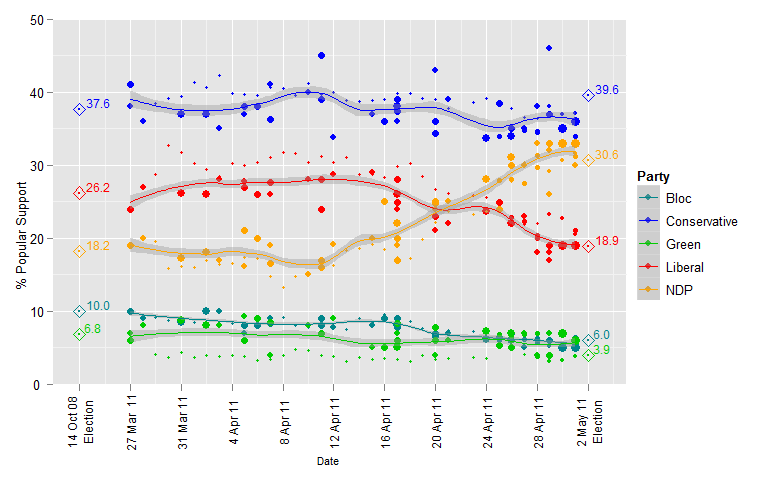
Dare to compare: 2011 and 2015 polling in 2 graphics

What the Liberals giveth to the NDP, they taketh away.

2011 polling:

2015 polling:

Source: Wikipedia federal election pages for 2011 and 2015

The Chinese community and the federal election: did anyone ask what they think?

Co-authored by Tung Chan 陳志動, former CEO of S.U.C.C.E.S.S. 

It would be nice to know what Chinese-Canadians are thinking about the federal election.  It would also be nice if they had been being asked… properly.

In Metro Vancouver, over 430,000 Chinese-Canadians make up 19% of the region’s population, which is a conservative estimate since this is based on the 2011 census.  Across BC, over 1 in 9 are Chinese.

The concentration is higher in areas like Richmond, Vancouver, and Burnaby.

The impact of the Chinese-Canadian vote on a significant number of federal ridings is undeniable.

Riding Cantonese Mandarin Chinese NOS* Taiwanese Total
Richmond Centre 16.77% 12.22% 14.61% 0.71% 44.31%
Vancouver Kingsway 18.32% 3.22% 10.89% 0.07% 32.50%
Vancouver South 17.50% 3.63% 10.82% 0.28% 32.23%
Steveston-Richmond East 13.10% 8.22% 8.14% 0.21% 29.67%
Burnaby South 7.49% 10.84% 9.28% 0.68% 28.29%
Vancouver Granville 8.07% 7.60% 8.32% 0.67% 24.66%
Vancouver East 11.65% 1.65% 6.56% 0.05% 19.91%
Burnaby-North Van Seymour 7.62% 4.65% 5.83% 0.26% 18.36%
Vancouver Quadra 4.29% 6.89% 6.43% 0.42% 18.03%
Coquitlam-Port Coquitlam 4.70% 3.86% 4.04% 0.13% 12.73%
New West – Burnaby 3.29% 4.37% 3.80% 0.23% 11.69%

*Not otherwise specified (NOS)

Every day, new opinion polls are being reported by the media.  These polls only tell part of the story, because we have no way of knowing if they are talking to a proportionate share of Chinese-Canadians.

Why?

  • Telephone surveys – there is no indication that media polls are being conducted in-language for those that speak comfortably in Cantonese and Mandarin, but not English.
  • Online surveys – those that are not confident in English are not likely to participate in an online panel.
  • IVR surveys – automated messages for media polls are almost always in English.

A tell-tale that multicultural communities, such as Chinese-Canadians, are not being properly represented is that polls are not weighted to reflect these communities.  In other words, if 25% of a riding has a Chinese language as their mother tongue, the poll should have a sample of 25% Chinese.  This isn’t happening.

Yes, some Chinese Canadians will be participating in these surveys but, it is likely below their share of the electorate, for the reasons listed above.

A recent example are riding polls released by organizations like Lead Now and the Dogwood Initiative.  They did not release a breakdown of ethnicities in riding surveys conducted in Burnaby-North Vancouver Seymour (18% Chinese) or Vancouver South (32% Chinese).  If they have under-reported the Chinese Canadian voters in those ridings, they may well be providing voters with a misleading portrait.

We would love to be proven wrong, but it is clear to us that media polls (usually polling that is provided free of charge to news outlets or released into social media) has a cultural bias.  It simply costs more to do it right.

It is true that the voter turnout rate for Chinese-Canadian voters can be lower than BC average.  The provincial riding with the highest population of Chinese Canadians, Richmond Centre (49.88% of population), also had the lowest turnout rate (43.65%) suggesting a lower turnout rate from that community.

Voter participation increases as proficiency in English increases and as length of residency in Canada increases.  This is intuitive – as newcomers become more integrated into their community, they tend to participate more.  Even with lower voter turnout, the impact of Chinese Canadian voters cannot be ignored.

Though in the recent transit plebiscite, the voter turnout rate in Richmond was almost the same as the region-wide average.  Low turnout among Chinese voters may in fact be overstated.

So, does this even matter?

Chinese-Canadian voters, on the whole, tend to have different values than other groups.  The results of the 2010 HST referendum show this.  Only 25 of 85 provincial ridings supported the HST, with the strongest BC Liberal seats being among those that provided the most support.  Yet, BC Liberal strongholds in Richmond and South Vancouver voted overwhelmingly against the HST.  It was a major swing compared to other BC Liberal ridings with lower Chinese populations. Chinese Canadians surely made a critical difference; the HST had taken a beating in Chinese media and at the retail politics level.

The following table shows 7 BC Liberal ridings based on proportion of Chinese Canadian population (mother tongue).  While 24 of 49 BC Liberal constituencies voted in favour of the HST, only 1 in 7 of the ridings with the highest Chinese population supported the HST.  The exception being the seat of the Finance Minister.  The 2010 pro-HST vote and BC Liberal 2009 election vote were almost identical on a BC-wide basis.  But in these 7 ridings, all with a Chinese Canadian population of over 20%, the pro-HST vote runs behind the BCL vote significantly, with the highest Chinese ridings having the highest discrepancy.  Even Quilchena, which had a pro-HST vote of over 60%, ran behind its BC Liberal vote.

BC Liberal-held ridings Chinese % (mother tongue) Riding Pro-HST vote 2009 BCL vote Diff: HST-BCL
Richmond Centre 49.96% 36.23% 61.51% -25.28%
Richmond East 37.88% 34.42% 58.73% -24.31%
Vancouver Langara 35.41% 38.35% 58.87% -20.52%
Vancouver Fraserview 32.15% 33.99% 49.29% -15.30%
Richmond Steveston 31.88% 44.81% 60.78% -15.97%
Vancouver-Quilchena 26.98% 62.40% 70.22% -7.82%
Burnaby North 22.68% 39.66% 48.19% -8.53%
British Columbia 8.20% 45.27% 45.82% -0.0055

We want to make it clear that the issue we are raising is not solely a Chinese Canadian issue.  This is a South Asian issue, a Filipino issue, a Korean issue, a Persian issue.  For example, the 45 % of residents in the riding of Surrey-Newton say that their language at home is not one of Canada’s official languages, with the largest group speaking Punjabi.  Metro Vancouver has changed and will continue to do so.

In this election, the smart political parties are tracking opinion carefully so that they know what is actually going on.

Media outlets and any organization conducting research should be no different as when they fail to account for large segments of the population, they are ignoring them at their own peril.

Postscript:

A 2009 survey of Cantonese and Mandarin speakers for S.U.C.C.E.S.S. by Innovative Research Group  provided interesting insights into newspaper reading habits.  Even among those Chinese-Canadians fluent in English, Chinese media sources were preferred.

Why Conservatives have hope

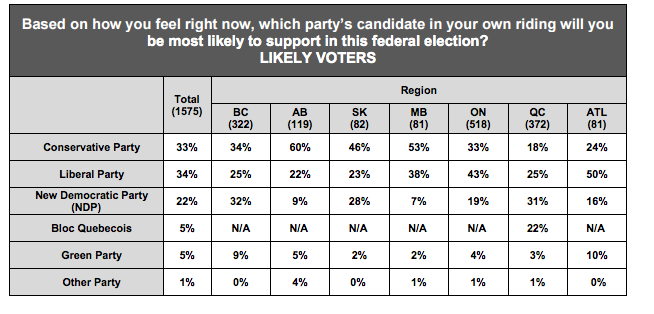
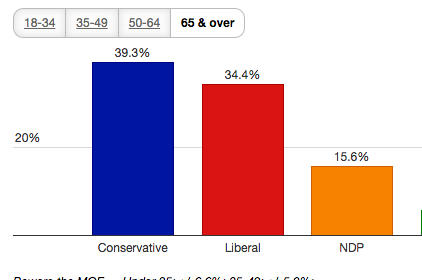
Conservatives who pay attention to media polls are praying for a turnout advantage based on older voters and firmly committed supporters.  And supporters of other stripes will want to head into the weekend with their eyes wide open.  I’m sure complacency is not an issue for anyone.

I’m not sure this praying cat is Conservative, but who doesn’t like a praying cat?

Today’s Angus Reid Institute (ARI) – hint, older people more likely to vote:

Screen Shot 2015-10-16 at 2.11.29 PM

Then there’s this:

Screen Shot 2015-10-16 at 2.25.51 PM

ARI looks specifically at likely voters, shrinking Liberal lead from 35-31 to 34-33:

Screen Shot 2015-10-16 at 2.14.37 PM

Today’s EKOS (65 and over):

Screen Shot 2015-10-16 at 2.12.36 PM

Ekos has overall race at 34 Lib, 33 CPC.

Is there a Liberal surge?  Nanos has six point Liberal lead and Liberal strength among seniors.  Mainstreet is predicting a Liberal majority.  Innovative also has a big red spread.

Ekos and ARI provide counter-evidence to suggest the CPC are far from dead and buried.  Not in majority territory (I don’t think we have a David Cameron surprise here) but still in the hunt for a plurality.

Pick your poison.

Adventures in Strategic Voting in Vancouver-Granville

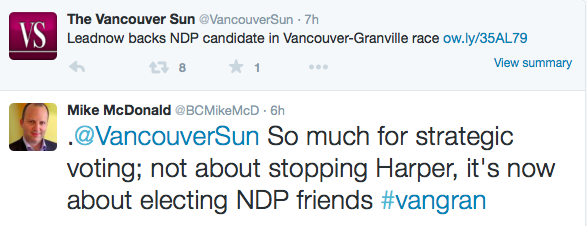
I was minding my own business on Thursday afternoon when a Vancouver Sun tweet came across my radar screen.  It said Leadnow – the ‘strategic voting’ organization was endorsing the NDP candidate in my riding, even though the Liberal candidate has been leading in the polls featured on their own website:

Screen Shot 2015-10-15 at 9.14.10 PM

The idea of unaccountable organizations driving strategic voting based on self-interested polling has been grating on me, but the Granville endorsement demonstrated the cynicism of their approach.

Screen Shot 2015-10-15 at 9.17.54 PM

The Candidates

Here’s the thing – the candidates for all parties are good candidates.  I know Mira Oreck a little – she hosted me when I spoke at the Broadbent Institute in June regarding the Alberta election.  I also think it’s great she’s running; if she’s elected, she will be a good MP.  She has a solid campaign team of very dedicated friends and followers and I have a lot of respect for them.  However, I think the Leadnow tactics will ultimately hurt her, and if her campaign was in cahoots, it was a mistake.

Jody Wilson-Raybould, the Liberal, is also an excellent candidate.  She has been a trailblazer as a First Nations leader while having an accomplished career as a lawyer.  Like Mira, she’s run a good campaign and running hard.  Moreover, she is running for the party that has momentum in a riding where her party has a natural advantage.  In the 2011 election when the Liberals were shattered, they almost won the polling areas within the new Vancouver-Granville riding (Conservatives were first) and finished ahead of the NDP.  Looking at 2015, it would be highly unusual for the Liberals to finish behind the NDP given the significant increase in Liberal support in BC, and if they win 7 seats in BC, Granville will be one of them.

For Leadnow to intervene against her is frankly all too predictable from a group that is trying to ‘manage’ election results; it’s just surprising they would be so transparently cynical.

This is all welcome noise to Erinn Broshko, the Conservative.  Who wouldn’t want a ‘strategic voting group’ to endorse the weaker of two rivals?

My annoyance with Leadnow has nothing to do with these candidates.  I will be content with my level of constituency representation from any of them if they are elected as MPs, I’m sure.  And, news flash, I’m no NDPer.  I’m happy to vote FOR Jody.

Into the Twitterverse

After the tweet from The Great Baldrey™ (“nice hair!”), the debate was joined by David Ball from the Tyee.  Admittedly, I’m not a soulmate of the Tyee but I certainly prefer them over the shills at the Observer!  I expressed my main beef that Leadnow lured people in through their poll-based approach – that they would poll in the ridings then advise voters on who had the best chance to win.

Screen Shot 2015-10-15 at 9.25.21 PM

I expressed my preference that political parties settle these kind of debates without these self-appointed outside groups mucking about with their polls.

Screen Shot 2015-10-15 at 9.29.57 PM

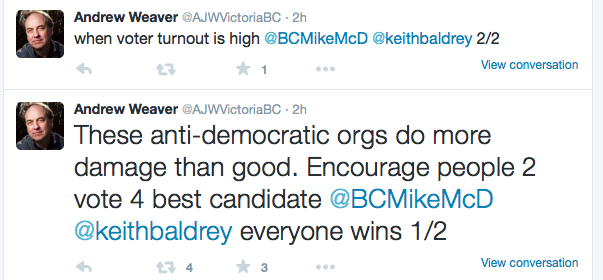
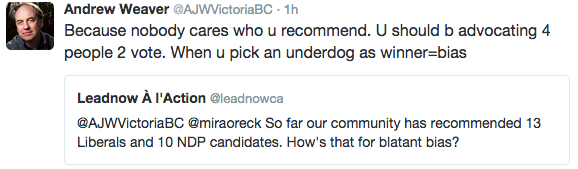
Later, the debate was joined by BC Green Party MLA Dr. Andrew Weaver, who retweeted my criticism that the Leadnow endorsement was a disgrace.  He went on to add his view:

Screen Shot 2015-10-15 at 10.03.59 PM

Screen Shot 2015-10-15 at 9.33.27 PM

I took the opportunity to ask Dr Weaver about his view regarding Green prospects on Vancouver Island:

Screen Shot 2015-10-15 at 9.37.21 PM

Leadnow poked their head out of their gopher hole:

Screen Shot 2015-10-15 at 9.38.49 PM

This issue has now become a FULL BLOWN CONTROVERSY.  How so?  When the Georgia Straight is quoting my tweets, you know the story is BIG.  The Sun and Province both ran pieces this morning highlighting the controversy.

The Uncivil war

What’s the upshot of this?  Groups like Leadnow and the Dogwood Initiative have succeeded in dividing like-minded people (I’m excluding myself here – I’m not like-minded).  You have all these Green Party supporters who are the tried and true believers of the issues espoused by leading environmental organizations and they are brushed aside by strategic voting groups.  It must be very disillusioning, hence Dr. Weaver’s anger.

In my post regarding the Nanaimo-Ladysmith federal race, some of my local correspondents made note of the tensions between the Greens and the NDP.  Strategic voting groups exacerbate these tensions.  Wouldn’t it be something if Leadnow and Dogwood endorse an NDP candidate and the Green finishes 2nd to the Conservative?  Holy cow, that would be an ugly scenario.

Victoria media commentator Adam Stirling has picked up on the vibes:

Screen Shot 2015-10-15 at 9.58.36 PM

The Upshot

Voters aren’t stupid.  They can see through these stunts and organizations like Leadnow spend a lot of time in their echo chamber and not necessarily engaged with swing voters.  My beef is that they presented an approach based on ‘evidence’ and they switched gears with four days to go in the election.

Poll postcript

And about those polls.  The level of reporting regarding Leadnow and Dogwood poll results has been very thin.  They have not provided detailed cross-tabs and without those, the media should not be reporting results.  In Metro Vancouver, I will wager that they are not tracking Chinese-Canadian respondents and in seats like Vancouver-Granville, not accounting for a major sub-population is methodologically dodgy.  Overall, these unaccountable organizations have avoided scrutiny.  The voters will have the last word.

Nanaimo-Ladysmith: the most interesting race in BC

UPDATE: (11pm, October 18) This original post was published on Oct 15.  Events continue to evolve, including new national and BC poll results.  My take on the Nanaimo-Ladysmith race as of the 15th may have been overtaken by events.  Feel free to comment.

UPDATE: (10pm, October 17) Seeing lots of traffic via Facebook to this post.  I encourage visitors to leave comments if you agree/disagree with observations and add any ‘colour commentary’.  

Nanaimo-Ladysmith is the most interesting race taking place in BC.  It has not received as much attention as Vancouver and Victoria area ridings, but it is one of the few ridings that can claim to have a four-way race, with my definition being that four parties are in the 20% territory.

Nanaimo is known for its world-famous bathtub race. These bathtubbers intently discussing strategic boating.

There may be some dispute with the idea of a 4-way race, but let me explain.

  • It is a new riding with no incumbent
  • Until this election, the City of Nanaimo was previously split down the middle with the CPC representing the north end and NDP representing the south end
  • The Green candidate is the son of a former NDP MP and was rejected by the NDP based on his views on Israel-Palestine issues.  By many accounts, he is in contention and displayed a show of force when he hosted a September townhall of an estimated 1,000 attendees in Nanaimo
  • The Liberals have been poor fourths in recent elections and have the weakest organization, but in the not-to-distant-past routinely netted 20% – can Justin’s appeal extend the Liberal brand into a contender?  It may only take 26% to win (and in the recent Alberta election, an NDP MLA was elected with 29%).

Where is Nanaimo-Ladysmith?

It’s a new riding formed after the latest redistribution.  The City of Nanaimo (pop. 83,000) is included in its entirety along with outlying feeder communities of Lantzville, Ladysmith, Cedar, and Gabriola Island.  It’s a cohesive boundary that is a considerable improvement over the split ridings that had been the case for decades.

What’s the local flavour?

Olden days – employer/labour conflict in the coal mines that led to the election of Socialist candidates.  Today, the only physical remnants of King Coal are slack piles in the small community of Extension and on Transfer Beach in Ladysmith.  Yet a legacy of labour politics persists in South Nanaimo and some surrounding areas and pride remains that Tommy Douglas represented Nanaimo for a time.  Unionized forest workers are an important bloc but are not as plentiful today; there is a stronger public sector union base, including the head office of BC Ferry Union.

The labour politics dissipate as one travels north across the Millstone River which bisects Nanaimo – NDP votes  evaporate and Conservative votes flourish.  North Nanaimo votes BC Liberal provincially and Conservative federally.

Nanaimo also has growing population of retirees; it has a very strong retail and tourism sector, mostly non-unionized; and it has an underrated university – Vancouver Island University – which is a regional hub for employment, research, and a considerable First Nations enrolment.

There’s a lifestyle element with Gabriola Island and rural areas having an eclectic brew of artists, blue collar workers, country squires, and back-to-the-landers living not-quite cheek to jowl on their five-acre lots, but having the common talking point of well water and septic tanks.

The riding is a potpourri.

How did Nanaimo-Ladysmith vote in past elections?

Transposed onto the current boundaries, the results of previous elections were:

2006 2008 2011
NDP 40 38 45
CPC 34 38 40
LIB 18 14 7
GREEN 5 8 7

Based on electoral history, how can this be a 4-way race?

Good question!  Let’s start with the Greens.  As stated, the Green candidate Paul Manly is a serious candidate who has mounted a serious campaign.  When parties don’t mount serious campaigns, voters will abandon them as they don’t want to waste their vote.  This time, the Greens have a candidate who is funded, built a strong campaign team, and has his base excited.

Just so you know I’m not making this up, two strategic voting polls in September and October both have the Greens north of 20%.  The strategic voting brain trusts must be wincing that Paul Manly is upsetting their carefully constructed storyline.

What about the Liberal?  The Liberals had been in the midst of an inexorable decline on Vancouver Island since 2004.  The demographics of Nanaimo-Ladysmith are similar to other ridings in Canada that do elect Liberals but they have barely raised the flag in successive elections.  This time, the Liberals have a spring in their step.  They have the weakest organization in Nanaimo of the four campaigns but they have Justin Trudeau, and Justin compared to Michael Ignatieff and Stephane Dion is a major step up on Vancouver Island.  It is certainly conceivable that the Liberals could return to their traditional 20% level and possibly higher if voters catch a wave.  Those same strategic voting polls had Liberal Tim Tessier lurking at 17-18%, and that was before the latest ‘Liberal surge’.   Electoral politics in Canada is certainly chock-a-block full of surprise MPs (see Quebec 2011, Alberta 2015) and the Liberal chance rests on the Leader’s shoulders.  In a four-way race, as little as 26% could deliver victory.

The Main Event

NDP candidate Sheila Malcolmson is an experienced local politician, but not particularly high profile.  She’s not a City politician – she’s from the islands.  She follows popular incumbent NDP MP Jean Crowder who had very high personal support and name recognition.  From what I understand, Malcolmson is not a drag on NDP support, but she’s had to establish herself.

Conservative candidate Mark MacDonald is a true blue conservative. He was a longtime publisher of Vancouver Island’s business newspaper and more recently had served as editor of the Nanaimo Daily News.  He’s tenacious and straight forward.  A majority of voters won’t agree with him, but he’ll be quite happy with 35% thank you very much (or less as long as he’s first).  He’s the one candidate in the race that I know and I’m sure he’s working his tail off.

These two parties shared 85% of the vote in Nanaimo-Ladysmith in 2011.  This time, they both will see their share of the vote cannibalized.

The Greens will hurt the NDP candidate.  This makes sense intuitively and is also what I’m hearing anecdotally.  You can see it in the strategic polls too, even if they are only roughly accurate.

The Liberals will hurt the Conservative.  The rise in the Liberal vote coincides with drop in Conservative support.  The question is – how much?

The Conservative brand does not resonate on Vancouver Island as well as more populist right-wing brands.  In 1993, the Reform Party stormed this area and were re-elected in 1997 and 2000 (Canadian Alliance).  Clearly, provincial NDP voters were supporting Reform and the Canadian Alliance federally.  This type of cross-over appears less frequent now.  The Conservatives have retrenched into a narrower base while the NDP have reclaimed most BC NDP voters.  (NDP federal candidates do poorly when the BC NDP is in power – ie. 1974, 1993, 1997, 2000 elections; they do better as memories fade)

Strategic Voting

This is one riding where I question the proponents of strategic voting.  Yes, I get it, “STOP HARPER”.  That’s their point.  But here you have a Green candidate who is positioned for an historic breakthrough – isn’t that strategic?  Ends-justifying-the-means  tactical fights to win a seat in a close election is clearly understood as an objective, but it seems like strategic voting organizations are eating their young.  I’m not a Green supporter by any stretch but I relate to their situation – I was a Liberal in the dark days of the 1980s.  Manly is running against the odds.  If Manly does win, he’s a nationally-significant politician as one of maximum three Greens that get elected.

There’s no question that Manly’s candidacy is a boon to the Conservatives.  I don’t think they would have a chance without it.  While the Liberal gain is coming at some expense to the Conservatives, those votes were likely lost to the Conservatives anyway in this election.  Three parties might be fighting over upwards of 70-75% of the votes while the Conservatives have a hard core.  They need that core to be in the high 20s to have a chance and likely over 30%.

The Upshot – my unscientific guess

My sense is that the race today is (1) NDP; (2) CPC; (3) GREEN; (4) LIB but that less than 15% separates 1 to 4.  NDP are likely leading at this point and probably a little above 30%; the Liberals are probably pushing 20%, with CPC and Greens in the mid 20s.  The Green factor is a huge wildcard.  Voters like having MPs and MLAs that are seen to “make a difference” and stand out.  Once a tipping point is reached, voters can defy convention as we saw in Oak Bay-Gordon Head and Delta South provincially, and Saanich-Gulf Islands federally.  That tipping point would typically be reached late in the campaign, but I’m not sure Manly has reached it.

Feedback from the Street

Don’t take my word for it.  I put a request out to friends who live in the riding and asked them to give me their ranking and whatever insights they would like to share.   Here are some comments – and of course, my friends are completely unrepresentative of the population, but they follow politics and were giving honest views.  Their comments represent a contradictory mix of assessments and judgments, and reflect why I find this the most interesting race in BC.

I have witnessed a tremendous amount of people from across the political spectrum rallying behind the Green banner….with a sizeable portion of what I understood as traditional NDP’s working on the local Green campaign. However, Sheila is doing very well and running a strong campaign with still a large army of volunteers.

None of these parties are taking votes from the CPC, only from each other, and I doubt too many LIBs or GRNs will strategically vote NDP – these people want to vote LIB or GRN.  I’m not sure the same is true for N-Dippers – I think they’re more likely to lose votes to Libs and Green, giving the win to CPC.

I think the Green factor is certainly real…they have run an impressive campaign. Paul Manly has been very active and visible. They’ve been everywhere with signs, social media ads and movies theatres – their graphic novel short was hilarious. Not sure this will result in a win, but I think they will be rewarded with support from unlikely corners.  Not surprisingly, many NDPers are quite unhappy about this fact – hostile even – as they feel they should easily win the riding. I still think they will prevail at the end of the day but not without bitterness.

None of the candidates appear to have much community profile, the NDP and Greens have had the best sign coverage. The Conservatives are getting a lot of vandalism and they seem slow making repairs.

The Greens appear to have a good candidate and strong appeal in this riding.  I have been somewhat surprised by the folks from various backgrounds that have indicated they are voting Green.

I strongly suspect Green rally drew people from all over the Island to show support in a winnable riding. Greens have more lawn signs on private property than NDP.  Not the biggest sign war. CPC seeing a lot of sign damage.  I haven’t seen a Liberal sign on private property.  Some Green supports I think will chicken out at last minute.  Conservatives will be quiet until ballot box

All four parties have a strong external presence, however, the NDP seems to have the most yard signs.

I attended the All Candidates Forum last week in Ladysmith.  Afterwards I discussed the performance of the various candidates, with others who attended.  There seemed to be a consensus… the NDP were first, followed closely by the Green, then followed by the Liberal, and the Conservative was at the bottom.

I attended an all candidates meeting and was really impressed with the Liberal candidate. More than I thought I would be. However, Green and Orange appear to be running neck and neck. Manly has had some impressive public events and very public shows of support, but you can never discount (as you know better than anyone) the Pavlovian response of the dippers on election day.

I have to say that I think the Justin factor is not in play to any extent and I do not see the emergence of a four way race. Nor indeed do I see a three way race.

This election is interesting here in Nanaimo, having a good feel for this town it will be between Paul and Sheila. We all know this is NDP country but the way the NDP handled the Manly nomination, many have jumped ship to Green. Federal Liberals have not appeared to have made much noise and [the Conservative] is guilty by association re to Harper. I have heard more chatter around Sheila and Paul but would say NDP will narrowly defeat Green and distantly followed by Libs then Conservatives.

It is clear that the NDP is clinging with its fingernails to its traditional base with a weak candidate.  So I think the battle is between Manly and MacDonald, with MacDonald likely to win because of the Green/NDP split.  As per provincial politics, conservative strength lies in North Nanaimo and in Saltair.   I think the Liberal candidate is a pleasant guy, and he seems to have more money and organization than previous candidates, but he is ploughing a tough row here. So in summary, my prediction is CPC/Green/NDP/Lib/Leninist Marxist (how could you forget him?)

Prediction market bearish on NDP, but has been fooled before

The Sauder School of Business is running its prediction market yet again, as it has done in many previous elections.  Real people invest real money on the outcome of the election.

It’s a bear market for Les Oranges

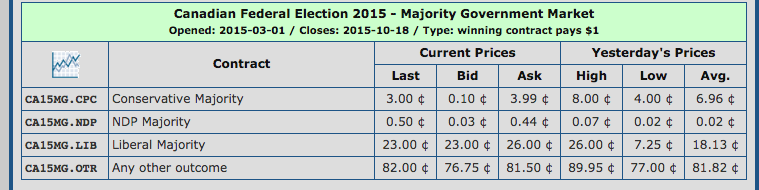
In the past day, there has been a run on the market.  Investors are scooping up “Liberal majority” government shares.  If the Liberals win a majority, one share = $1.  If they don’t, the share is worth nothing.  The Majority Government Market betting is an all-or-nothing proposition.

Screen Shot 2015-10-14 at 10.39.49 AM

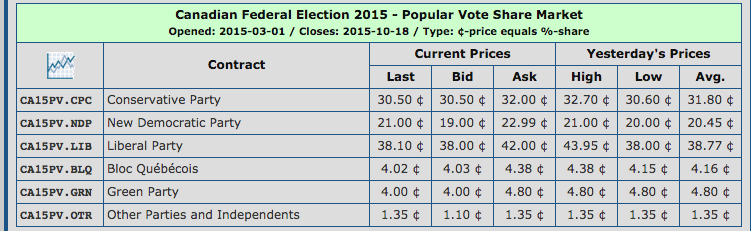
Liberal majority government shares have moved from a low of 7 cents on the dollar to 23 cents.  Conservative majority shares have declined to 3 cents.  NDP majority shares are now at less than half a cent.  That’s a pretty good windfall if the Orange ship comes in.

The minority government (“any other outcome”) option has risen from the low 60s a few weeks ago to 82 cents.  Still, a decent return of over 20% if that outcome is realized.

The popular vote market shows Liberal shares being traded at 38 cents with the lowest asking price at 42 cents.  The market is very bullish for the Liberals; surprising then that the majority government betting for the Liberals isn’t higher.  But are bettors getting ahead of themselves ?

Screen Shot 2015-10-14 at 11.27.34 AM

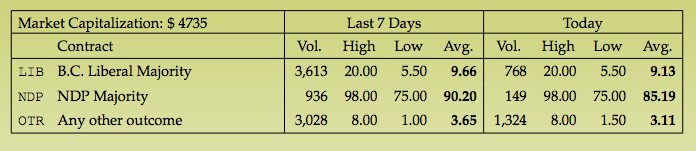
I have observed in recent years that this market mirrors media coverage of poll results, though with the added touch that people have to put their money where their mouth is.  It’s an interesting social experiment but it doesn’t necessarily predict outcomes.  The poll results are likely too dominant a consideration in investors’ behaviour.

Here are the statistics of the last day of trading prior to the BC provincial election in 2013:

Screen Shot 2015-10-14 at 11.32.35 AM

In the meantime, you still have time to make some money off of other political junkies.  There are doubtlessly some emotional bettors that will part with their hard-earned cash on Tuesday.

Reasons to second guess polls

The latest polls give plenty of fodder to suggest that there is a Liberal surge overtaking the race.  There are a number of supportable points on this:

  • Nightly poll tracking by Nanos has been reinforced by Innovative and Ekos.  The narrative is that the Liberals are pulling away from the Conservatives with the NDP far behind.
  • The “not ready” line of attack has been embraced by the Liberals; they have played it differently than “just visiting” and “not a leader” attacks from previous campaigns.
  • The heat of the anti-Harper passion is far beyond that what has been seen in previous elections.  Various poll metrics (eg. “time for a change”) suggest voters are ready for a new government.
  • Advance voting turnout is high which could mean higher overall turnout favouring the Opposition.

What could possibly go wrong betting on a horse race?

Yet, there is that gnawing feeling that there could be another polling surprise just around the bend.

Look at the UK election last May.  Screen Shot 2015-10-12 at 11.08.00 PMThe intensity of British media coverage and polling exceeded that of the Canadian election yet no one saw a Conservative majority coming.  Even famed predictor Nate Silver blew it badly.  When BBC forecasted a majority moments after polls closed – based on results from exit polls – pundits were absolutely gobsmacked.  Not only that, two of the party leaders were caught with their pants down by their ankles and resigned by morning.  The prime minister (“Bluedini”) was likely as surprised but had the winning strategy on his side.  (Exit polls were based on interviews with voters immediately after they voted, not pre-voting surveys)

Yes, there is the litany of Canadian surprises too.  Mainly favouring incumbents – Christy Clark, Alison Redford, Greg Selinger, Dalton McGuinty, and Kathleen Wynne to name some plus Jean Charest who just missed re-election when pollsters had him in third.  Remember Doug Ford?  The final polls in the Toronto mayor’s race had him dead and buried but he only lost by 6.5%.  Overall, it’s certainly not a sterling track record.  I’m speaking about media polls here.  Sure, some parties have got it wrong too, but clearly some (the winners) are getting it right.

But they called it in Alberta, right?  A quick check from the 308 poll aggregator site shows that most pollsters (not all) overstated NDP support and understated PC support.  It didn’t matter since the NDP won handily.  But in a close election, some of the pollsters were off by a considerable margin when you look at the NDP-PC difference.  The poll aggregator had that gap at 20 points (it was 13%).  That’s a big difference in a close election and an error of similar magnitude in this election would lead to a different outcome.

Screen Shot 2015-10-12 at 10.23.41 PM

Three things I’m watching

  1.  The engagement level of voters

Last week, I wrote about Greg Lyle’s extensive research.  He updated his research this week with a research deck of over 100 pages.  There is enough data here to keep Wikileaks busy for a month.  Overall, his survey reported a 35-30-24 race (Lib – CPC – NDP).

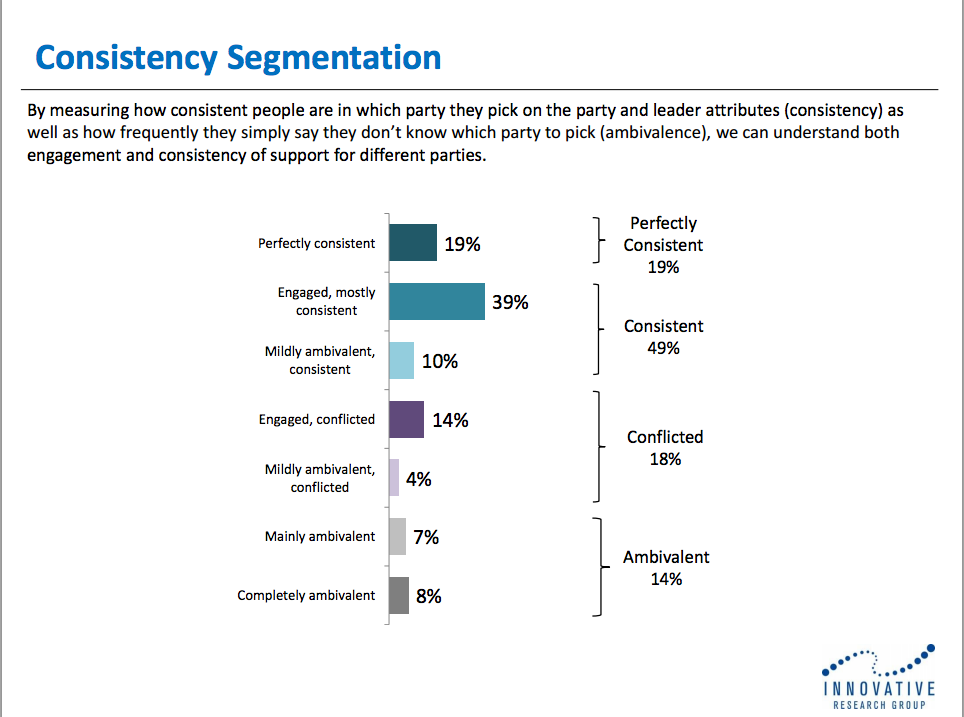
Screen Shot 2015-10-12 at 10.30.49 PMGreg has built a respondent profile based on consistency versus ambivalence.  If the respondents have a consistent pattern to their responses, they are at the ‘consistent’ end of the scale.  If they answer “don’t know” to a lot of questions, they are on the ‘ambivalent’ end of the scale.  Conflicted respondents are in the middle.

About 15% of respondents are ambivalent.  Most will not vote.The ‘perfectly consistent’ are primed to vote.

This week, Greg posted the vote results by each of these clusters.  Bearing in mind the Liberals had an overall five-point lead on the CPC, here’s how that broke down among the consistency segmentation:

Screen Shot 2015-10-12 at 10.30.25 PM

The race is tied among the ‘perfectly consistent’.  I would throw out the 15% of ambivalent respondents, which shaves a fraction off the Liberal lead.  Among the 18% of ‘conflicted’ voters, the Liberals have a substantial lead over CPC, which appears to be based on NDP switchers (hence the fact they are ‘conflicted’). These respondents are a lot more likely to vote than ‘ambivalent’ but less likely than consistent voters.

Therefore, the Liberals have more work to do to mobilize this voter group in order to realize a five-point win.

         2.  Inconsistencies between pollsters in age and gender

There has traditionally been a gender split with the Conservatives doing better among men and the Liberals doing better among women.  Ekos, which had the Conservatives ahead two points, shows the Conservatives leading among women.

Screen Shot 2015-10-12 at 10.46.40 PM

Meanwhile, Nanos in the field at the same time, has the Liberals with an 11.6% lead among women.  That’s a pretty big gap between pollsters.

nanos female
Is Ekos overestimating CPC support through a blip in female support, or is Nanos overestimating Liberal support among males (below).  Nanos has shown a consistent Liberal uptick.

Screen Shot 2015-10-12 at 10.44.51 PM

Oh, and did you see the Ekos age split?  48-30 for CPC among seniors.  Nanos has the Liberals with a 1.5% lead among plus 60 voters.  Again, another big difference.  Who’s right?  I dunno.

        3.  Regional races

There is considerable variance in the regional horse race numbers, especially in Ontario and Quebec.

In Ontario, it is either a death-duel between the Blues and the Reds OR it’s the Reds walking away.

In Quebec, it is either a four-way collision or the NDP retain enough support to win the majority of seats, keeping it in national contention.  When you see numbers like this, the party above 30% can harvest a lot of seats.  The difference in Quebec between 27% and 32% could be 40 seats.  The latest poll findings are inconclusive, to say the least.

308 Leger Nanos IRG Forum ARI
NDP 30% 28% 33% 29% 25% 31%
LIB 27% 28% 29% 26% 29% 24%
CPC 19% 20% 14% 19% 22% 17%
BLOC 21% 23% 23% 22% 21% 27%

Finally, there are the usual warnings:

  • 10-second Tories (in BC, we called them 10-second Socreds).  Voters that decide in the final analysis to hold their nose and vote for the incumbent.
  • “Cranky won’t says” – the 6-8% of voters who won’t and don’t cooperate on surveys are a statistical wildcard.
  • The final weekend – voters have a sixth sense that is not entirely detectable.  The Redford win in 2012 manifested from an unease about Wildrose in the final week.  A combination of not-likely voters, strategic voters, and strange bedfellows changed the game.
  • Advance and special votes – Perhaps up to 20% of votes are already in the bag.  Who do they favour? Will the winner on October 19th lose the overall election?

I’m not forecasting anything here – only caution.  It is clear that the Liberals have won the campaign thus far.  They started with low expectations and have exceeded them, and have to this point eclipsed the NDP in the ‘primary’ that established which party had the best chance to defeat the Conservatives.

Having said that, if I was a Liberal strategist, I would be tempering my grassroots’ naturally-occurring public-poll-based-optimism with Eeyore-like gloom and insist they are still running from behind.  I wouldn’t want to be like the gobsmacked Brit who couldn’t read the tea leaves – even at tea time.  If I was a CPC strategist, I wouldn’t assume the poll numbers will necessarily improve – it is going to be a gruelling week but a plurality is very much possible if they have a strong finish, particularly with the likeliest of voters.  If I was an NDP strategist, I would move mountains to move vote in Quebec.  If they lose Quebec, all is lost.

Ultimately, the great thing about campaigns is that it’s up to the voters.  The strategic voting organizations, the media outlets, and the pundits are not inside the voting booth.  It’s between the voters and the names on the ballot.  And that is the greatest variable – voters just damn well choose who they want to, sometimes with surprising results.

ROC looking like 2004 with Quebec as the wildcard

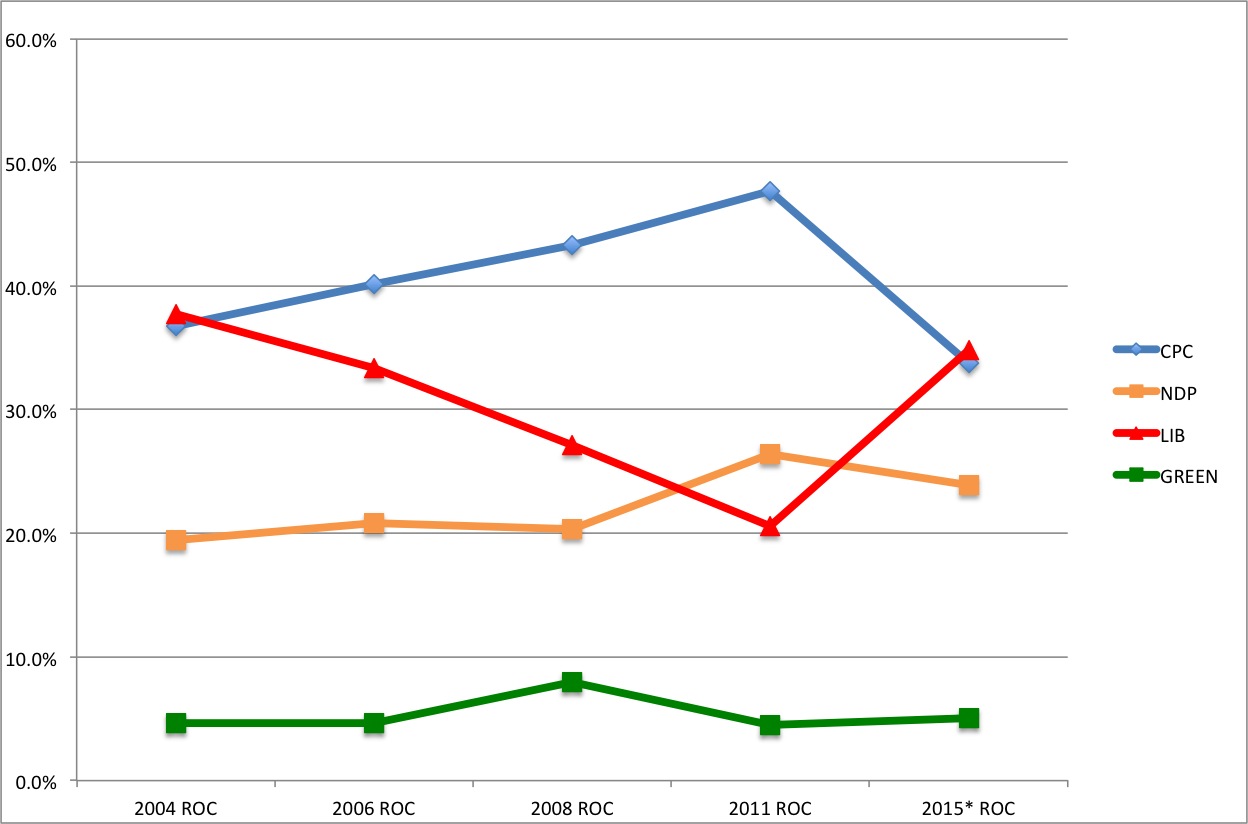
In ROC – the Rest of Canada – this election is beginning to look like 2004, when the Blues and the Reds were in a dead heat outside of Quebec, and the NDP were trailing in third.

ROC Oct 9

The 2015 numbers are taken from today’s Mainstreet poll.  There wouldn’t be too much difference from Leger or other recent polls.  The trends are similar.

As you recall, 2004 was a Liberal minority.  In 2006, the Conservatives started pulling away, ending 13 years of continuous Liberal rule.  They built up their margin in ROC in 2008 when they squared off against Stephane Dion and decimated the Ignatieff Liberals in 2011 outside Quebec.  Meanwhile Jack Layton had flat support levels in ROC from 2004-2008 and even in 2011, while the rise was significant, it was not as dramatic as Conservative gains.  The NDP paradigm shift was in Quebec.

Which brings us to la belle province.  A series of polls is showing the NDP in free fall.  Since the start of the campaign, various pollsters have shown a drop in the neighbourhood of 20 points.  Now, Mainstreet shows them in third.  Leger last night showed them tied.  Both have them in mid to high 20s.

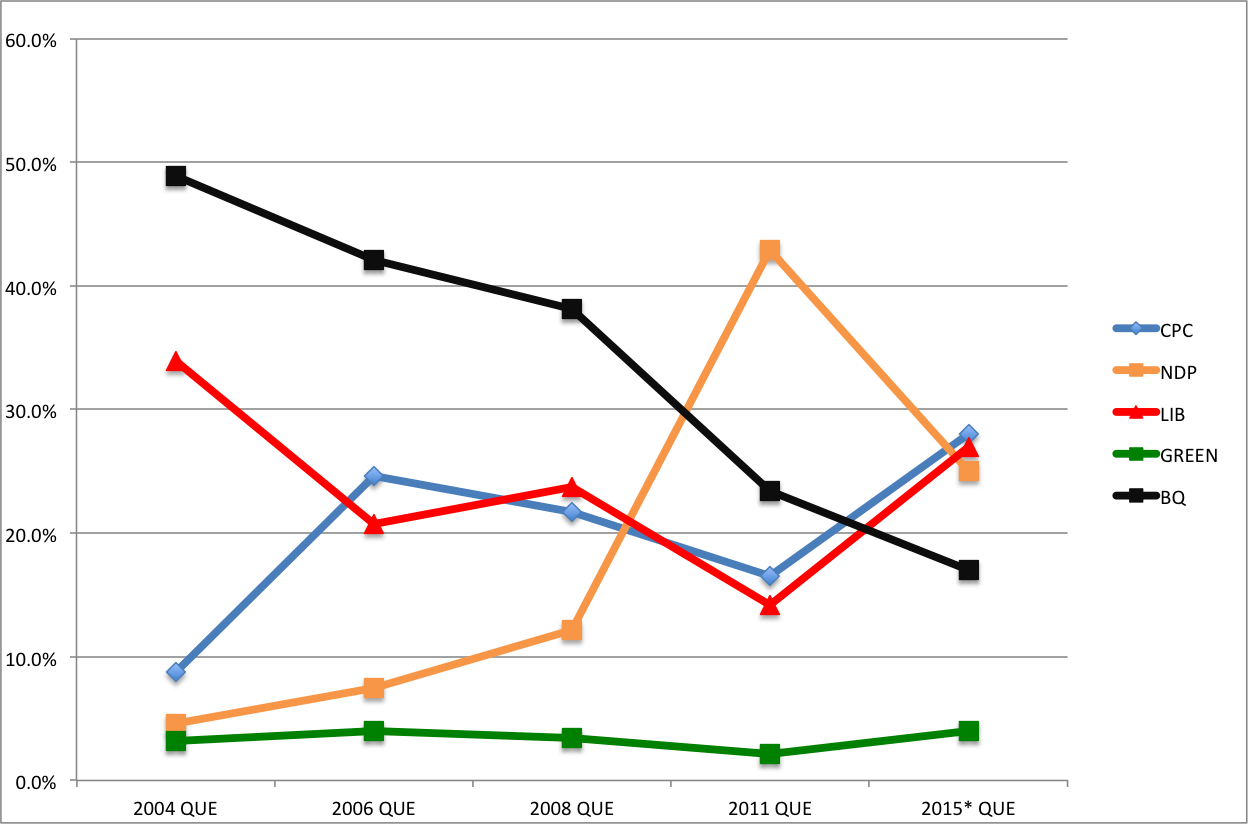
The chart below shows the volatility in Quebec in federal elections since 2004. (Again, Mainstreet numbers are used for 2015)

Que Oct 9

While ROC is looking like 2004, Quebec does not offer the same comparable.

The steady decline of the Bloc Quebecois has been apparent and they still remain below 2011 levels when their share of seats collapsed.  However, the demise of the NDP creates opportunities for regional gains for the Bloc, CPC, and Liberals.  If one party pulls away from the pack, there is potential to win a lot of seats.  Or a small NDP uptick to bring the party over 30% could save many or most of their seats.  We are in the territory, under a three or four-way first-past-the-post fight, when the difference between 27% and 32% means a pile of seats.

If the dynamic in ROC holds – which is a close two-way race, a shift in Quebec could very well be the difference.  Quebec has shown it can move en masse as it did for Diefenbaker in 1958, PET through most of his elections, Mulroney in 1984 and 1988, the Bloc in 1993, and Layton in 2011.  Perhaps this time will be different as the Liberals and CPC appear to have regional limitations.

This federal election has become a a two-way race with a big wildcard in Quebec.