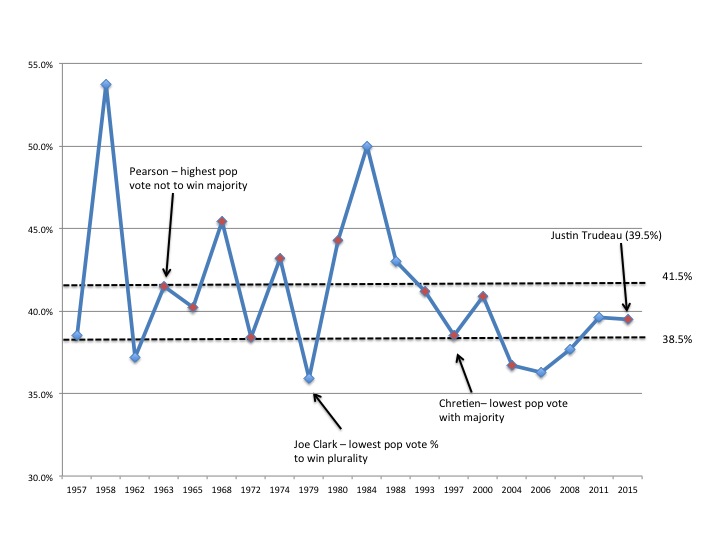
When it comes to winning a majority government, what does it take in terms of popular vote? While its the number of seats, and not the number of votes, that truly matters, popular vote is a guide as to the likelihood of whether the leading party forms a minority or majority government.
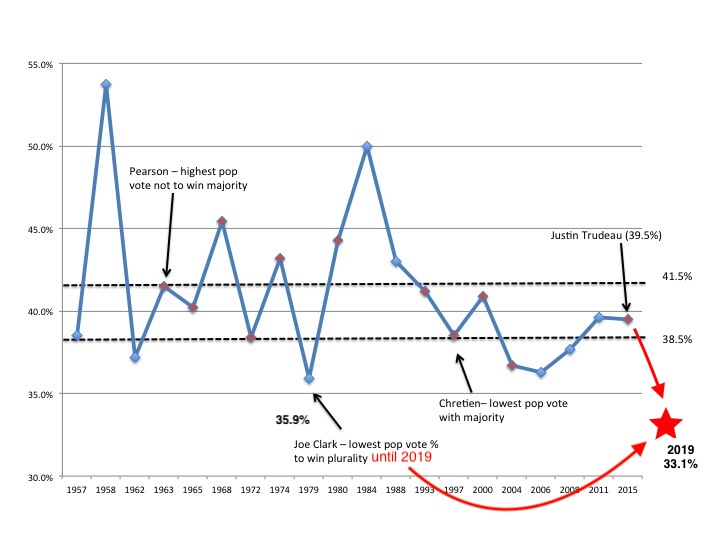
In the past 65 years, the magic number has been a minimum of 38.5% for a majority and a minimum of 33.1% (the Liberal 2019 result) for a plurality of the seats, which historically leads to a minority government. The highest popular vote that did not translate into a majority was 41.5% (Pearson, 1963), therefore, the modern-day range has been 38.5% to qualify for a majority and over 41.5% to most likely be free and clear of a minority.
In fact, the 2019 election was the first time the governing party was elected with less than 34% of the popular vote. Justin Trudeau’s 33.1% was the new low, falling beneath John A. Macdonald’s 34.8% from Canada’s first post-Confederation election in 1867.
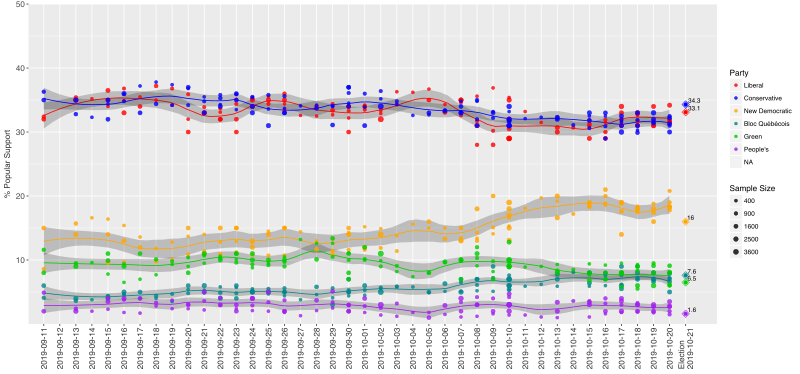
In 2019, the relative standings of the major parties were fairly consistent except for a latter-campaign uptick for the NDP. No major reversals of fortune took place with no party able to pull away to gain a majority.
It was a different story in 2015. The Liberals eclipsed the NDP mid-campaign, won the ‘Stop Harper primary’, and gained separation over a static Conservative voter base. (In 2011, Jack Layton’s NDP eclipsed Michael Ignatieff’s Liberals during the writ period).
There are different pathways to a majority as parties cobble together seats across the provinces. For the Liberals, a assuming they are BLOCked from major gains in Quebec, it’s getting more out the regions outside of Ontario. For the Conservatives, it’s doing better, much better, in Ontario – in 2011, Stephen Harper won 69% of Ontario’s seats, but in 2019, Andrew Scheer only took 30% of the seats there. For both the reds and the blues, the competitive British Columbia battleground can add the mustard to the winning hot dog.
Momentum shifts can take place, sometimes imperceptibly. The public pollsters are telling us, in Election 2021, that no party has demonstrated it’s in ‘majority territory’. In this day and age, with the Bloc taking a good share of votes in Quebec, and the Greens and PPC carving upwards of 10% of the vote, a majority may not require 38.5%, but until a party climbs above 36-37%, it’s most likely that a minority government, in some form, will be the likely outcome.
Update:
Justin Trudeau’s Liberals won a plurality of seats with an even lower popular vote than 2019, dropping from 33.1% to 32.6%., thus it was the first time a government had been elected with less than 33% of the popular vote. Erin O’Toole’s Conservatives had a higher popular vote with 33.7%, though it was lower than Andrew Scheer’s level in 2019. The Liberals obviously had a more efficient vote, winning more seats by a slimmer margin, while the Conservatives won many seats by a large margin (e.g., Alberta and Saskatchewan).
Prime Minister Justin Trudeau appears poised to call an election for September 20th with the hopes of attaining a majority of the seats. The Liberals won 157 seats in 2019, falling 13 short of a majority. Losing six seats in BC certainly didn’t help.
The Liberals enter this election with 11 seats in BC.
Party – BC standings
2015
2019
Liberals
17
11
Conservative
10
17
NDP
14
11
Green
1
2
Independent
0
1
In 2019, there were 32 seats in BC that stayed the course and 10 seats that switched hands, mostly at the expense of the Liberals.
Riding
2015 winner
2019 winner
Vancouver Granville
Liberal – floor crossing to independent
Independent
Steveston – Richmond East
Liberal
Conservative
Pitt Meadows – Maple Ridge
Liberal
Conservative
Cloverdale – Langley City
Liberal
Conservative
Mission – Matsqui – Fraser Canyon
Liberal
Conservative
Kelowna – Lake Country
Liberal
Conservative
South Surrey – White Rock
Conservative – Liberal (by-election)
Conservative
Nanaimo – Ladysmith
NDP – Green (by-election)
Green
Port Moody – Coquitlam
NDP
Conservative
Kootenay – Columbia
NDP
Conservative
*The Liberals had 17 seats heading into the 2019 election, with the election of Gordie Hogg in the South Surrey-White Rock by-election offsetting the loss of Jody Wilson-Raybould who was sitting as an Independent at dissolution. Paul Manly of the Green Party won a 2019 by-election in Nanaimo-Ladysmith, filling the seat vacated by NDP MP Sheila Malcolmson.
The Conservatives gained eight seats in the 2019 election (winning back one that they lost in a by-election), though Conservative governments have typically relied on winning a majority of seats in BC, or close to it. In Stephen Harper’s 2011 election victory, the Conservatives won 21 of 36 BC seats.
Given the amount of dancing and celebrating on Election Night, the NDP campaign was seen as a ‘success’ in 2019 despite losing seats nation-wide and in BC. Blessed by low expectations, they ended up salvaging 11 of 13 held seats in BC, but failed to win back Nanaimo-Ladysmith which they lost in a by-election. The Greens doubled their seat count, while Jody Wilson-Raybould defended her seat as an independent.
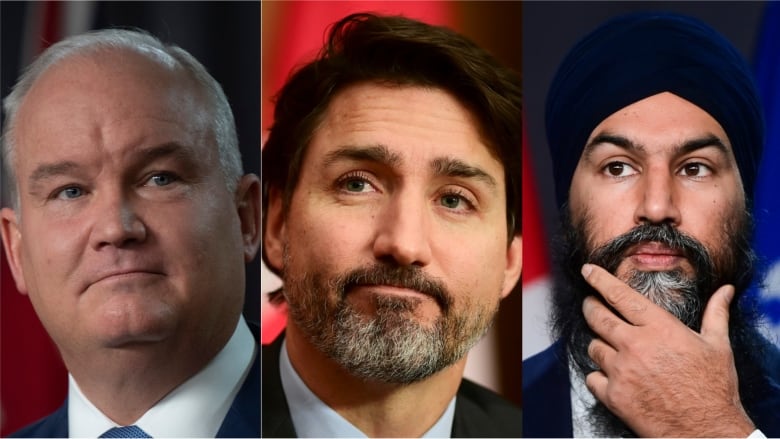
All eyes on BC’s battleground ridings. (image: CBC)
What’s ahead in the 2021 election?
The Liberals have been leading in BC according to various pollsters. Pre-writ polls are an unreliable indicator of future events, since most voters won’t tune-in until the writ period. But going with the prevailing trend right now, the Liberals look poised to retain and add seats, the NDP are competitive and in a position to add seats, and the Conservatives’ biggest battle will be in seat retention. Again, things can change. “Campaigns matter”, scream political strategists everywhere.
As of Friday, August 13th, the CBC poll tracker has the popular vote in BC at an aggregated 34% Liberal, 29% NDP, and 26% Conservative. This is basically a return to 2015 popular vote numbers in BC for the Liberals, when they had a plurality of the seats. The Conservatives are going in the wrong direction. The NDP look stronger compared to 2015 and 2019, while the Greens appear to be struggling compared to the last election.
What’s striking about the table below is how fast things change. Stephen Harper’s Conservatives had a massive win in 2011, along with a strong popular vote result from Jack Layton’s NDP. The dramatic resurgence of the Liberals in 2015 reshaped the landscape into a 3-way BC battle, which is where we are at today.
Party – Popular vote (BC)
2011
2015
2019
2021 polls*
Liberal
13%
35%
26%
34%
Conservative
46%
30%
34%
26%
NDP
33%
26%
24%
29%
Green
8%
8%
13%
7%
A rough application of current aggregated poll results to seats would see the Liberals win about 19 seats, the Conservatives cut down to 9, the NDP up to 13, and the Greens down to 1.
The campaign hasn’t even started yet, so you can consider those projections as written in sidewalk chalk during a rainstorm.
But where is the battleground right now? Largely in those seats listed above – the ones that changed hands between 2015 and 2019. Given the Liberals’ current strength, this is where they would likely win next. The NDP would see opportunities to win Conservative seats and edge out both parties in tight 3-way races.
Liberal Targets (previously held)
Liberal Targets (not held 2015-2019)
Vancouver-Granville
Port Moody-Coquitlam
Steveston-Richmond East
Richmond Centre
South Surrey-White Rock
Langley-Aldergrove
Cloverdale-Langley City
Kamloops-North Thompson
Pitt Meadows-Maple Ridge
Victoria
Mission-Matsqui-Fraser Canyon
Kelowna-Lake Country
The previously-held targets are fairly straight-forward. They won there recently and, with Conservative weakness, can likely win there again or come close. In the other targets, the Liberals almost won Port Moody-Coquitlam in 2019 and presents itself as a juicy target. The rest of the list are outliers. Richmond-Centre has held firm behind Alice Wong, but this could be the time the Liberals win back the seat held by Raymond Chan for several terms? Langley-Aldergrove, by virtue of being a suburban riding in Metro Vancouver, could be in play (the BC NDP won there last year). It is hard to envision the NDP losing a seat to the Liberals on Vancouver Island – it would require Green voters to defect to the Liberals. Unlikely, but Victoria may be the Liberals best shot on the Island (some wags may argue Esquimalt-Saanich-Sooke). Kamloops was close in 2015 and would require Conservative collapse of sorts. The inimitable Terry Lake learned the hard way in 2019. Right now, I would expect the Liberals would view 17 seats in BC as a minimum target with stretch goal of 19-20.
NDP Targets (previously held)
NDP Targets (not held 2015-)
Port Moody-Coquitlam
Pitt Meadows-Maple Ridge
Nanaimo-Ladysmith
Coquitlam-Port Coquitlam
Kootenay-Columbia
Mission-Matsqui-Fraser Canyon
Burnaby North – Seymour
Vancouver-Granville
The NDP are likely circling Nanaimo-Ladysmith like a Stanley Park coyote, looking to take a bite out of the Green Caucus. With Greens in disarray, MP Paul Manly may need to win as a virtual Independent. Port Moody-Coquitlam was held by Fin Donnelly and was a near-miss in 2019. The belt of ridings on the north side of the Fraser River from Coquitlam out to Mission and up the Canyon have elected many NDP representatives over the years and could be fertile ground if the NDP moves up the ladder. Burnaby North-Seymour seems like a reasonably safe Liberal seat, but the last election saw the mid-campaign firing of the Conservative candidate. Now that is reset, and the NDP candidate is a known quantity on the North Shore, it might intrigue orange strategists. Another outlier could be Vancouver-Granville where the NDP would expect to run second and could contend with a strong candidate and JWR dynamics. NDPers may argue that Cloverdale-Langley City could follow the pattern of the BC election where NDP MLAs were elected in hitherto safe ‘free enterprise’ seats. My take is that the federal Liberals will be the non-Conservative contender.
The Conservatives, until they right the ship, will be thinking retention. Of course, in order to win the election, they need to do a lot better than that. A lot can happen in 35 days and recent history proves that. Where would the Conservatives win next, beyond their current seats, if the winds of change blow in their direction?
South Okanagan – West Kootenay: NDP edged the Conservatives by 3% in 2019
North Island – Powell River: this is one riding with an issue that favours the Conservatives – salmon farming. Conservatives offer a clear alternative to NDP and Liberals. NDP edged CPC by 5% in 2019.
In the Lower Mainland, the Conservatives have retreated from the City and have done poorly in the suburbs in successive elections. Targets to reclaim would be:
Coquitlam-Port Coquitlam: former stomping grounds of James Moore
Fleetwood-Port Kells: narrow loss to the Liberals in 2019
West Vancouver-Sunshine Coast-Sea to Sky: with Avi Lewis as NDP candidate, a usually strong Green effort, and Liberal who won with 35% last time, Conservatives could fantasize about ‘coming up the middle’. Former CPC MP is running again.
Vancouver South: Liberals won by only 8% in 2019. Conservaitives would need to do well in Chinese community.
As for the cuddly Greens, they don’t look as cuddly this time with their dirty laundry strewn about. Elizabeth May appears to be electable in her own right and not requiring brand support. Paul Manly, as noted above, will be in for a tougher time. While they have contended on the South Island in the past, it doesn’t look like fortunes favours them this time.
That’s what the battleground looks like to me … today. Prove me wrong in the comments as you wish.
The floor crossing of Jenica Atwin from the Green Party of Canada to Justin Trudeau’s Liberals is noteworthy in one respect – it’s the first time a federal Green MP has crossed the floor to another party. It completes a ‘trade’ that happened 13 years ago when erstwhile Liberal MP Blair Wilson from British Columbia crossed to the Greens to become its first MP in Parliament. Atwin becomes the latest in a long line of Canadian politicians who have crossed the floor to sit with a different political party than the one they shared a ballot with in the previous election.
Newly minted Liberal MP
Not so long ago, a Liberal went Conservative. I had never heard of Leona Alleslev, the Member of Parliament for Aurora-Oak Ridges-Richmond Hill, before she switched from red to blue.
Most of the time, the end is nigh for that politician. Some are pushed by desperation. Some are motivated by pique. Others for genuine policy and ideological reasons. Some are able to make the change stick, as Alleslev did in the 2019 election when she was re-elected as a Conservative.
Floor crossing is older than Canada itself. Wikipedia informs us that, in 1866, an anti-Confederate politician in New Brunswick switched sides when he did not receive a desired cabinet post. We could go back to WWI when many Liberal MPs left Wilfrid Laurier and joined with the Unionist government under Robert Borden. Or to 1935 when British Columbia’s H.H. Stevens bolted the Conservative barn to form the Reconstructionist Party.
At times, a floor crossing can signal a sea change in politics. Réne Lévesque leaving the Quebec Liberal Party in the 1960s to form the Parti Québécois is one of the most momentous moves in Canadian political history. It led to the election of the first Péquiste government in 1976 and a referendum on sovereignty-association in 1980. Watch the documentary Champions to see Lévesque’s impact and his enduring rivalry with Pierre Trudeau.
Réne Lévesque: probably the most impactful floor-crossing in Canadian history (CBC)
In 1990, Lucien Bouchard spectacularly left the Mulroney government after the collapse of the Meech Lake accord, forming the Bloc Québécois and taking other Quebec PC and Liberal MPs with him, including Liberal MP Jean Lapierre. Bouchard led the Oui forces to the brink of victory in 1995, and shortly thereafter became Premier of Quebec.
The 1993 election saw the collapse of the Progressive Conservatives to two seats with Preston Manning’s Reform Party dominating Western Canada. After Jean Chrétien continually swept up in Ontario, PC Senator Gerry St. Germain was one of the first to attempt to unify the Conservative parties and changed his allegiance in the Senate from PC to become the first Canadian Alliance senator in 2000. Later, eleven Canadian Alliance MPs left caucus to sit as the “DRC” – Democratic Representative Caucus when they couldn’t get along with Alliance leader Stockwell Day, and included some political heavyweights like the first Reform MP ever elected, Deb Grey. The DRCs would morph into a coalition with Joe Clark’s (second-coming) PC caucus: the PC-DRC. Ultimately, most everyone got back together under the leadership of Stephen Harper after new PC leader Peter Mackay agreed to merge the PCs with Stephen Harper’s Alliance. Harper became the leader of the new Conservative Party and held Paul Martin to a minority in 2004 before winning his own minority in 2006. (Joe didn’t cross, he stayed PC until the end). The key point is that floor crossing influenced the course of events between 2000 and 2004.
In 2018, we saw Maxime Bernier jump out of Air Scheer without a parachute. It caused a rearguard action that hampered Scheer’s Conservatives as they readied themselves to fight the Liberals in the 2019 election. For Bernier, the impact of this Xtreme floor crossing was the sound of hitting political ground zero with an ear-splitting splat.
Some floor crossings reflect the ebb and flow of political tides. Scott Brison was elected as a Progressive Conservative, but left when that party merged with the Alliance to form the modern-day Conservative Party. Brison became a senior Liberal cabinet minister. One can argue that he represented a shift in Canadian politics where some Progressive Conservatives migrated to the Liberals. Many politicians, like Bob Rae and Ujjal Dosanjh, sat for one party, then came back to run for another party later, reflecting how they had migrated through the political spectrum.
Provincially, MLAs in both the Saskatchewan PCs and Liberals crossed the floor to the new Saskatchewan Party in 1997, which has governed the province since 2007. The PCs were extinguished and the Liberals are in the wilderness.
In 2002, Yukon NDP MLA Dennis Fentie left his party to join the Yukon Party. A month later he was leader and later that year he became Premier, serving until 2011.
The leader of the New Brunswick NDP from 2011-2017, Dominic Cardy, found himself as a New Brunswick PC MLA in the government of Blaine Higgs. In fact, he’s now the Minister of Education and Early Childhood Development and has been heralded for his role in advocating for a strong early response to COVID-19. In Cardy’s case, he didn’t “cross the floor” but nonetheless a rare sighting of a political leader switching sides and his experience going from the political hinterland to inner sanctum likely not lost on Jenica Atwin.
A candidate for the Liberal leadership in Newfoundland famously switched sides afterward. John Crosbie was a Minister of Finance under longtime Premier Joey Smallwood. Crosbie, and other younger Liberal MLAs, like Clyde Wells, chafed under Smallwood’s leadership and left Caucus, sitting as ‘Reform Liberals’. When Smallwood announced his retirement, Crosbie stepped up to run as Liberal leader. Smallwood came back to oppose him and won. Crosbie then left the Liberals to run as a Progressive Conservative, winning, and sitting in the new government of Frank Moores. He would go on to be elected federally in 1976, serve as Joe Clark’s Finance Minister, become a major contender for the 1983 PC national leadership, serve as a heavyweight in Brian Mulroney’s cabinet, and serve as Newfoundland’s Lieutenant-Governor. Quite a career for a party switcher! Clyde Wells stuck with the Liberals and would serve as Premier, famously scuttling the Meech Lake Accord promoted by his old caucus ally, Crosbie.
BC has had three significant floor-crossings that led to a restructuring of political support bases. Leading up to the 1952 election, Conservative MLA WAC Bennett left that party and migrated toward to the Social Credit Party. The leaderless party won the plurality of seats in 1952 and Bennett became its leader (and, ultimately, Premier) after the election. Bennett governed for 20 years.
Seismic shift in BC politics when three senior Liberal MLAs join Bill Bennett and the Socreds in 1974 (Vancouver Sun)
Then, following his defeat in 1972, his son Bill Bennett, the new leader, recruited former Liberal leader and MLA Dr. Pat McGeer, Allan Williams, and Garde Gardom to join the Socreds, along with PC MLA Hugh Curtis. All four floor crossers would play major roles in Bennett’s government, which lasted 11 years. He also attracted former Liberal leadership candidate Bill VanderZalm to run as a Socred in 1975 too. Then, in the 1990s, there was a two-step process. First, four Social Credit MLAs left the former dynasty in ruins when they turned away from the fledgling BC Liberals under Gordon Campbell, to join the BC Reform Party in 1994. Their defection ultimately benefited the ruling NDP – Glen Clark would win a majority in 1996 while losing the popular vote. Campbell corralled the Reformers after 1996 and remaining Reform MLA Richard Neufeld crossed the floor to the BC Liberals, marking the formalization of a de facto coalition. Neufeld served as BC Liberal minister for seven years and the BC Liberals governed continuously for 16 years.
(A footnote to the 1975 example above is that Frank Calder, British Columbia’s first First Nations parliamentarian, lost his NDP nomination in the riding of Atlin leading up to the 1975 election. Having been first elected in 1949, Calder brought his winning ways to the Socreds and was elected yet again. Four years later, he lost by one vote to the NDP’s ‘Landslide’ Al Passarell. Passarell would later cross the floor from the NDP to the Socreds).
Some floor crossings backfire spectacularly. Arguably, the WildRose defections to the ruling PC’s under Jim Prentice destroyed the political careers of those MLAs, like former leader Danielle Smith, and boomeranged disastrously on the Prentice government. It looked too cute, too orchestrated – the overdog overdoing it. Belinda Stronach’s floor crossing to the Liberals in 2005 helped save the minority Martin government for a time, but arguably galvanized Stephen Harper’s Conservatives in the forthcoming election in 2006.
Some leave and come home again. The most famous example is Winston Churchill going Conservative-Liberal-Conservative. The aforementioned Jean Lapierre left the Liberals to join the Bloc Quebecois upon the election of Jean Chretien as Liberal leader. He returned to the Liberals under Paul Martin and was a senior cabinet minister in his government. Then there’s Joe Peschisolido who was a leading Young Liberal who drifted right and was elected as an Alliance MP then crossed the floor to the Liberals. After a stint out of politics, he was elected again as a Liberal MP in 2015 before his defeat in 2019. Gordon Wilson was Liberal leader in BC from 1987 to 1993. He left, with fellow MLA and wife Judi Tyabji, to form his own party, the PDA, and won his seat again in 1996 under that banner. He was recruited by NDP Premier Glen Clark to join the NDP cabinet in the late 1990s and then ran for the leadership of the NDP, unsuccessfully. Since 2001, he has been out of elected politics, but he did go ‘home’ again in 2013 when he made an intervention in that year’s election campaign in favour of BC Liberal Premier Christy Clark (who once worked for him) and against NDP Leader Adrian Dix (who once recruited him). Never dull in BC.
Some floor crossings weren’t meant to be. BC Liberal MLA John van Dongen left the BC Liberals over unresolvable disagreements. He joined the BC Conservatives, but within months, left them over unresolvable disagreements. Conservative MP Eve Adams defection to the Liberals on the eve of the 2015 election reeked of desperation. Her career was soon over, at least for now. A husband and wife both crossed the floor from the New Brunswick PCs to the Liberals in 2007, but by 2010 they were both out of politics. As noted above, one-term West Vancouver-Sunshine Coast-Sea to Sky Country Liberal MP Blair Wilson got into some hot water and would eventually leave the Liberal Caucus to sit as an independent. Just before the 2008 election, he migrated to the Greens to become their first ever MP in Canada. He failed in his bid for re-election, as a Green.
Some cross and never look back, like Scott Brison and John Crosbie. Dr. Keith Martin was elected as a Reformer in 1993 and ran for the leadership of the Canadian Alliance. He crossed the floor to the Liberals in 2004 and served as a Liberal until 2011. David Kilgour was a longtime Progressive Conservative MP. Even though John Turner was his brother-in-law, he stayed as a PC, but after Turner left, Kilgour crossed to the Liberals and continued from there.
Some floor-crossers are peripatetic. Paul Hellyer was elected as a Liberal MP in 1949 and went on to be Minister of National Defence under Lester Pearson and a major contender for the leadership of the Liberals in 1968, placing second on the first ballot. He fell out with Pierre Trudeau the following year and tried to form his own party. He then crossed the floor to the PCs and in 1976, he ran for the leadership of that party. He would return to the Liberals in 1982 and ran unsuccessfully for a nomination in his old seat in 1988. He then formed another party, the Canada Action Party, and would try to merge it with the NDP. At the age of 97, he may have another run in him, but for which party? (fun fact: he’s the longest serving member of the Privy Council)
There’s also the interesting case of Garth Turner. Elected as a Progressive Conservative MP in 1988 and ran for the leadership of the party in 1993. He lost his seat and returned as a Conservative MP in 2006. He defeated Liberal Gary Carr who had himself changed parties having been elected originally as a provincial Tory. Turner then fell afoul of the Conservatives, went independent, flirted with the Greens, and finally joined Stephane Dion’s Liberals before Lisa Raitt ended his political career in 2008.
Countless others have gone to sit as independents only to return later. Some are sent because they were naughty, others leave because they’re mad but come back once they’re happy. BC MLA Blair Lekstrom left caucus over the handling of the HST but came back after a leadership change. MLAs and MPs who never leave, and feel that they are team players, can often be annoyed and upset when those that leave are welcomed back. If handled properly, it can be seen as beneficial to the greater good that they return. Alternatively, it can be seen as rewarding bad behaviour.
Surrey MP Chuck Cadman was elected as a Reform MP and carried on as an Alliance MP, but prior to the 2004 election, he lost his nomination. He ran as an independent and won. In 2005, battling cancer, he was pivotal in keeping Paul Martin’s minority government in power during critical votes, against the wishes of his former colleagues. Liberal MP John Nunziata was bounced from the Liberal fold in 1996 after voting against Paul Martin’s budget. He showed them – he won re-election as an independent in 1997. They showed him – he lost to the Liberals in 2000. Gilles Bernier was a Progressive Conservative MP elected in the 1984 Mulroney sweep, but in 1993, the Rt. Hon. Kim Campbell would not approve his candidacy due to fraud charges (he was later acquitted). Bernier ran as an independent and won his seat. He was appointed Ambassador of Haiti by Prime Minister Chrétien. He managed to miss the 1993 PC wipeout and appointed ambassador. The benefits of going against the grain may have inspired his son, Maxime.
There’s Bill Casey who was elected three times a PC, and twice a Conservative before announcing he would not support the Harper government’s budget. He was bounced and ran as an Independent, winning 69% of the vote in 2008. A clear case of constituents agreeing with his reasons for opposing his party. He would resign his seat later, before returning in 2015 as a Liberal MP – making it four different ways he had been elected – PC, Conservative, Independent, and Liberal.
And, of course, there is Jody Wilson-Raybould. Considered a ‘star candidate’ in the 2015 campaign, and made Minister of Justice, JWR’s shocking confrontation with her then-colleagues over SNC Lavalin gripped Ottawa for months in early 2019, culminating in her departure from the Liberal Caucus. She won re-election as an Independent and appears intent to seek re-election on that basis.
Another ‘star candidate’ from BC, David Emerson, shockingly defected to the Conservatives days after the 2006 federal election effectively marking the end of his career in electoral politics. The ink was barely dry on the ballots when he reversed course, causing much consternation among his former Liberal supporters. But it provided Stephen Harper with experience and depth in cabinet for two years and demoralized the Liberals, who sat out of power for nine years. Emerson, like JWR, did not have any roots in the Liberal Party. It is with some peril that political managers recruit candidates from outside the party – those candidates do not ‘owe’ anyone and tend to be untethered to party loyalties. In JWR’s case, the reasons for her leaving the Liberals were front page news for months. It was not unexpected that there would be a break-up (in fact, she was bounced from the Caucus). Emerson, on the other hand, gave no hint he was leaving. He was approached, he agreed. The voters that elected him, and party members that supported him, were caught unaware. There is the old argument – “I can get more done in government than Opposition”, which is a reason provided by Jenica Atwin.
Alberta PC MP Jack Horner crossed over to Pierre Trudeau’s Liberals in 1977, joining the Trudeau cabinet. There has rarely been a good time to be a federal Liberal in Alberta and this wasn’t one of them. His constituents did not reward him for his efforts in the subsequent election. Following the Atwin switch, I talked to a grizzled old Prairie Liberal who was shuddering with Jack Horner flashbacks. The ‘betrayal’ of constituents by Horner was not unlike that felt by Emerson’s constituents in Vancouver-Kingsway. Around the time Horner ran into the arms of Pierre Trudeau, Winnipeg’s James Richardson, a member of PET’s cabinet, left the Liberal Caucus never to return, sitting as an independent. He tried to set up his own party then eventually helped found the Reform Party of Canada after he left elected life. My sources tell me his crossing was notable in that he told the Clerk, “I’m sitting over there from now on”. And off he went.
Many, many, many more floor crossings happen in the imaginations of political back roomers. There is always the threat of a disgruntled MLA or MP taking off. Most of the time, that representative is governed by some restraint. The voters elected him or her largely on the basis of their party label. Imagine you worked hard in support of your party only to find that the recipient of your hard work crossed no-man’s land to sit in enemy trenches? Many would-be floor-crossers have surely taken a step back when realizing they would have to explain their actions to the volunteers who backed them.
To be accepted by the voters, the conflict usually has to be real and substantive and/or that representative must have a lot of personal credibility. If it’s opportunistic, and imposed from the top, it’s not likely to go down well with the voters or the supporters of the sending and receiving party. Not many like a turncoat, especially when they weren’t part of the process.
What floor crossings can demonstrate is the dynamic state of our political system. In the ‘first past the post system’, parties are always in a state of constant movement. Parties continually search for a plurality of votes and seats, and attracting someone who represents a set of ideas or representative of a community of interest is a way to grow a party’s base. A floor crossing can give a tiny party a foothold in Parliament. Parties that fail to unify their members behind a common purpose can disintegrate, with floor crossings one such manifestation. Unlike the United States, Canadian parties can rise and fall (and rise again). There is much more fluidity. Real policy differences – such as Quebec independence – can lead to dramatic changes and fracture coalitions. Strong leadership glues coalitions together, unifying disparate elements. When it comes down to it, elected representatives are just people, unbound to their party label. They have the ability to exercise their free will.
As University of Manitoba Political Science professor Royce Koop puts it, “When an MP crosses the floor, it’s a beautiful reminder that in Canada we cast our votes for candidates, not parties”.
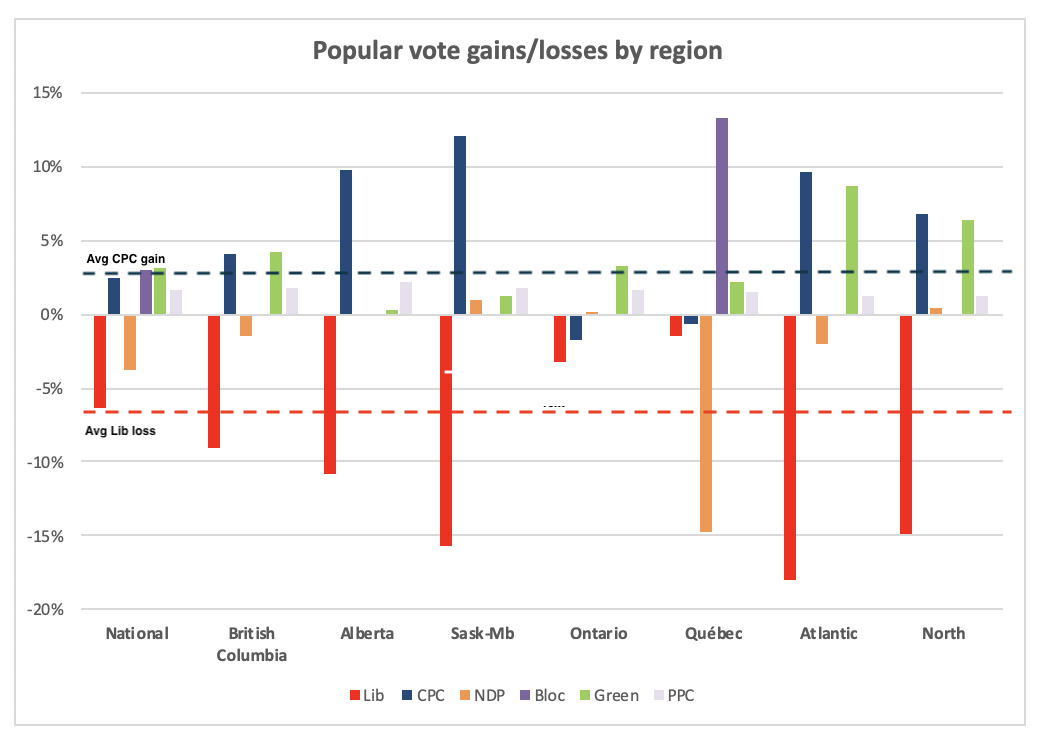
How did the votes get distributed on election night? Nationwide, the Liberal vote share declined by 5.6% compared to 2015, while Conservative vote share increased by 2.5%. NDP vote share decreased by 3.8%, while the Greens increased 3.1% (this is counter-narrative). The Bloc increased 3% nationally, translating to a 13.2% boost in Québec, and the Peoples Party, new to the scene, carved out 1.6%.
How the parties rose and fell varied on a regional basis. The Liberals went down in every region, in terms of popular vote. However, their losses were lowest in vote-rich Ontario and Québec. They suffered a decline in their popular vote by over 15% on the Prairies, where they only elected 5 seats in 2015. They also suffered an 18% decline in the Atlantic, but because they were so dominant in 2015, they had a buffer which allowed them to retake 26 of 32 seats.
Conservative gains were disproportionately higher in Alberta and Saskatchewan, where they already had a near dominant position. Significant gains were made in B.C. (4 point increase) which allowed for a six seat gain. A ten point gain in the Atlantic helped deliver four new seats but they were climbing out of a big hole and needed more in order to harvest bushels of seats. In Central Canada, Conservative popular vote declined, down 1.8% in Ontario and 0.7% in Québec. To get from opposition to government, you can’t give up ground in the two provinces that combine for 199 seats.
Therefore, for the Conservatives, seat gains were modest. Of the 22 newly acquired ridings, seventeen were west of Ontario: seven in B.C., four in Alberta, six in Saskatchewan-Manitoba. Of the remaining five pick-ups, four were in the Atlantic and three were in Ontario, offset by the loss of two seats in Québec.
Liberal losses were spread fairly evenly. They gave up 27 seats, compared to the 2015 election, but lost no more than six in any region (B.C. and Atlantic). The key to victory was only losing a net of one seat in Ontario, where they had a very strong showing in 2015. Their Québec losses were lower than what they gave up in the Atlantic.
The storyline as it relates to the Greens and the NDP is interesting. Much was made of NDP momentum and the Greens blown opportunity. And it’s true.
However, the NDP momentum was relative to their abysmal standing in the polls at the outset of the campaign. When it was all said and done, the NDP lost a significant share of its popular vote, based mainly on it being decimated in Québec. It made no headway in Ontario, where its leader is originally from and previously elected in the Ontario legislature. Wasn’t the business case for Jagmeet Singh that – to offset losses in Québec – he could win in the suburbs of Toronto and Vancouver and broaden the base in the rest of Canada? Didn’t happen. Outside Québec, Singh’s share of the vote (17.5%) was lower than Tom Mulcair’s (17.9%).
The Greens on the other hand can see some encouragement in the wake of a hollow election night. Yes, they had a golden opportunity on Vancouver Island, which passed them by. They did, however, make significant popular vote gains in B.C. and the Atlantic, far surpassing the NDP in New Brunswick and P.E.I. While the NDP went down 3.8% nationwide, the Greens went up 3.1%. Again, it was a disappointment based on expectations, but in the long-run, it is a step forward.
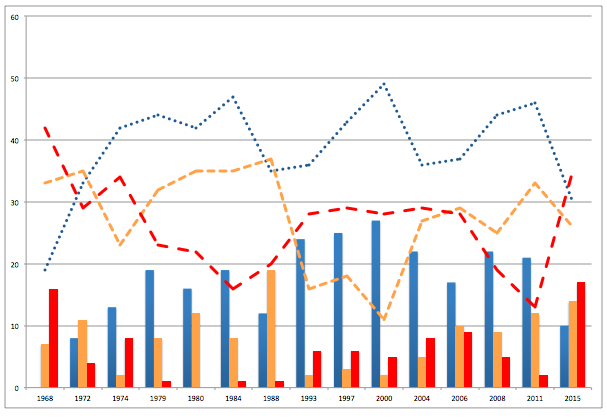
As these graphs show, there was really only one leader who excelled at regional math on election night: Yves-François Blanchet.
It’s not uncommon in Canada to have a party with the most seats have fewer votes than another party. But the 2019 election will be the first time the governing party was elected with less than 34% of the popular vote. Justin Trudeau’s 33.1% is the new low, falling beneath John A. Macdonald’s 34.8% from Canada’s first post-Confederation election in 1867.
Justin Trudeau’s minority win is much lower than other minority wins we have seen over the past sixty years. Joe Clark’s government came to power in 1979 after winning a plurality of seats with 35.9% of the popular vote, over 4% lower than Pierre Trudeau’s Liberals.
Aside from Justin Trudeau and Joe Clark, other prime ministers and parties that had more seats, but fewer votes:
1896 – Wilfred Laurier Liberals lost popular vote by 7 points to Charles Tupper’s Conservatives
1926 – William Lyon MacKenzie King’s Liberals lost popular vote 43% to 45% for Arthur Meighen’s Conservatives
1957 – John Diefenbaker’s Progressive Conservatives had 39% compared to Louis St. Laurent’s Liberals 41%
Then there is MacKenzie King who had fewer votes and fewer seats in 1925, but continued to govern thanks to the Progressives which held the balance of power. That could have happened following October 21st had Scheer won more seats, but fallen short of a majority.
So, that’s where the Trudeau Liberal win on October 21st fits in the context of Canada’s electoral and parliamentary history. It’s not a majority and it’s underwhelming in terms of popular support. With the lowest popular vote since Confederation to form government, the Trudeau Liberals can reflect on how it approaches governing where two-thirds of the electorate voted for other parties.
It could be a long night. Results will be coming in rapid fire from Cape Breton to Cape Scott. How to make sense of it all?
Here are five charts to help you follow along on election night.
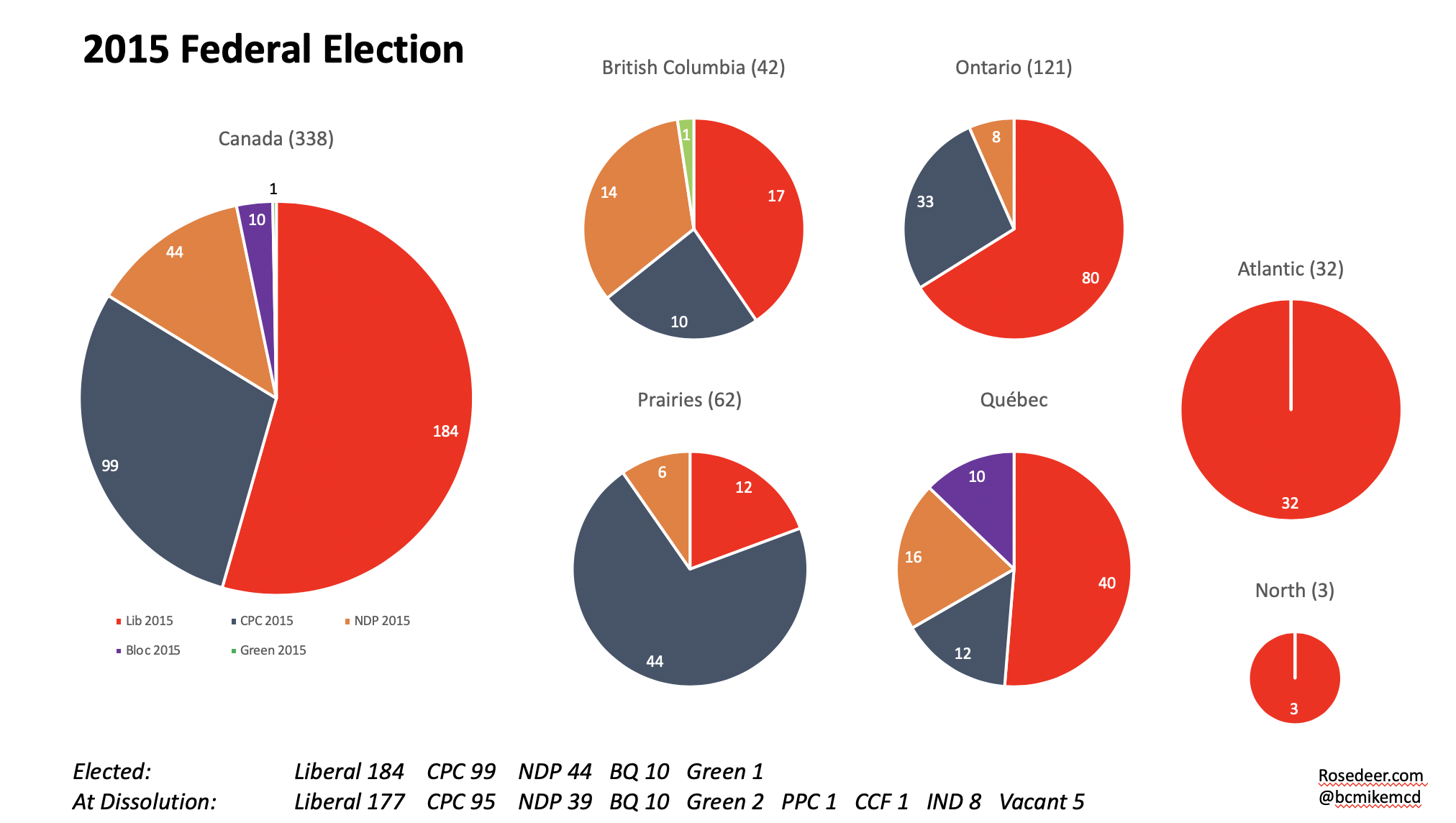
Chart 1: 2015 federal elections results by region
In 2015, Justin Trudeau’s Liberals took 184 of 338 seats – a majority is 170. As the chart above shows, the Liberals swept the Atlantic and North (35 for 35), took a majority in Québec, two-thirds of Ontario, and a bigger slice than usual on the Prairies and B.C.
Winning 160 seats is a ‘stretch goal’ tonight, and if Andrew Scheer’s Conservatives pull it off, it will likely be because they won three-quarter of the seats from B.C. to Manitoba, and took at least half of the seats in Ontario.
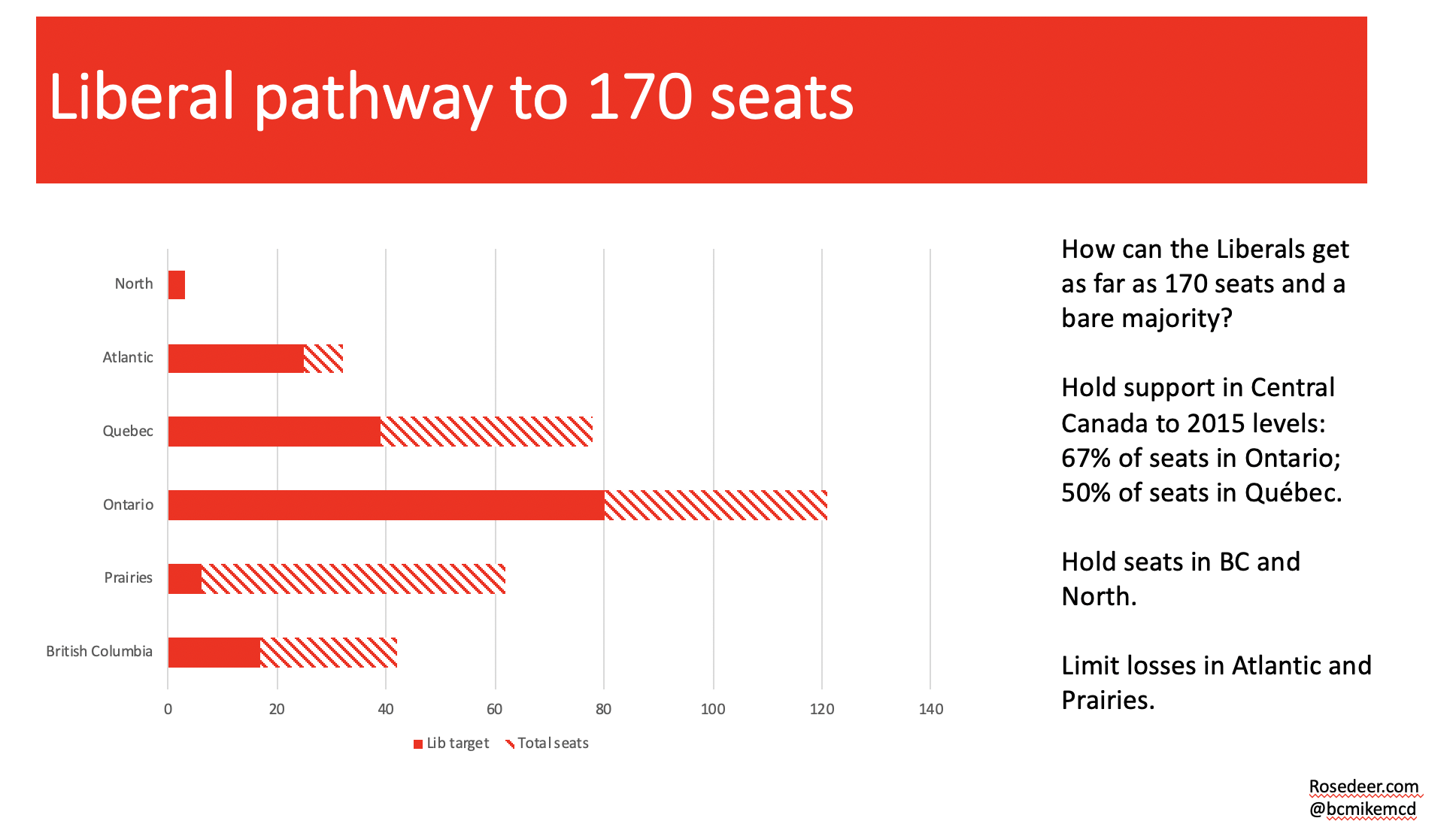
Chart 3: Liberal pathway to a majority
No one is really talking about the prospect of a Liberal majority and appears quite unlikely unless there is a last minute surge. I looked at the ways Liberals have won in the past. A minority may look like Paul Martin’s win in 2004, but if they come close to, or pull off a majority, it may look like this:
Hold support in Central Canada
Limit losses in Atlantic Canada and the West to about 12-15 seats
Chart 4: the ‘over-under line’
No party has won a majority government with less than 38% of the popular vote. It’s not impossible, but it hasn’t happened yet.
No party has won a plurality of seats in past 60 years with less than 35% of the vote. Perhaps tonight is that night.
The first campaigns of Pierre Trudeau and Justin Trudeau were the high water marks for Liberals in British Columbia between 1968 and 2015. During most of that time, the leading conservative party had the plurality of seats, with two NDP exceptions. Will the Liberals be able to hold 2015 gains tonight? Will the Conservatives return to historic patterns? Will the NDP hold its own and surge to a plurality in B.C.? Will the Greens add to their current tally of two seats? And what about JWR?
It’s Vegas for political nerds. It’s one thing to read the polls, listen to your gut, and have a prediction. But what about putting hard-earned, cold cash on the line? That’s exactly what UBC’s Sauder School of Business offers with their Election Prediction Market. You can invest up to $1000 to test your theories.
The prediction market has been taking place in one form or another since 1993. Here’s why they do it:
The exclusive purposes for conducting the prediction markets are teaching and research. Participants learn first-hand about the operation of a financial futures market and, because they have an added incentive to do so, learn more about the political or economic events associated with the contracts. As a research project, our markets generate valuable data that provide insights into market and trader behaviour.
There are four markets where you can bet:
Popular Vote Share Market
This is my least favourite as the bettors slavishly follow the latest poll results. Sometimes you will see some sentimental investing, but the results basically mirror poll aggregators. The payoffs aren’t great unless the pollsters are very wrong.
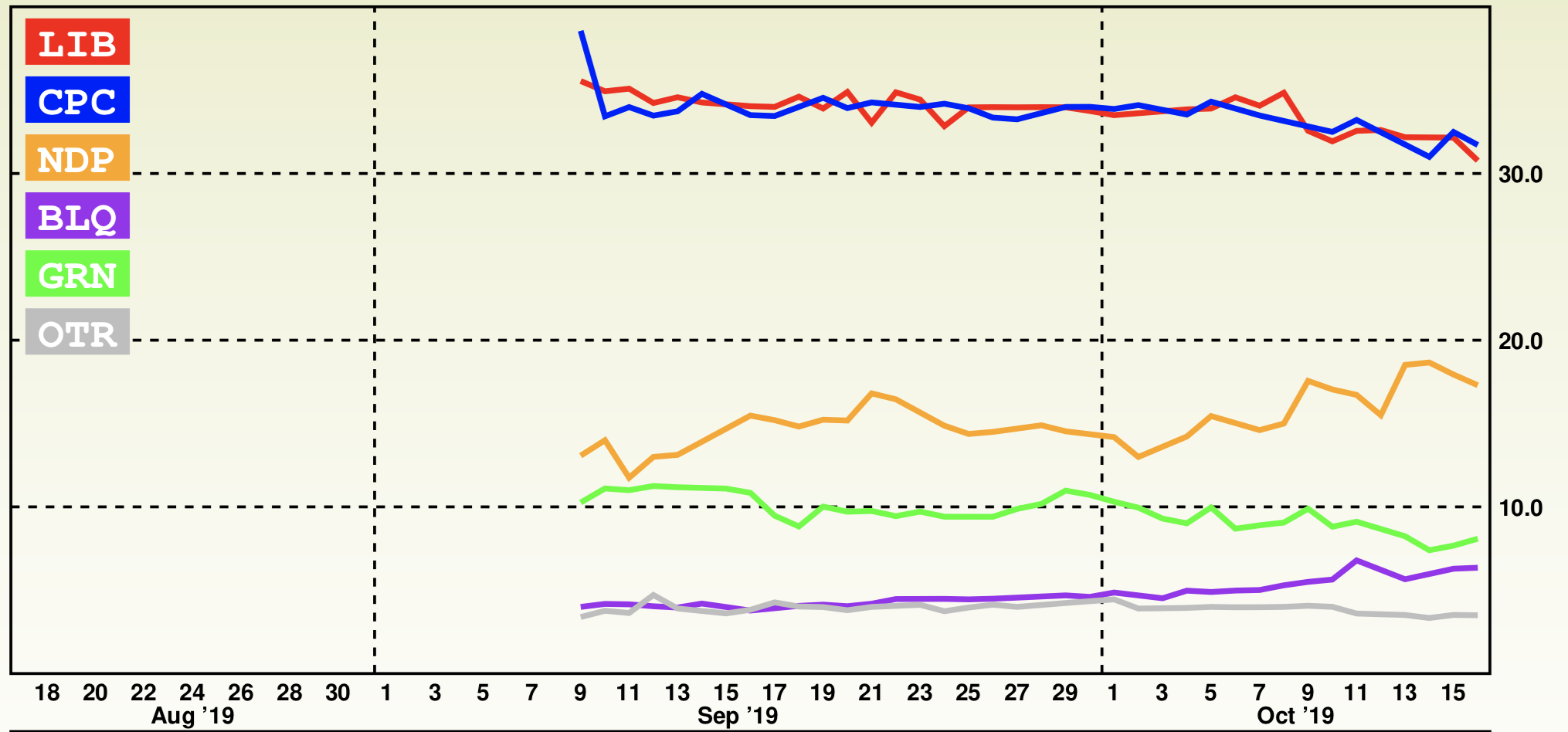
As the chart below indicates, the betting lines have closely mirrored public opinion during the writ period. In the past 7 days, the Liberals have traded at a high of 33.69% and the Conservatives peaked at 33.88%. The NDP fever crested at 18.98%, but miserly traders currently peg them at 17.54% (no more Jagmentum, says the market).
Seat Share Market
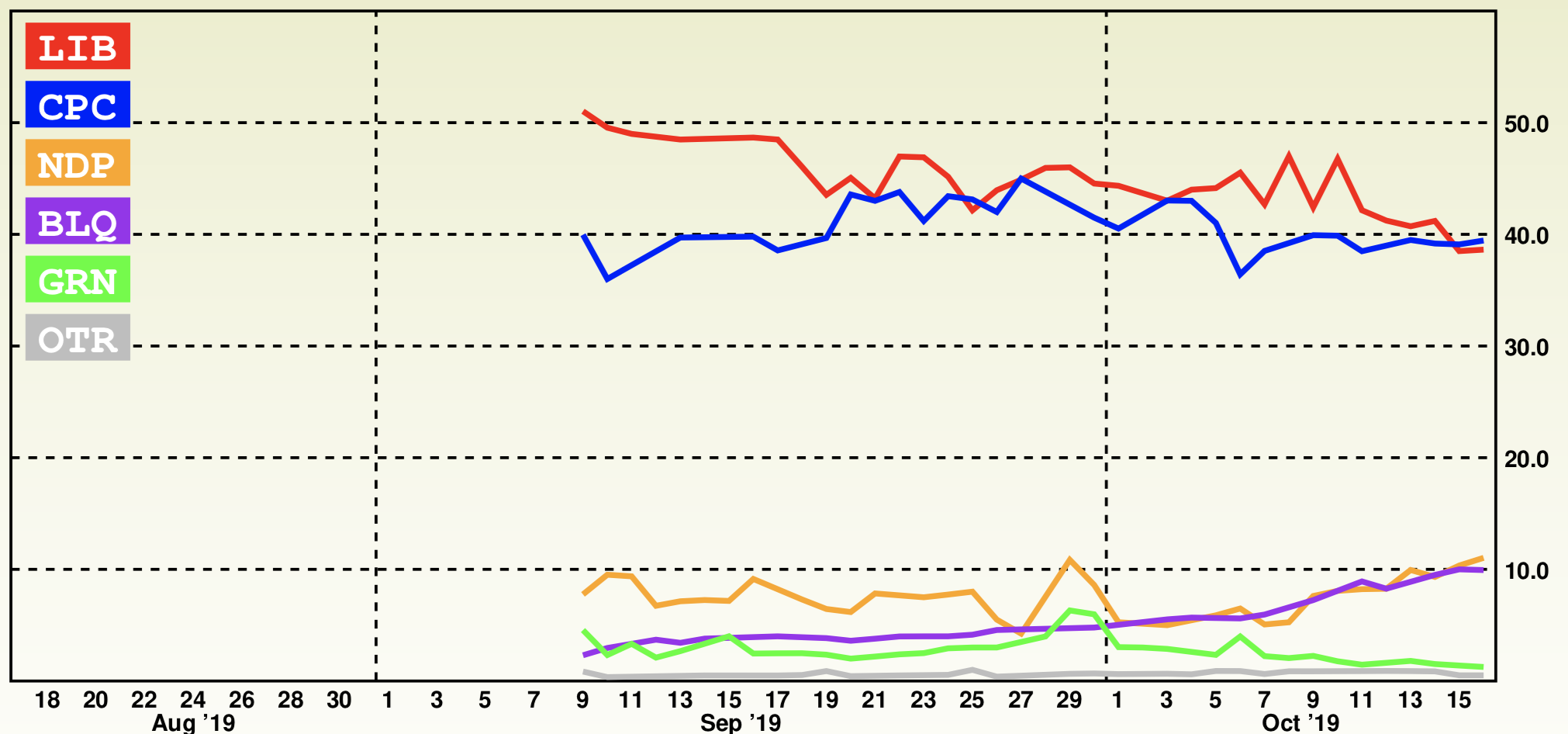
This one is more interesting and has more volatility. Right now, the market has the Liberals and Conservatives both at about 39 cents, based on 132 seats each in the House of Commons. There is likely some betting upside for one of the parties.
The NDP are trading at 11 cents, which translates to 37 seats. This seems high. If only I knew how to short sell. The Bloc Québécois comes in at 10 cents or 34 seats, while the Greens are a penny stock (1.25 cents), translating to 4 seats. It’s depressing when an historic breakthrough is only trading for a penny! They don’t even make pennies even more.
This market has seen the NDP move from a low of 7 cents to almost 12 cents in the past week, while the Liberals have dropped from 47 cents to 39 cents.
Parliamentary Plurality Market
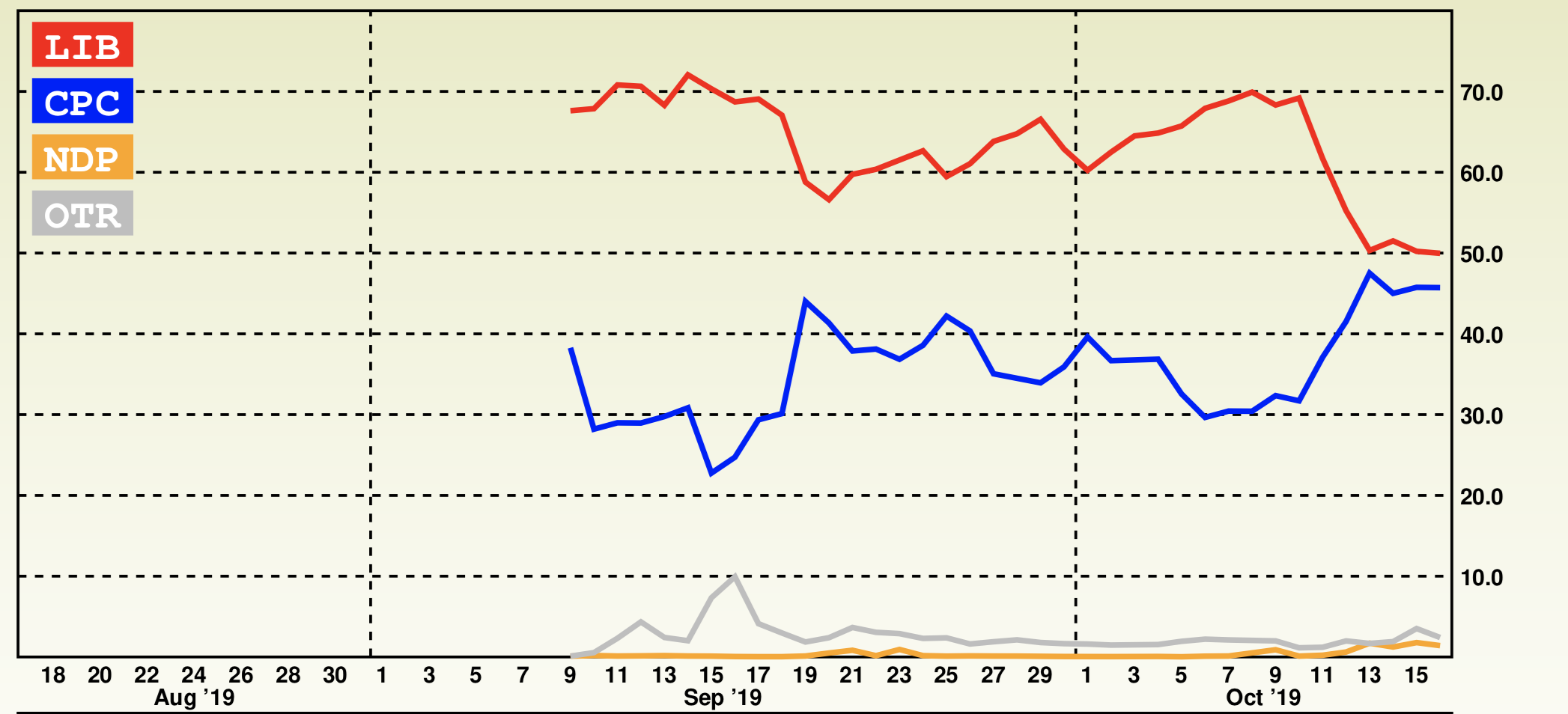
Now, here’s a place to make 2:1 on your bet. Only one party can win a plurality so it’s feast or famine. The Liberals have moved from 71 cents to 50 cents over the past week, while the Conservatives have moved up from 31 cents to 46 cents.
With the Conservatives and Liberals both in the 50 cent range, that’s a tidy payoff if you get it right.
Majority Government Market
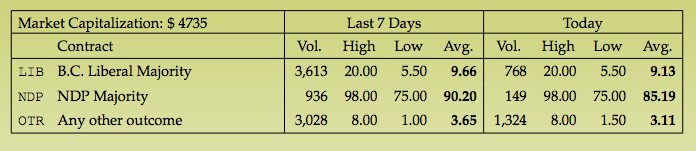
The market has moved away from a majority government during the writ period. Now, “any other outcome”, ie. minority government, is trading over 76 cents. Still, if you are convinced that is the likely outcome, it’s still giving you in the neighbourhood of a 30% return.
A Liberal majority is trading at 12 cents and a Conservative majority is trading at 10 cents. Wouldn’t it be nice to get an 8:1 or 10:1 return on your investment.
The market is moving all the time so be quick if you see an opportunity.
The OVERWHELMING CONSENSUS is that there will be a minority government. We know the Holy Trinity – public pollsters, pundits and political scientists – are never wrong and would never lead the market astray!
Uh, so this was the 2013 BC election prediction market:
I can tell you there was a very sweet payoff. More than 10:1.
The prediction market at least proves one eternal truth. There is a sucker born every minute, 19 times out of 20.
Jaggernaut. Jagmentum. Jagmeet Singh has been the story of the campaign since the English-language debate – in English Canada – where the NDP, for most of its history, has won its seats.
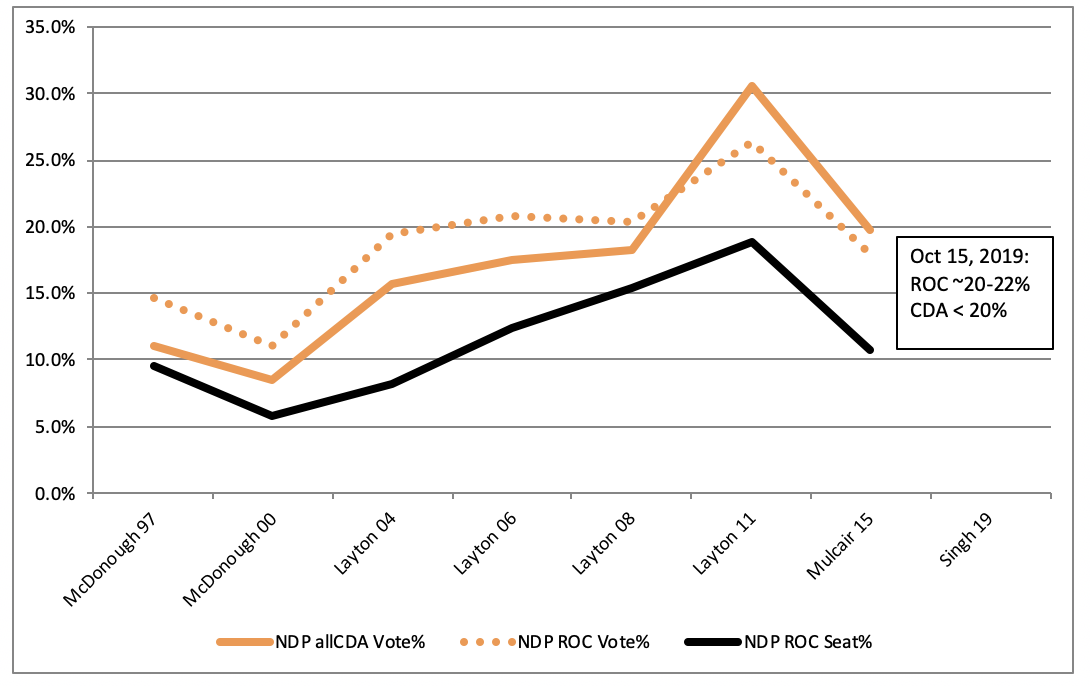
Until 2011, the NDP’s political game plan was all about Canada outside Québec – the rest of Canada (ROC). It has only won multiple seats in Québec twice – the previous two elections. Historically, NDP vote in ROC ran far ahead of its vote in Québec. But in 2011 and 2015, that equation changed, with NDP vote in ROC running behind the national number, because of NDP strength in Quebec.
Table 1: NDP popular vote and seat share (1997 to current poll estimates in 2019)
Layton’s Quebec surge of 2011 did not translate the same way in ROC. Even at its peak in 2011, the NDP was only at 26% of the vote in ROC, which translated into the NDP winning only 19% of ROC seats, running well behind the Harper Conservatives. Happily for the NDP in that election, 59 seats of the 75 seats in Quebec went orange, more than doubling their best-ever seat count in a federal election.
In 2015, the NDP plummeted in ROC from 26% to 18% – a lower level than all four of Jack Layton’s elections between 2004-2011, and resulted in only 11% of the seats from ROC. – half of those (14) were in British Columbia. The remaining seats were in Alberta (1), Saskatchewan (3), Manitoba (2), and Ontario (8).
Table 1: NDP by the numbers in Canada and ROC (1997-2015)
Jagmentum?
Clearly, the NDP leader has been the recipient of well-deserved positive media coverage since the English debate, and he has campaigned well throughout the writ period. How does it translate into seats?
In ROC, the NDP looks to be at or above where it finished the 2015 election under the leadership of Thomas Mulcair. However, they will likely lose all or almost all of their 16 seats in Québec. That’s a lot of seats to make up in ROC, especially when they are still a fair distance below the historic ROC highs of Jack Layton’s 2011 campaign (44 seats) and Ed Broadbent’s effort in 1988 (43 seats in ROC). In other words, to come out even in this campaign with 2015 (which was a disappointment that caused the resignation of Mulcair), Singh will have to pull off a record performance in ROC.
Even if Singh’s NDP pushed it to Laytonesque levels (26% in ROC), the NDP would still be far behind the major parties. As it sits right now, the NDP may be the fourth place party in the House of Commons behind the Bloc Québécois.
The more impactful consequence may be the NDP feasting on Liberal votes in suburban battlegrounds where the Conservatives stand to benefit. NDPers can also rightly assert that their rise may come at the expense of Conservatives in other places, such as the BC Interior where two NDP incumbents face tough re-election battles.
The campaign momentum is surely a welcome reprieve from the doom many NDPers feared. To their credit, the federal NDP has finally shaken off its extended phase of self-destruction and unsteady start of Mr. Singh. It was only four years plus a month ago that the NDP were on the very verge of power with Thomas Mulcair. Now, here they are celebrating momentum that will deliver, what, 30 seats? Singh’s comeback started with winning the Burnaby South by-election, and, now, the NDP has stabilized itself on a footing very consistent with its history, but a long way from what a 2015 pathway looked like: Quebec domination plus seats in all regions.
So, who is really cheering Jagmentum in the final week? Scheerly, you can figure that out.
If the Big Red Machine rolls to victory on October 21st, how will it be done? Regional seat balances have been like whack-a-mole this election. In this post, I look at examples of Liberal wins, and the regional coalitions they were based on, since the 1960s – and which of these scenarios Justin Trudeau’s Liberals might emulate this time. (See my recent post on Conservative pathways to power).
Will it be:
Lester Pearson’s near miss in 1965
Pierre Trudeau’s close shave in 1972
Pierre Trudeau’s Central Canadian Special in 1980
Jean Chrétien’s ‘Ontario, baby!’ win in 1997 (a model he used three times), or
Paul Martin’s missing majority in 2004
Or a repeat of the all-in majority of 2015?
Pearson 1965: the near miss
He loved baseball but couldn’t hit the home run in 1965
Lester Pearson won a minority in 1963, defeating John Diefenbaker’s minority government that was elected in 1962. The 1965 campaign was their fourth battle and Diefenbaker seemed out of gas. Pearson recruited three star candidates in Québec by the names of Pelletier, Marchand, and Trudeau. Despite boosting support there, Diefenbaker stubbornly clung to support in the rest of Canada (ROC), and rolled back Liberal support to some extent in the west and Atlantic Canada. The math came up a little short with Pearson winning 49% of the seats (131 of 265). Tommy Douglas’s NDP held the balance of power along with the Social Credit/ Créditistes. Pearson won almost three-quarters of Québec, a majority in Ontario, but did poorly in the West.
Won big in Quebec, majority in Ontario, but lost badly in the west
PET’s close shave in 1972
Land was Strong, but campaign wasn’t
Pierre Trudeau’s first win was in the height of Trudeaumania in 1968. He won two-thirds of the seats in B.C. along with a strong showing in Central Canada. By getting more out of the west, he had done what Pearson couldn’t do – win a majority.
The mood soured by 1972. In the rematch with Progressive Conservative leader Robert Stanfield, Trudeau’s Liberals were very much on the back foot, and reduced to 38% of the vote and 109 seats in a Parliament of 265 members. The Liberals sunk below thresholds that Pearson had won with in 1965, scraping by with a two-seat margin over the PC’s because of its strength in Québec where they won over half of their seats (56).
Won big in Québec, lost majority in Ontario and Atlantic, lost badly in the west
PET’s Central Canadian Special in 1980
In his fifth and final election campaign, Pierre Trudeau drove the Central Canadian Special right down the gut of Canada’s electoral map, winning a majority with 147 of 282 seats (52%). He took 99% of the seats in Québec and a majority of seats (55%) in Ontario. He had a little help from the Atlantic too, where he had a better result (59%) than the previous two examples. In the west, the Liberals were virtually extinguished, winning two seats in Manitoba. Nuttin’ in BC, Alberta, or Saskatchewan. Blanked in the North as well.
Dominated Québec, majorities Ontario and Atlantic, nowhere in the west
Jean Chrétien’s ‘Ontario, baby!’ in 1997 (and 1993 and 2000)
“Ontario was really good to me, like really really really good”
In his first re-election campaign, Jean Chrétien’s Liberals took 155 of 301 seats for a majority. It was not the mandate that Chrétien received in 1993 but it was still a majority. No party has ever relied upon one region so thoroughly as the Liberals did in this campaign – Ontario – where they won 101 of 103 seats. Ontario accounted for 65% of the Liberal Caucus. This was due to a stubborn vote split where the PC’s and Reformers played chicken with the Liberals coming out on top. Even the NDP couldn’t figure out how to steal some seats from the the wily Shawinigan fox in Ontario. Unlike PET and the Central Canadian Special, Chrétien only won about one-third of the seats in Québec, and also failed to win a majority of seats in the Atlantic and the west, though he had a much stronger showing in the west and north than PET did in 1980. Chrétien’s Ontario, baby! formula was entirely based on the opposition’s lack of unity. Though it worked three times, it was not sustainable.
Dominated Ontario, got enough from Québec, Atlantic, and west to reach majority
Paul Martin’s missing majority in 2004
And now the opposition gets organized?!
Paul Martin looked like an unstoppable force when he won the Liberal leadership in 2003 but he was bedevilled by lingering scandal from the decade-old Liberal government. New Conservative leader Stephen Harper chipped away, as did new NDP leader Jack Layton. The opposition was now much stronger than the Chrétien years.
Martin did better in the Atlantic and came in about the same in the west as Chrétien, but he could not replicate the Ontario dominance and fell a bit in Québec. Losing 31 seats in Central Canada cost him the majority. Under any other circumstance, winning 70% in Ontario would be a huge accomplishment but it wasn’t the 98% that Chrétien had, and he couldn’t make those seats up in other regions.
Strong majority in Ontario and Atlantic, weak in Québec and the west
Justin Trudeau’s all-in majority in 2015
Justin Trudeau’s majority in 2015 (54% of seats) was unlike these other examples. It was much more balanced than his father’s majority in 1980 – not as dependent on Québec and much stronger in the west, winning almost 30% of the seats there (the most of any example discussed). Justin won two-thirds of the seats in Ontario, half in Québec, and 100% in Atlantic Canada. There were no glaring regional weaknesses. Of all the examples, this was the most regionally representative.
Strong majority in Ontario, dominant in Atlantic, majority in Québec, competitive in west
Chart 1: Results from six Liberal wins (popular vote %, and seat %)
What it means for Justin Trudeau, this time
The examples discussed demonstrate that you can win by utterly dominating a large region, as PET did in 1980 and Chrétien did in 1993, 1997, and 2000. However, if there’s not domination, there must be some regional balance. Justin Trudeau’s pathway is regional balance.
It looks like it will be very difficult to replicate the regional strength he had in 2015. Seats will be given up in the Atlantic. The Bloc Québécois is a stronger contender this time making it difficult to hold 40 seats (not impossible). The likely pathway to victory is a strong majority of seats in Ontario and Atlantic, bolstered by getting enough seats out of Québec and the west to win a plurality. Without regional dominance, it depends on broad popular support, which works on a rising tide, but can be fatal when the tide goes out. The Liberal 2019 position looks very similar to the regional shape of Paul Martin’s 2004 results. It does not look like 1972 when PET nearly lost his first re-election bid. Justin Trudeau is much stronger in ROC, but weaker in Québec than his father. The final week will show if the Liberals can stay on a pathway to victory. Like the Conservative pathway, it is not an easy one.
British Columbia will be fascinating to watch on election night. As advance polls open, there has been a struggle between the Liberals and Conservatives to emerge as a clear leader, while the NDP appear to be on the move post-debate. The Greens maintain a strong presence on the Island that could be converted into a bushel of seats.
When you see these poll numbers bouncing around, how do they convert to seats? I thought it would be ‘fun’ to play with numbers today.
Four parties (and an independent) in the hunt for seats in BC. It’s that close, it seems.
In ‘BC Battleground’, I wrote about the key regions. In particular, the Lower Mainland outer suburbs and Vancouver Island are very volatile.
A political sniffle can lead to an electoral coma for parties mired in three and four way battles.
When we forecast results, they are based mainly on the result of the last election, adjusted to potential 2019 scenarios. When it’s all said and done, the seats normally follow a similar pattern. The ranking of seats, party by party, doesn’t usually shift that much from election to election (a party’s best and worst seats tend to be consistent, such as the NDP in East Van, CPC in Peace River, or Liberals in Quadra). Over time, yes, coalitions shift and parties evolve, winning in places that are new, and losing in places that used to be strongholds. That pattern usually takes a few cycles.
Assuming patterns are fairly consistent to 2015, we can look at how seat totals might play out based on popular vote. This does not take into account special local factors.
Reminder that in 2015, the seat totals in BC were:
17 Liberal
14 NDP
10 CPC
1 Green
Scenario 1: Three-way tie, with Greens trailing in fourth
CPC
Lib
NDP
Green
Vote%
26.5%
26.5%
26.5%
16.0%
Seats
12
13
16
1
Despite the three-way tie in popular vote, the NDP has an efficiency advantage, mainly based on winning, like they did in 2015, six of seven seats on the Island with about one-third of the vote.
Scenario 2: Top 2 CPC and Liberals, NDP third, with Greens trailing in fourth
In 2015, the Liberals won popular vote in BC by 5.5%. This scenario has the CPC tying the Liberals, with NDP trailing by about same amount as 2015.
CPC
Lib
NDP
Green
Vote%
28%
28%
23%
16.0%
Seats
14
14
12
2
Both Conservatives and Liberals vote breaks evenly into seats with NDP punching above its weight due to the Island.
Scenario 3: CPC lead over Liberals, NDP third, Greens trailing in fourth
If the Conservatives take a 4-point lead over the Liberals, the math starts to move.
CPC
Lib
NDP
Green
Vote%
30.0%
26.0%
23%
16.0%
Seats
17
11
12
2
Seat pick ups increase in the outer suburbs of Vancouver for the Conservatives, levelling that region which the Liberals dominated in 2015. The Liberals would hold most of their Vancouver-urban core seats.
Scenario 4: Liberals lead Conservatives, NDP third, Greens fourth
Scenario 3 is flipped to a Liberal 4-point lead, holding the NDP and Greens constant.
CPC
Lib
NDP
Green
Vote%
26.0%
30.0%
23.0%
16.0%
Seats
10
17
13
2
Scenario 5: NDP falters, Greens rise
The previous four scenarios have the Green constant at 16%. This scenario moves them to 20% and the NDP to 22%.
CPC
Lib
NDP
Green
Vote%
27.0%
27.0%
22.0%
20.0%
Seats
14
14
10
4
The Island is very dynamic in terms of vote splits. If the Greens rise over there (with 20% province-wide indicating a popular vote on the Island of over 35%), then NDP seats fall to the Greens, at least on the Lower Island.
Scenario 6: One party blowout
It would take a 10%+ lead in the popular vote for any one party to grab 50% of the seats (21 seats).
Blue crush
CPC
Lib
NDP
Green
Vote%
35.0%
24.0%
22.0%
15.0%
Seats
22
9
9
2
Big red machine
CPC
Lib
NDP
Green
Vote%
24.0%
35.0%
22.0%
15.0%
Seats
5
23
12
2
Jagmentum
CPC
Lib
NDP
Green
Vote%
24.0%
24.0%
33.0%
15.0%
Seats
9
11
21
2
Green armageddon
CPC
Lib
NDP
Green
Vote%
15%
15%
15%
50%
Seats
0
0
0
42
I mean, isn’t Green armageddon just inevitable? Who doesn’t want unicorns and rainbows?
Local factors
The seat modelling ignores that Paul Manly won the Nanaimo-Ladysmith by-election for the Greens, that the Conservatives fired their Burnaby-North Vancouver candidate, that the Liberals fired candidates in Victoria and Cowichan last election, thus lowering their base for this model. It also does not account for a candidate by the name of Jody Wilson-Raybould. So, yes, local factors can confound the model, but the model overall speaks truth. Due to our system, the votes have to land somewhere. When you see fortunes rise and fall in the polls, the seats will follow.
It seems that close. We’ll see which scenario prevails.







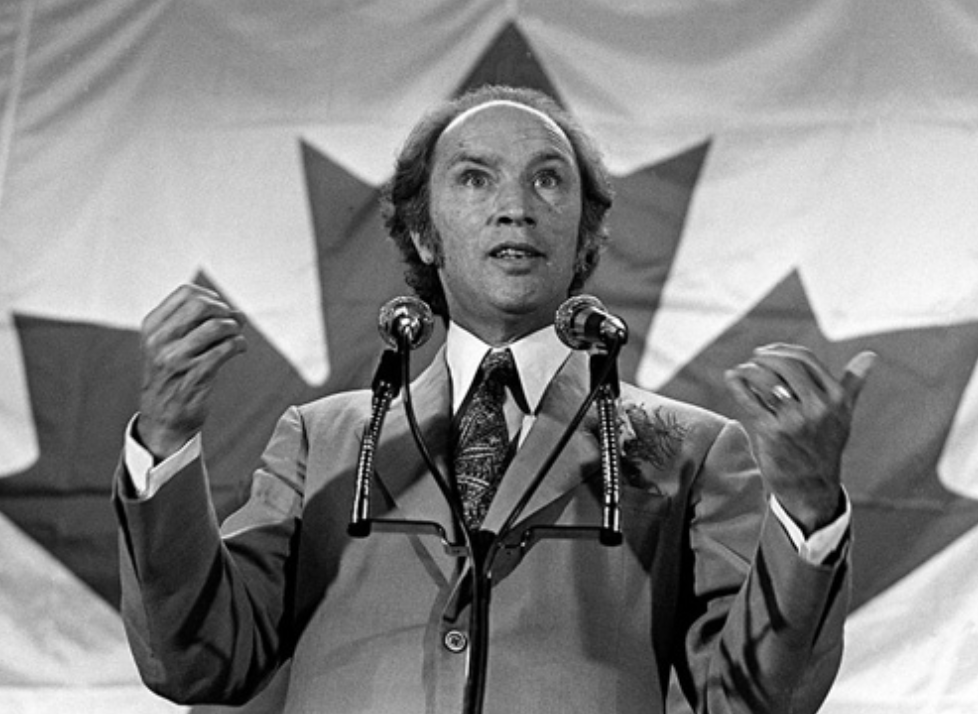
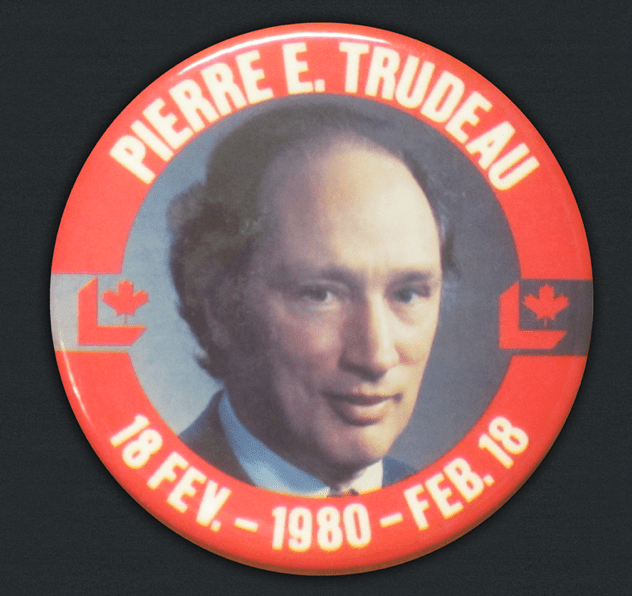 In his fifth and final election campaign, Pierre Trudeau drove the Central Canadian Special right down the gut of Canada’s electoral map, winning a majority with 147 of 282 seats (52%). He took 99% of the seats in Québec and a majority of seats (55%) in Ontario. He had a little help from the Atlantic too, where he had a better result (59%) than the previous two examples. In the west, the Liberals were virtually extinguished, winning two seats in Manitoba. Nuttin’ in BC, Alberta, or Saskatchewan. Blanked in the North as well.
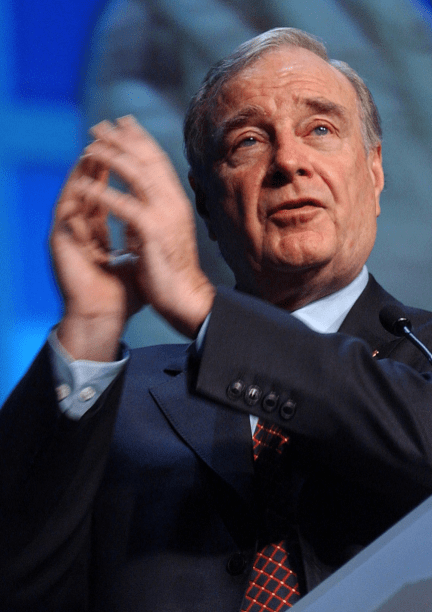

 The examples discussed demonstrate that you can win by utterly dominating a large region, as PET did in 1980 and Chrétien did in 1993, 1997, and 2000. However, if there’s not domination, there must be some regional balance. Justin Trudeau’s pathway is regional balance.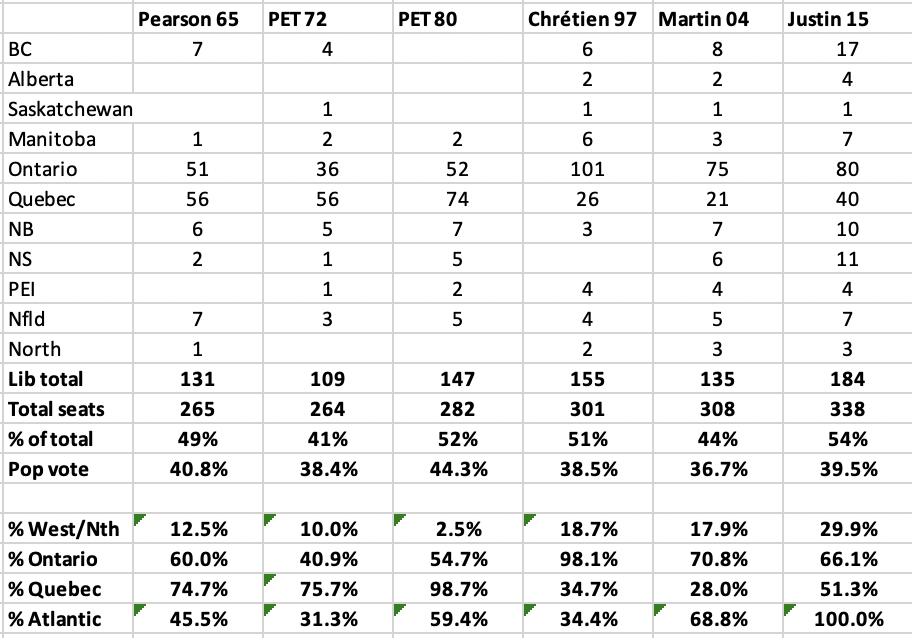
 Rosedeer