When it comes to Leaders, BC is “Barely Chosen”

The Conservatives will be electing a new leader prior to the next federal election and, who knows, maybe the NDP too.

When it comes to electing Leaders, BC might as well stand for “Barely Chosen”.

I recently wrote on BC’s place in Cabinet since Confederation.  Now, I’ve turned my attention to our place at the head of the table.

In Canada’s history, I count 58 people who have led one of the contending national parties – Liberal, Conservative (including PC, Reform, Alliance), and CCF/NDP.  Only 23 became prime minister.

Of those 58, I count only three British Columbians among them.

Rt. Hon. Kim Campbell remains the only BC-born and raised leader to win a national leadership among the three major parties since parties (not caucuses) began electing leaders.

Not many British Columbians have their painting hanging in the Parliament Buildings

For the purpose of my analysis below, I’m designating John Turner as a British Columbian too.  Well, he has to belong somewhere, and given that he spent his early years in Rossland, was a star student and athlete at UBC, and sought election in Vancouver-Quadra twice as a Leader, I claim him as a British Columbian.  Aside from Campbell and Turner, BC’s performance in national leadership races has been very spotty.

Hold on, we do get in the back door sometimes.  Hon. John Reynolds served as Leader of the Opposition for the Canadian Alliance when Stockwell Day stepped down.   By my math then, three British Columbians have served as Leaders (elected or otherwise) in the past 148 years.

Then there are some on the bubble.  Stockwell Day?  He has as much claim to being a British Columbian perhaps as John Turner.  He spent some his early years in BC and represented BC ridings as leader, yet for the purpose of this analysis, I’m classifying him as Albertan given that he was fresh from serving in the Alberta Cabinet.  He might quarrel with that.

Deborah Grey also spent early years in BC, is related to former BC Premier Boss Johnson, and lives in BC now.  She served as Leader of the Opposition, in between Preston Manning and Stockwell Day.  But she was clearly representing Alberta at that time.

Liberals in BC might claim Justin Trudeau with his BC grandparents and work experience in the province, but you would have to put him in the Quebec column.

Then there’s John A. who represented Victoria for four years as prime minister, but, look, since he hadn’t built the railroad yet, he didn’t even see his riding so, no, he doesn’t count.

I’m tempted to add the federal Social Credit into this analysis to pump up BC’s numbers.  They had an interim leader from BC in the 1960’s.    Maybe the Greens should be considered too, but let’s stick to the major parties.  I don’t have all day here, and neither do you.

Therefore, that’s three leaders from BC, none elected in a general election as Leader.  That compares to 17 leaders from Ontario, 13 leaders from Quebec, 7 from Alberta and Nova Scotia.  The Yukon is breathing down our neck with 2 leaders.

When the time a BC Prime Minister has been in office compared to other provinces, it’s a bit humbling.   BC is at < 1 year combined (Turner and Campbell) while Quebec is 60+ years and counting.  Our neighbour, Alberta, has had three elected prime ministers elected totalling about 15 years.

Some might argue this type of analysis is pointless since national leaders embody more than their home-province.  In some cases, they are very much pan-Canadian and hard to peg regionally.  However, history does illustrate the challenge facing BC-based leaders.

The focus of this piece is regional, but it’s important to note that only 5 of 58 leaders have been women.  Three were NDP – Audrey McLaughlin, Alexa McDonough, and Nycole Turmel.  Two Conservatives: Kim Campbell and Rona Ambrose.  The Liberals have yet to elevate a woman as leader.

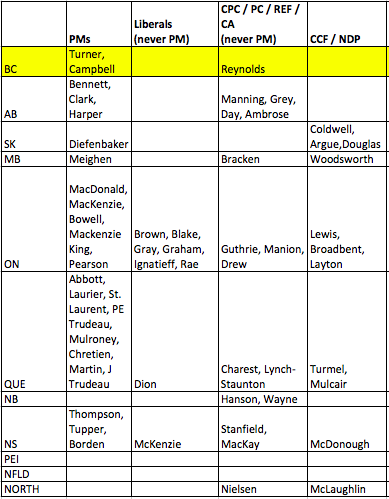
The following table shows the leaders (elected and interim) by province by parties.

Table 1: Leaders by party and province, as I see it:
Screen Shot 2015-11-13 at 1.25.03 PM

Did I miss any?   I bet you might be wondering who some of these people are that I have listed in the table above.  Some of the interim leaders are fairly obscure but, in their time, were important figures and judged by their colleagues to have the gravitas to lead their party in a troubled time, usually after death or a defeat:

  • Daniel MacKenzie from Cape Breton took over the helm of the Liberal Party upon Sir Wilfred Laurier’s death and contested the leadership against MacKenzie King, which he lost.  Hazen Argue acted as interim leader before losing a subsequent leadership convention to Tommy Douglas (Argue left for the Liberals shortly thereafter).
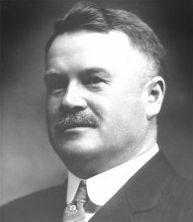
  • There’s Richard Burpee Hanson, a former Mayor of Fredericton and Trade Minister in the RB Bennett government, who served as interim leader after the Conservatives were trounced in the 1940 election.  Not exactly a household name.

    Richard Burpee Hanson: “I’m fading into history much like this photo”

    He gave way to the comeback-kid Arthur Meighen when he returned to national politics after serving as PM twice in the 1920s.  But Hanson had to stick around longer when Meighen lost a by-election, ending his brief return.  New Brunswick’s other leader, Elsie Wayne, also served as an interim when Jean Charest left the post of PC leader to lead the Quebec Liberal Party.

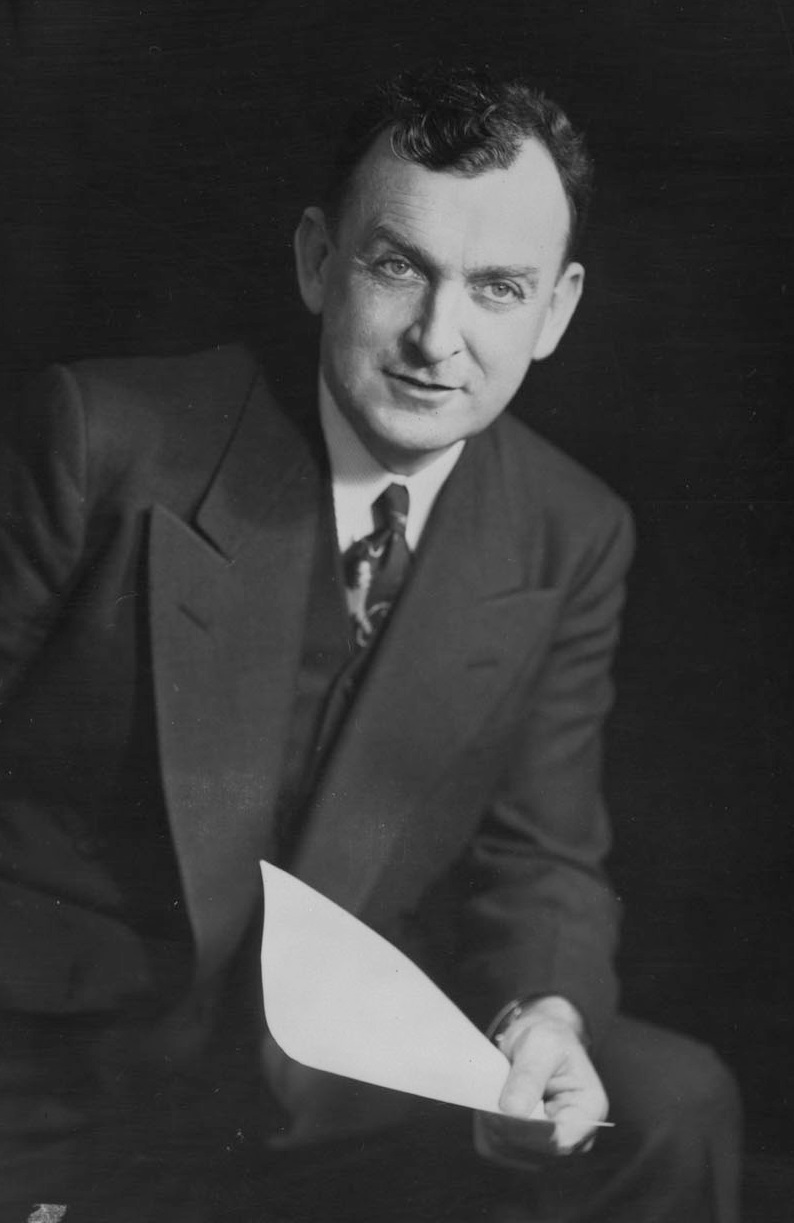
My brother was Leader ???

  • Erik Nielsen (“velcro lips”) was the first leader of a major political party from the North and was also a major force in the early years of Brian Mulroney’s government.  He was the brother of famous actor Leslie Nielsen (if you’re a Millennial, go see Airplane).

Rona Ambrose joins this illustrious list.  She may not be there for a long time but she has her job to do, as did recently Bob Rae, Nycole Turmel, and John Lynch-Staunton (whoever he is).

Leaving aside historical footnotes, when you look at leadership conventions, not only is BC’s winning percentage quite miserable, the lack of participation by BC candidates also stands out, at least in Liberal and Conservative races.  With the NDP, British Columbians keep running … and keep losing.

The Liberals

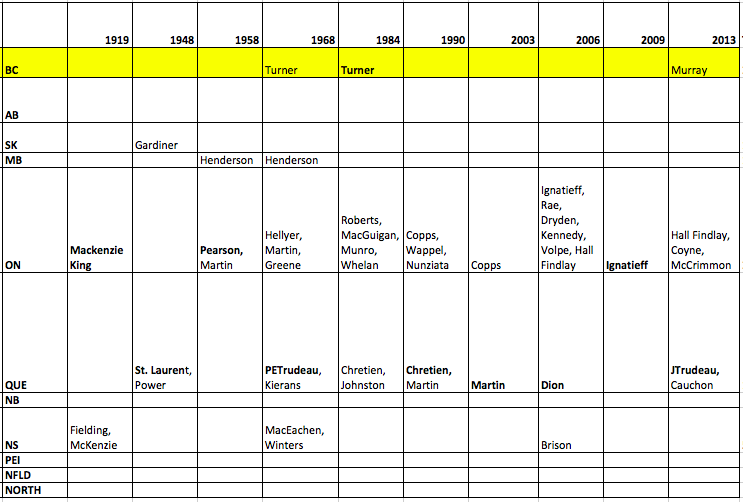
The BC story is not very compelling when it comes to the Liberal Party of Canada leadership races.  Again, I’m counting John Turner and he accounts for 67% of all BC candidates in the past 148 years.  Joyce Murray is the other in 2013.  That’s three candidates over 10 leadership races totalling 47 contestants.  Well, it could be worse.  Alberta Liberals haven’t found a way to show up at all.  Neither has New Brunswick, PEI or Newfoundland, despite viable leadership candidates over the years like Frank McKenna, Brian Tobin, and Joe or Rob Ghiz.

Table 2: Candidates listed by province for each Liberal convention (winner in bold)
Screen Shot 2015-11-12 at 3.39.50 PM

For a long time, the Liberals just didn’t have many conventions because their leaders were successful.  MacKenzie King served for 29 years !  He fended off two Nova Scotians in 1919 and never looked back.  Laurier lasted even longer – 32 years!  Aside from the interregnum after Laurier’s death, Laurier and MacKenzie King spanned over 60 years between them.  Incredible.

When WLMK finally retired in 1948, former Saskatchewan Premier Jimmy Gardiner sought the leadership losing to Louis St. Laurent.  Gardiner remains the strongest western candidate (other than Turner) to seek the leadership of the Liberals.

The elected Liberal leadership has been a story of alternation between English Canada (principally Ontario) and Quebec.  St. Laurent to Pearson to Trudeau to Turner to Chretien to Martin to Dion to Ignatieff to Trudeau.  Very few Maritimers or Westerners.  It’s the Upper-Lower Canada show.

In recent times, this reflects the woeful state of the Liberal Party in Western Canada from the mid 1970s to, basically, October 19th.  While there have been regional heavyweights like Lloyd Axworthy, their ambitions were thwarted, in part, by a lack of regional caucus colleagues and party infrastructure.  For many years, senators not MPs called the shot in western provinces for the Liberals.  That is not a good starting point for a leadership race.  John Turner, for all of his BC roots, drew heavily from his Bay Street and Montreal power bases.

Joyce Murray: representin’

Hedy Fry waved the flag in 2006, deciding to withdraw before the convention, choosing to endorse Bob Rae.

Joyce Murray finished second among six contenders in 2013, though Justin Trudeau walked away with over 80% support on the first ballot.  In both Fry and Murray’s case, they were putting a stake in the ground for British Columbia which no one, but for Turner, had ever done in the party’s history.

The Conservatives

This analysis encompasses the Conservatives, the Progressive Conservatives, the Reform Party, and the Canadian Alliance.  These are all parties that have governed or acted as the Official Opposition.

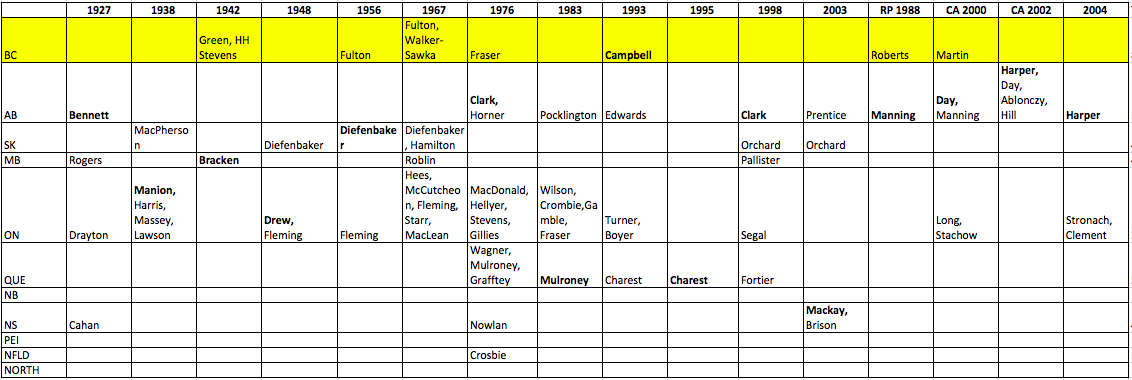
Table 3: Candidates listed by province for each conservative (all types) convention (winner in bold)
Screen Shot 2015-11-12 at 9.19.55 PM

Of the 16 leadership conventions among Canada’s conservative parties since 1927, there have been eight BC-based candidates – a much stronger showing by British Columbians than in Liberal races.  They make up 9 candidacies out of a pool of 75 contestants.

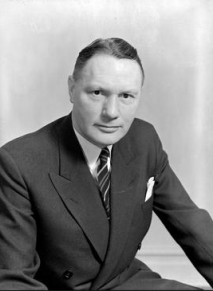
Howard Green: was said to walk the hallways with a Bible in one hand and a stiletto in the other

In 1942, two British Columbians challenged for the leadership, losing to incoming leader John Bracken from Manitoba.  HH Stevens had been a major force in RB Bennett’s government prior to a bitter break whereupon he led his own party – the isolationist Reconstruction Party – in the 1935 election, surpassing the fledgling CCF and gaining 8.7% nationally.  He split the vote in the process and decimated the Conservatives.  He won only one seat – his own.  Howard Green had a long career in Parliament ultimately serving as Minister of External Affairs under Rt. Hon. John Diefenbaker.  Both Stevens and Green were from Vancouver.

E. Davie Fulton from Kamloops challenged for the leadership twice, in 1956 against Diefenbaker and again in 1967, when he sought to succeed Dief.  He lost to Nova Scotian Robert Stanfield.  Fulton would serve as Justice Minister but returned to BC in an ill-fated stint as provincial Conservative leader where he was trounced by WAC Bennett.  In both conventions, he finished third and was probably BC’s best hope as prime minister material for decades.

Rt. Hon. John Diefenbaker and two-time leadership rival Hon. E. Davie Fulton

Fulton’s leadership runs deserve attention.  He was a national figure who, as Justice Minister, had attracted the best and the brightest.  A Catholic, and bilingual, he worked hard to develop support in Quebec.  As Minister, he unsuccessfully proposed the Fulton-Favreau formula to bring about the patriation of the Constitution.  In 1967, he had the support of future prime ministers Joe Clark and Brian Mulroney.  He was seen as a modern man when he lost to Diefenbaker, and perhaps missed his window when he lost in 1967, though still only in his early 50s.

Screen Shot 2015-11-12 at 9.35.32 PMAn interesting footnote from the 1967 PC convention was the candidacy of Mary Walker Sawka.  Not much is written about her candidacy but it appears she was a filmmaker from Vancouver.  Her candidacy was last-minute and she garnered two votes.  The Globe & Mail cruelly reported that Walker Sawka “looked like a housewife who had mistakenly wandered on stage while looking for a bingo game”.  She is the first BC woman to seek the leadership of a major political party.

Moving on to the 1976 PC leadership convention, Vancouver South MP John Fraser was one of 11 candidates seeking to replace Robert Stanfield.  Stanfield had three runs at prime minister, losing to Rt. Hon. Pierre Trudeau each time, once by a hair.

Fraser, at the time, was in his early 40s.  He lasted two ballots, finishing eighth, and bringing his support to Joe Clark.  Clark started that convention third with 12% of the votes on the first ballot and prevailed when he garnered down ballot support, leaping past Quebec frontrunners Claude Wagner and Brian Mulroney.  Fraser went on to serve as the senior BC minister in both the Clark and Mulroney governments, prior to becoming Speaker of the House of Commons.

British Columbians sat out the 1983 leadership tilt.  Many BC Red Tories stuck with Joe, while a lot of ‘young turks’ from BC supported Mulroney.

The BC branch was very united behind Kim Campbell in 1993.  Campbell had resigned her provincial seat mid-term in 1988 to run federally.  She had had enough of the Vander Zalm government and sought to replace Hon. Pat Carney.  She won Vancouver Centre (back when PCs could win in the urban core) and was appointed Minister of Justice.  She built a considerable profile and went on to serve as Minister of National Defence.

The Mulroney government was deeply unpopular in its second term.  Following its 1988 re-election on the strength of Free Trade, it brought in the controversial GST (which no government will remove now) and paid a heavy political price.  Layered on was the ongoing constitutional quagmire following the failure of Meech Lake in 1990.  The 1992 national referendum to approve the Charlottetown Accord failed badly and sealed Mulroney’s fate.

Unfortunately for successors, he did not leave a lot of time for a leadership convention in advance of a general election.  Five years were almost up.  While there was some early hopes for Campbell following her convention win over Jean Charest, her support wilted over the summer and fall.  She was annihilated by the Chretien Liberals, and with that, her leadership of the party ended.

For once, a BC born (Port Alberni) and raised politician had climbed to the top in a party’s leadership process.  While the outcome was clearly a disappointment for her, Rt. Hon. Kim Campbell remains the exception in 148 years of Canadian politics not only as a BC prime minister, but also as the only female prime minister.

Two more British Columbians round out the slate of those seeking the leadership of conservative parties.  Keith Martin from the Victoria-area sought the leadership of the Canadian Alliance in 2000, finishing back in the pack.

The other contender is a bit of a stretch.  Stan Roberts sought the leadership of the Reform Party against Preston Manning in 1987.  He didn’t make it to the ballot but he was instrumental in the formation of the Reform Party.  I’m including him because he was an interesting character.  A Liberal MLA in Manitoba.  A head of the Canadian Chamber of Commerce.  A VP of Simon Fraser University.  A candidate for the BC Liberal leadership in 1984, losing to Art Lee.  A federal Liberal candidate in Quebec in 1984 (unsuccessful).  And finally a contestant for the Reform leadership.  I will count him as a BCer for the purposes of this list.   We need all the help we can get.

Of the 16 total conventions across the conservative movement, Albertans have won 44% of them.  Rt. Hon. RB Bennett was first then a long wait until 1976 when Joe Clark won the PC leadership (and he would win it again in 1998).  Stockwell Day, Preston Manning, Stockwell Day, and Stephen Harper round out the list.  Alberta has had a strong run in modern times and possibly more to come.  Having Albertan Rona Ambrose as Interim Leader seems to be rubbing it in!

Unlike the Liberals, conservatives prefer to go outside Ontario and Quebec, only choose four of 16 from Upper/Lower Canada and not an Ontarian since 1948.

The CCF / NDP

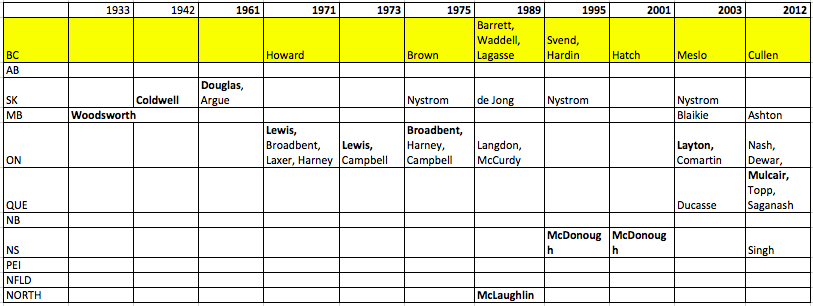
British Columbians have been a part of seven of eleven CCF/NDP conventions since 1932.  The first two leaders – JS Wordsworth and MJ Coldwell – were elected unanimously. (Technical point: I’m counting leadership challenges to incumbent leaders in 1973 and 2001).

Table 4: Candidates listed by province for each CCF/NDP convention (winner in bold)
Screen Shot 2015-11-12 at 10.28.07 PM

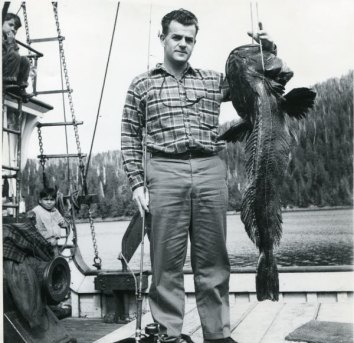
Frank Howard reels in 50 lb ling cod near Klemtu. He reeled in a lot of votes over the years too.

BC’s presence at CCF/NDP conventions starts with Frank Howard, a strong Trade Unionist who hailed from northwest BC and served as an MP for 17 years and, later, MLA from Skeena.

Howard’s story is a fascinating one and is recorded eloquently by Tom Hawthorn in Howard’s obituary.  He was a fighter who rose from “Cell Block to Centre Block” – an ex-con from the humblest of roots who fought hard for his constituents.  He would lose the leadership race in 1971 to David Lewis.

The 1975 NDP convention that elected Ed Broadbent was the scene of the strongest bid by a British Columbian to lead a major party, at that time.  Rosemary Brown, then an NDP MLA  from Vancouver, finished second with 41% on the final ballot.  The first Black politician to seek the leadership of a major party, Brown received many accolades after she retired from elected politics in 1986, including an Order of Canada and Order of BC.  She was also featured on a Canada Post stamp.

Ed Broadbent had a long run as leader, but when he left, British Columbians jumped in.  The 1989 convention saw three west coasters jump in: former BC Premier Dave Barrett, MP Ian Waddell, and grassroots member Roger Lagasse.  Barrett is the only BC premier to ever seek the leadership of a federal party.

A great read on Dave Barrett’s government, by Geoff Meggs and Rod Mickleburgh

Barrett was a strong contender, but lost to Yukoner Audrey McLaughlin.  McLaughlin had been elected in a by-election to replace “velcro lips” and had a different style than Barrett,  setting up a classic showdown. Of 2400 votes cast, only 80 separated the two on the first ballot and even fewer after the second ballot (Waddell and Lagasse dropped after the first ballot).  This convention had some candidates, including MP Simon de Jong, wearing an invisible mic.  To the consternation of many participants, CBC TV revealed the inner workings including backroom negotiations between de Jong and Barrett.  de Jong was heard to say, “Mommy, what should I do?”  He went to McLaughlin, who defeated Barrett 55% to 45% on the final ballot.  Another close call for a BC candidate.

Svend got a lot of media in his day

McLaughlin tanked in the 1993 convention, hampered by unpopular NDP governments in BC and Ontario.  Of the two remaining NDP MPs in BC, one was the brilliant yet polarizing Svend Robinson.  Svend – any observer in BC would know who you were talking about – was at the forefront of major issues concerning the environment, aboriginal rights, and right-to-die.  He also had a reputation as an excellent constituency MP.  In 1995, he was 43 years old but had already served 16 years in Parliament.   Herschel Hardin from Vancouver was also a candidate in the process.

The 1995 convention had an incredible outcome.  For the first time in NDP history, a British Columbian led after the first ballot.  Svend had 38% to Alexa McDonough’s 33% and Lorne Nystrom’s 32% (Hardin was part of the process but didn’t make it to the first ballot).

Svend sized up the result and decided that there was no way he could win.  In an unprecedented move, he withdrew from the race – despite leading – handing the leadership to McDonough.  And so went another BC leadership candidate.

The 2003 NDP convention that elected Jack Layton did not see a significant BC presence, with only grassroots member Bev Meslo offering her name.

Nathan Cullen: Next up?

In 2012, MP Nathan Cullen emerged as a contender through the course of the campaign, taking on favourites Tom Mulcair and past-party president Brian Topp.  Cullen rose from 16% to 20% to 25% on consecutive ballots but that’s where it ended.  He couldn’t make it past Brian Topp to get to the showcase showdown.

BC’s immediate future in leadership races

As NDPers ponder their fate and their future, they may well grant Tom Mulcair another chance.  He delivered more seats than any other leader except Layton, but clearly fell far short of expectations.  If he does move on, BC may well be in the heart of another national leadership race with Nathan Cullen surely a leading contender.  MPs from BC make up almost a third of the NDP caucus which puts a BC candidate in a good position.

The Conservatives also face a choice.  Once again, Alberta is in a strong position having elected 29 of their 99 MPs, while BC’s Conservative caucus slipped to 10.  Albertans Jason Kenney and Michelle Rempel are two candidates that spring to mind as contenders, along with Ontario’s Kellie Leitch and Tony Clement, Quebec’s Maxime Bernier, and Nova Scotia’s Peter Mackay.  Saskatchewan Premier Brad Wall ruled himself out.

But what about a BC candidate?  My view is that it would be good for Conservatives in BC to have an oar in the water in this race, if for nothing else but to show up.

If this lengthy analysis shows anything, British Columbians are less likely to show up to a Liberal or Conservative race, and when they do, the results speak for themselves.  While the Conservatives have been more active than Liberals, as the third largest province, there should be someone in that race.  And the next NDP race.  And when Justin retires in 2035 (because it’s 2035), there should be a British Columbian in that race too.

Ed Fast – you led the TPP negotiations.  What say you?  Dianne Watts – you led the fastest growing city in Canada – a strong urban, female voice – what your party needs.  Cathy McLeod – a former small town mayor who was re-elected in a tough seat.  Alice Wong – putting a Chinese candidate on the national ballot, and, frankly, a constituency where the Conservatives have a strategic advantage.  James Moore – c’mon, you wanna work at a law firm and miss this?  Now firmly ensconced as a British Columbian, Stockwell Day would be a major contender if he stepped up, but Stock would likely say that the Party needs renewal.  A business case can be made for many BC Conservatives to show up on the ballot, for BC’s sake, not to mention their own electoral hopes here.

In conclusion, BC is a tough place to represent in Ottawa.   The travel imposes a heavy toll on individuals let alone their families.  Serious kudos are deserved for anyone who strives to lead from British Columbia.  My hat goes off to those who have tried whether they were serious bids or quixotic ones.  Combing through history to write this piece, I am struck by the quality of candidates from BC who didn’t make it.

The ambivalence of British Columbians to federal politics may in fact be the greatest handicap to success.

When 148 years are counted up, among born and raised British Columbians, only Kim Campbell can truly say that she made it to the mountaintop, as brief as it was.  Hopefully we’ll see more try.

B.C.’s Place at the Federal Cabinet Table

UPDATED: November 2019

With a cabinet announcement looming, what will it mean for British Columbia?

Sir John A parachuted into Victoria in 1878

B.C.’s place at the Cabinet table was at the head of the table in the 1870s when Sir John A. MacDonald was elected from Victoria in 1878, despite never having seen the place.  He would eventually visit Victoria once he fulfilled the ultimate the election promise – the construction of the CPR.

Who have been B.C.’s heavyweights at the cabinet table?  An historical review reveals British Columbia’s conflicted past in dealing with race relations and uneven influence compared to its provincial peers.

The early years ~ B.C. notables in Cabinet

In the late 1800’s, Edgar Dewdney was elected from Yale B.C. and served as an MP under Sir John A. MacDonald, becoming a partisan loyalist, personal friend, and ultimately an executor of his will.  Lured to B.C. by the Gold Rush, Dewdney’s name is remembered through major roads (Dewdney Trunk) and localities, principally for his role in surveying the province.  John A. dispatched him to oversee the territories as a direct report where he dealt with the Riel Rebellion and the demise of buffalo herds and resulting starvation.   Not averse to mixing public duties with private land speculation, he eventually made it to federal cabinet in 1888 but not from B.C.; later, he was appointed B.C. Lieutenant-Governor.  A B.C. cabinet minister?  Not exactly, but an influential British Columbian at and near the cabinet table, yes.

Hewitt Bostock founded The Province newspaper and went on to win as a Liberal MP from the riding of Yale-Cariboo in 1896 on the Wilfred Laurier ticket, serving one term.  Reflecting popular opinion at the time, Bostock opposed further Chinese immigration, and he also called Italians “a menace”. Laurier would appoint him to the Senate where he would eventually serve as Leader of the Opposition in that body.  Like many Liberals in English Canada, he supported Borden’s Unionist government over the conscription issue, but would return to the Liberals and sit in William Lyon MacKenzie King’s government as Minister of Public Works briefly, before becoming Speaker of the Senate.  Not many federal politicians have a mountain named after them, but he does, near the Fraser Canyon.

Conservative Martin Burrell, representing Yale-Cariboo, served in Prime Minister Robert Borden’s Conservative and Unionist cabinets as Agriculture minister, Mines Minister, and Minister of Customs & Inland Revenue.   He also served briefly in Arthur Meighen’s ministry. An interesting note about Burrell (a former mayor of Grand Forks), was that he was appointed Parliamentary Librarian in 1920 and served in this post until his death in 1938.

Future B.C. premier Simon Fraser Tolmie would serve in both of Arthur Meighen’s

simon_fraser_tolmie

Simon Fraser Tolmie

cabinets as Minister of Agriculture.  In both stints, Meighen’s governments didn’t last long, out-wrangled by William Lyon MacKenzie King.  Tolmie was recruited to return to B.C to take on the leadership of the B.C. Conservative Party, leading them to victory in 1928.  Shortly thereafter, his government was caught in the jaws of the Great Depression and was dispatched by the voters in 1933 after one term.  Along with Ujjal Dosanjh, Tolmie has been one of two B.C. premiers to serve in a federal cabinet.  Other premiers, such as Amor de Cosmos, Fighting Joe Martin, and Dave Barrett, also served in Parliament.

H.H. Stevens aboard the Komagatu Maru

Conservative heavyweight H.H. Stevens served in Meighen’s brief cabinet (1926) then, later, for four years under Prime Minister R.B. Bennett.

He was a powerful Trade minister who crusaded against price-fixing.  He resigned in epic fashion and created the Reconstruction Party which split the vote and destroyed the Bennett government in 1935.  Stevens survived in his own seat in Vancouver Centre, but did not elect any other MPs.

He returned to the Conservatives thereafter but his political career fizzled out.

Stevens trajectory resembles both Maxime Bernier (started his own party in protest of leadership) and Jody Wilson-Raybould (Vancouver cabinet minister rebelling against prime minister).  Like Wilson-Raybould, he won his own seat back in the subsequent election.  Like Bernier, his party failed to launch, though his results were better, taking 8.7% of the popular vote in Canada, including 11% in Ontario (but no seats).

While he was unquestionably a force of politics in B.C. during the 1920s and 1930s, Stevens is also remembered for his role in stifling the Komagatu Maru and for reflecting public opinion during his time concerning Asian immigration: “We cannot hope to preserve the national type if we allow Asiatics to enter Canada in any numbers.”

Fishing boats seized during internment of Japanese-Canadians

Fear over Asian immigration was a multi-partisan issue, with labour leaders and Liberal politicians eager participants as well.  Liberal Ian MacKenzie was sworn into Prime Minister William Lyon Mackenzie King’s cabinet prior to the 1930 election.  He won his seat but the government lost power.  In 1935 he re-emerged as Minister of National Defence.  He also became the first Government House Leader in the House of Commons.  As B.C.’s top cabinet minister, he championed the internment of Japanese-Canadians during WWII, stating in the 1942 election: “Let our slogan be for British Columbia: ‘No Japs from the Rockies to the seas.”

H.H. Stevens is probably the most notable figure in Canadian politics coming from B.C. between Confederation to the end of WWII.  But perhaps it was the librarian Martin Burrell who left the most lasting mark.

Moving toward modern times

James Sinclair: Justin Trudeau’s grandfather

Coast-Capilano Liberal MP James Sinclair, the grandfather of Prime Minister Justin Trudeau, served in Parliament from 1940 to 1958; he served as Minister of Fisheries from 1952-57.  The Sinclair Centre, at the corner of Hastings and Granville in Vancouver, bears his name.  Again, reflecting mainstream opinion, Sinclair’s comments on race bear mentioning.  In 1947, post WWII, he spoke in favour of welcoming citizenship rights to the Chinese already in Canada, contrasting to the Japanese-Canadian population: “We have never had the feeling against the Chinese in B.C. that we have had against the Japanese”.  He said he would support restoring voting rights for Japanese if the post-war dispersal policy proved successful.  It wasn’t until 1949 restrictions were lifted.

Vancouver-Centre Liberal MP Ralph Campney served as Solicitor-General, Associate Minister of Defence and Minister of Defence under Prime Minister Louis St. Laurent.  A WWI veteran, and lawyer, he served as political secretary to MacKenzie-King and was part of the Canadian delegation to the League of Nations in 1924.

Campney would lose in 1957 to Douglas Jung, the first Chinese-Canadian Member of Parliament; Sinclair lost in 1958, thus making way for new Liberal cabinet leaders from B.C. in the 1960s.

After 22 years in the wilderness, the Progressive Conservatives finally returned to power in 1957. The Diefenbaker era ushered in B.C.’s first dose of serious cabinet clout.  From 1957-63, three senior ministers hailed from the west coast.

EdmundDavieFulton-1916

Two-time P.C. leadership contender E. Davie Fulton

Kamloops MP E. Davie Fulton, a leadership rival to Diefenbaker, was an influential Minister of Justice for much of that time; Vancouver Quadra MP Howard Green ultimately served as Secretary of State for External Affairs; and George Pearkes, Victoria Cross recipient, served as Minister of National Defence prior to his appointment as B.C.’s Lieutenant-Governor in 1960.

Fulton had sought the leadership of the Progressive Conservatives twice, finishing third to Diefenbaker in 1956, at age 40, and third again in 1967.  Bilingual, he was the first true contender from B.C. for either of the major federal parties.  In cabinet, he was a key player in the Canadian Bill of Rights, the Fulton-Favreau Formula (an earnest attempt to repatriate the Constitution), and Columbia River Treaty. Fulton left federal politics in 1963 to lead the B.C. Conservative Party, but was thwarted completely by W.A.C. Bennett and the governing Socreds, returning to federal politics one more time in 1965. After leaving office, he was elevated to the bench.

While Fulton was a contender, Pearkes was a hero.  He was recipient of the Victoria Cross for conspicuous bravery in battle in World War I during the Battle of Passchendaele – his biography, released in 1977, is titled For Most Conspicuous Bravery. His name was revered in my father’s household as my grandfather, in charge of the militia in Drumheller, reported to Pearkes when he commanded the 13th Military District based in Calgary at the outbreak of WWII.  He served in various capacities in Europe and in preparing for war on the Pacific, before retiring from the military in 1945 to jump in to politics, winning a seat for the PCs in Nanaimo.  He was approached to be the leader of the BC Conservative Party but stayed with federal politics. When the time came for the PC’s to govern, he was a front bencher, and under his command in Defence, he recommended the cancellation of the Avro Arrow.  He defended the decision during interviews for his biography, noting that he had been under huge pressure to stay the course. In 1960, he was appointed Lieutenant-Governor and had his term extended by Liberal Prime Minister Lester Pearson to serve through the centennial to 1968.  Like Hewitt Bostock, he also has a mountain named after him, near Princess Louisa Inlet, among many other tributes and honours in his illustrious career.

The election of the Pearson government in 1963 continued B.C.’s cabinet presence with capable ministers, albeit at a less prestigious level than the Diefenbaker years.

Screen Shot 2018-07-18 at 11.39.19 AM.png
Arthur Laing served in Pearson’s cabinet as Minister of Northern Affairs and Natural Resources then later as Minister of Indian and Northern Affairs.  A former leader of the B.C. Liberal Party, Laing was the “B.C. Minister”; the bridge from YVR to the City is named in his honour.  Laing’s wingman in cabinet was John Nicholson who served in various posts under Pearson.

B.C.’s decline in clout

While B.C. held at least three seats in cabinet during the first PET ministry (1968-79), B.C. seemed to lose ground with other provinces who had powerful ministers.  B.C. was not without credible ministers, but it was the Marc Lalondes, Jean Marchands, Jean Chrétiens, John Turners, and Allan MacEachens that defined the Trudeau era at the cabinet level.

In 1968, Prime Minister Pierre Trudeau brought young Vancouver MP Ron Basford into cabinet as Minister of Consumer and Corporate Affairs.  He is remembered as the minister who championed Granville Island among other B.C. legacies.  Laing continued in Public Works until 1972.  Jack Davis served in Fisheries and Environment portfolios between 1968-1974 (before his election as a Social Credit MLA).

Len Marchand and Iona Campagnolo both served as Ministers of State in the mid 1970s, with Marchand finishing as Minister of Environment in 1979.  Marchand was the first First Nation cabinet minister and first First Nations Member of Parliament in Canadian history.  Iona Campagnolo was the first female federal cabinet minister from British Columbia.  Had the Liberal government not met the buzz saw in 1979, it would have been interesting to see what would have become of Campagnolo and Marchand’s budding cabinet careers.  Marchand went on to serve with distinction in the Senate, being an important voice for indigenous issues.  Campagnolo went on to serve in many important public duties, as president of the Liberal Party of Canada, and as Lieutenant-Governor, one of three formal federal cabinet ministers to do so, along with Pearkes and John Nicholson.

Senator Ray Perrault, a former leader of the B.C. Liberal Party who went to defeat Tommy Douglas in 1968 and serve one term in the House of Commons, served as Government Leader in the Senate from 1974 to 1979.  Perrault was the heart and soul of the party among grassroots Liberals for decades.

The short-lived Joe Clark government featured prominent B.C. politicians like Minister of Environment John Fraser, Defence Minister Allan MacKinnon from Victoria, and Minister of State Ron Huntington (father of former Delta South MLA Vicky Huntington). Fraser had run for leader in 1976, dropping off on the second ballot but delivering his support for Clark. Their tenures were short-lived when the Clark government was defeated in the House on December 13, 1979 and disposed of at the ballot box in February 1980.

When PET was campaigning again for election in 1980, he had the makings of a strong front bench from B.C..  Popular ex-mayor of Vancouver Art Phillips had been elected to the Liberals in 1979, serving in Opposition.  Former B.C. Liberal leader Gordon Gibson contested North Vancouver-Burnaby while renowned resource economist Peter Pearse sought election in Vancouver Quadra.   That would have been a strong trio of B.C. ministers, however, none were elected, nor were any other Liberals in B.C., Alberta, or Saskatchewan.  It was a western wipe-out, much worse than Liberal setbacks in 2019.  Senators Jack Austin and Ray Perrault became B.C.’s unelected representatives in Cabinet.  Perrault was later dropped, contributing to B.C.’s alienation from the Liberal Party.

When Prime Minister John Turner decided to seek office from Vancouver Quadra in 1984, he sought to bridge the divide between the Liberal Party and the west coast.  While he gained his seat (in the face of an electoral onslaught), he alone was elected from B.C.

Screen Shot 2017-12-08 at 9.23.42 AM
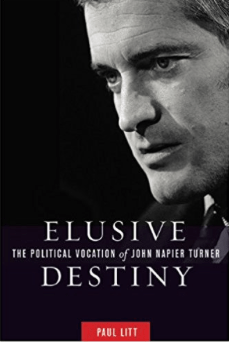
Turner’s B.C. story is a compelling one.  He spent his early years in Rossland and, while his formative years were spent in Ottawa, he returned to UBC for university (his stepfather was Lieutenant-Governor) where he was very much Big Man on Campus along with being Canadian 100 metre sprint champion.   His B.C. years are chronicled in Elusive Destiny, an apt title for a political giant who’s timing was off.  (Incredibly, his Olympic dreams were dashed when his car was hit by a train on the Arbutus Corridor).  Turner served as MP for Vancouver Quadra for 9 years, retaining his seat after relinquishing his leadership to Jean Chretien.  He had a strong B.C. connection but Turner was really a pan-Canadian instead of being owned by any region, representing three provinces during his illustrious parliamentary career.

The Mulroney-Chretien eras

From 1984 to 2004, B.C. had a steady presence at the cabinet table, not strikingly influential, but it produced our first and only B.C.-raised prime minister.

Prime Minister Brian Mulroney came to power in 1984 riding a wave of western alienation, but he also won big in Ontario, Quebec, and the Maritimes too.  Screen Shot 2018-07-18 at 11.42.39 AM.pngIt was a huge mandate.  “Red Tories” John Fraser and Pat Carney, an upset winner over Art Phillips in 1980, led the B.C. contingent in cabinet.  Fraser went to Fisheries and Carney to Energy – two significant portfolios. Carney was the first woman from B.C. to lead a department (Campagnolo was a Minister of State).

Fraser would resign halfway through the first term during “Tunagate”, as scandal concerning rancid tuna, but his stature among MPs led him later to election, and much-dignified reign, as Speaker of the House of Commons.  Overall, Fraser served in the House from 1972-1993.

Carney would move to International Trade during the dramatic US-Canada Free Trade negotiations.  She did not run again in 1988 (and, later on, appointed to the Senate where she was an outspoken member). Tom Siddon would replace Fraser, and others like Gerry St. Germain, Frank Oberle, and Mary Collins would ultimately join Mulroney’s cabinet.


Screen Shot 2018-07-18 at 11.45.47 AM.pngSt. Germain was a Mulroney favourite.  The bilingual, Metis chicken farmer was my Member of Parliament in Mission-Port Moody.  He entered Parliament with Mulroney following a pair of 1983 by-elections.  He was also my opponent when, as a teenager, I rode my ten-speed bike down to Liberal Mae Cabott’s campaign office on the Lougheed Highway in 1984.

Losing big to Gerry taught me an early lesson in humility  (Tip: be careful burmashaving on a busy highway when everyone hates your political party, and they are not telling you that your party is #1 when they use their middle finger).  

In 1986, I found myself looking for a seat to Question Period in Ottawa and contacted my local MP, Gerry.  With great gusto, Gerry led me through the back halls of Parliament proclaiming, “Let me show you what a Tory can do for a Grit.”

Gerry became National Caucus Chair in 1984, a huge responsibility considering it remains the largest caucus in Canadian history. He was elevated to cabinet during that term, but, incredibly to me, Gerry lost his seat in 1988 at the very moment he was poised to move up into the senior cabinet ranks.  He would have been the senior B.C. minister with huge clout. BCers often choose protest over pragmatism.  He would be appointed to the Senate, serve as president of the Progressive Conservative Party in the dark years, and be an early mover on bringing the PCs and Reform/Alliance parties together.

A B.C. prime minister… briefly

In 1988, Pat Carney’s retirement created a vacancy in Vancouver-Centre.  Back then, Progressive Conservatives were electable in that riding, seemingly unimaginable today.  Kim Campbell resigned her seat in the provincial legislature part way through her first term, secured the PC nomination, then won the seat, and was catapulted into Cabinet.  She was another rarity – a french-speaking British Columbian. As Justice minister (then National Defence), she held a high national profile, and emerged as the consensus favourite to succeed Mulroney following the demise of the Charlottetown Accord.  Campbell fended off Jean Charest for the leadership win.

Kim Campbell on the campaign trail, 1993

She had a strong B.C. network behind her, like Chief of Staff Ray Castelli and other apparatchiks that have been a big part of federal politics from B.C., but Mulroney did not leave her much time to make her own mark and the subsequent election played out for her like it did for John Turner in 1984, except worse.  The party was decimated and, like 1984, Vancouver bore witness on election night to a humiliating concession speech by a sitting prime minister.  Unlike Turner, Campbell lost her own seat.

Jean Chrétien’s election in 1993 and subsequent cabinets through 2003 had consistent B.C. representation (unlike PET from 1980-84), yet it was not at the heaviest of heavyweight levels.  David Anderson, first elected in 1968, before switching to provincial politics to lead the B.C. Liberals, returned from the political wilderness in 1993 to serve as National Revenue Minister before moving on to Fisheries, then to his signature role in Environment.  Herb Dhaliwal was another prominent minister during the Chrétien era, following Anderson in National Revenue and Fisheries before going to Natural Resources.  Ministers of State included former B.C. ombudsman Stephen Owen, Richmond MP Raymond Chan, and Vancouver-Centre MP Dr. Hedy Fry.  Chrétien could never elect more than 6-7 from B.C. so he didn’t have a lot of MPs to choose from.  Moreover, about 99% of the MPs during his years as prime minister from Ontario were Liberal, therefore, B.C. was vastly outnumbered in the Liberal caucus.  The influential non-minister during that time was Senator Ross Fitzpatrick.  Fitzpatrick was a Chrétien confidante who backed him during the 1984 and 1990 leadership campaigns, and called the shots in B.C. for the general election campaigns.

B.C.’s return to Diefenbaker-like prominence: 2004-2011

I’ll run for the Liberals in 2004, says ex-NDP Premier Ujjal Dosanjh

Both the Paul Martin cabinet and early Stephen Harper cabinets saw a decided uptick in B.C. clout at the federal cabinet table.  Following the 2004 election, Martin appointed a record five B.C. ministers including star recruits David Emerson (Industry) and former B.C. NDP Premier Ujjal Dosanjh (Health).  The lineup was rounded out by Stephen Owen, Raymond Chan, and Senate Leader Jack Austin.  The B.C. delegation was aided by a regional campaign, led by Mark Marissen, that punched above its weight in the 2004 election with its “Made in B.C. Agenda”.  The Liberals won more seats in B.C. despite dropping from a majority to a minority.  (They would win more again in 2006 in a losing national effort)

Consul General Phil Chicola and Minister Stockwell Day with their Spouses

Stock

Harper’s first cabinet contained a major surprise – David Emerson.  To the astonishment of Liberals and Conservatives alike, the Liberal star switched jerseys, eschewing politics for policy, and assumed the International Trade portfolio and eventually Foreign Affairs before he left office in 2008.  Emerson was recruited to Harper’s cabinet by outgoing MP John Reynolds.  Reynolds served in the House of Commons from B.C. ridings on two occasions (1972-77 and 1997-2006). In between, he was a Social Credit MLA from 1983-1991, serving as a cabinet minister and Speaker.  Reynolds acted as interim Leader of the Official Opposition, turning over the reins to Stephen Harper.  In 2006, Harper appointed Reynolds to the Privy Council.

Emerson was joined from B.C. by former Canadian Alliance leader Stockwell Day (Public Safety, International Trade, Treasury Board).  A former Alberta Finance Minister, Day was a B.C. MP  by virtue of running in a by-election in the Okanagan upon becoming leader.  He stayed put and became an influential B.C. minister.  Day was also an important interlocutor between the Harper government and the nascent Christy Clark government in 2011, helping build a cohesive relationship at a sensitive time.

Chuck Strahl (Agriculture, Indian and Northern Affairs, Transport), and Gary Lunn (Natural Resources) rounded out Harper’s first cabinet.  Jay Hill’s appointment in 2007 as Whip (elevated to cabinet) then Government House Leader would make it five ministers for the B.C. delegation, matching Martin.  B.C. had considerable clout.

Fading out of the Harper years

Emerson, Day, Strahl and Hill would all choose to leave politics by 2011, and Lunn involuntarily when he lost to Green Party leader Elizabeth May.  They would give way to James Moore, who started in Heritage and went to Industry, becoming the face of the government in B.C. during the final Harper term.  Ed Fast, in International Trade, North Islander John Duncan who served in Aboriginal Affairs & Northern Development, then-Delta MP Kerri-Lynne Findlay, and Richmond Centre MP Alice Wong all served in the final term.  As the Harper mandate struggled in its final years, so too did its profile in British Columbia – not an uncommon life cycle for aging governments.

A new team in 2015

Screen-Shot-2019-08-14-at-10.49.22-AM

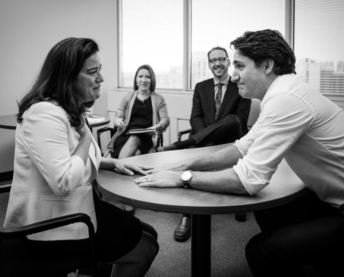
The appointment of JWR

Justin Trudeau only had two incumbents from B.C. heading into the 2015 election, but neither were invited into his first cabinet.  Instead, he went with new blood that aligned with Liberal political priorities.  Three ministers were appointed, all newcomers to Parliament Hill.  Jody Wilson-Raybould was a historic choice as Justice Minister – the first indigenous Justice Minister.  She followed in the footsteps of Kamloops indigenous MP Len Marchand who served in PET’s cabinet.  Joining Wilson-Raybould in the ranks of senior cabinet was Vancouver South MP Harjit Sajjan, appointed as Minister of National Defence, a post he kept for the entirety of the first term.  Delta MP Carla Qualtrough joined cabinet as Minister of Sport and Persons with Disabilities.  While

171109-D-GY869-080

Harjit Sajjan: senior post from day one

Wilson-Raybould and Sajjan were in the upper tier of cabinet, the Trudeau government took a different term in equating senior cabinet ministers with regional clout.  There was no “B.C. minister”, the traditional model where a minister is the “go-to” between the federal government and the province and its stakeholders.  Backed by a Ministers’ Regional Office, this role has informal influence and is where a lot of regional brokering would take place.  Instead, it appeared JWR and Sajjan focused on their considerable cabinet duties, freed from the political responsibilities coming from a regional boss role.

qualtrough_200x200_0

Carla Qualtrough: moved up the ladder

Qualtrough emerged as a steady player and was elevated to Minister of Public Works in 2017.  Colleague Jonathan Wilkinson was recruited to cabinet in 2018 as Minister of Fisheries & Oceans, a vexing role which many previous B.C. MPs have performed.  With four full ministers, B.C. enjoyed a solid presence in cabinet despite the absence of a traditional regional minister role.

Then in 2019, everything changed.  The controversy surrounding JWR and the prime minister is well documented.  An early 2019 cabinet shuffle moved JWR from Justice to Veteran Affairs.  Sparked by the resignation of cabinet minister Scott Brison, the shuffle ignited tensions that culminated in JWR’s resignation from cabinet, then her removal from caucus.  Like H.H. Stevens, she sought re-election after parting ways, and won her Vancouver seat.  For several months, JWR’s future with the Liberals hung in the balance.  Today, she moves forward as an independent, and who knows what else.

Her departure created an opening for longtime Vancouver-Quadra MP Joyce Murray, a former provincial cabinet minister.  Murray took the helm at Treasury Board in spring 2019, keeping a low profile.

pmjw-1024x562

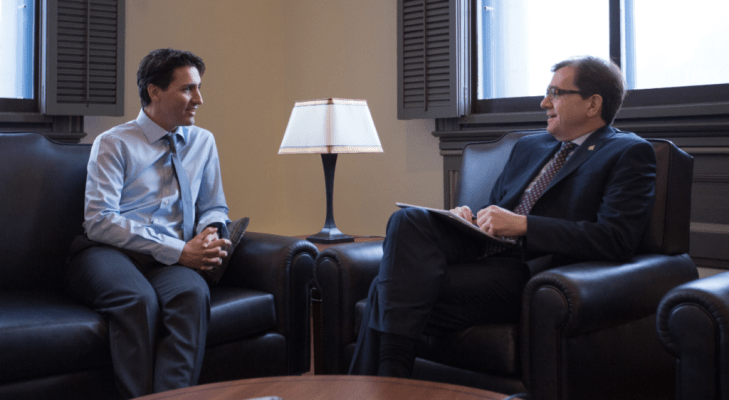
Jonathan Wilkinson with the prime minister:  Saskatchewan roots may be called upon in next term of office

As Prime Minister Trudeau puts in place his cabinet picks on November 20th, he may well stay the course with Sajjan, Wilkinson, Qualtrough, and Murray, though one would think that roles will change for most of them.  They were all re-elected, and contribute to the gender balance that the prime minister says will be maintained.  Perhaps B.C. will gain more influence because of the absence of Liberal MPs in Alberta and Saskatchewan.

There are now 11 Liberal MPs from British Columbia. Trudeau will also be able to consider Terry Beech, Sukh Dhaliwal, Ken Hardie, Randeep Sarai, Patrick Weiler, and the indomitable Hedy Fry.  All Liberal MPs are from Metro Vancouver, meaning no opportunity for the Island or the Interior to have a voice in cabinet.

Eclipsed by other regions

For many Liberal governments in the Pearson-Trudeau-Chretien eras, it was often a case of being “west of the best” or so it seemed.  B.C. had many capable ministers during this time but very few national personalities that one hearkens back to when remembering an era.  Ron Basford may have the strongest claim for cabinet legacies.  The Martin government went in a stronger direction for B.C. but its lifespan was short.  Harper’s team started off strong but B.C.’s collective influence seemed to fade down the stretch.

Conservative cabinets have seen B.C. eclipsed by Conservative-crazy Alberta, which has established the storyline for much of the past 40 years.  Alberta had leader (1976-83) and Prime Minister Joe Clark (later Secretary of State for External Affairs and lead constitutional negotiator) and Deputy Prime Minister Don Mazankowski.  The demise of the PCs was born in Alberta too with Preston Manning’s Reform Party.  The evolution and return of the conservative movement was an Alberta story – Stockwell Day (who ran for leader of the Alliance from Alberta before moving to B.C.) and Stephen Harper led in succession.   Harper’s cabinet also featured prominent Albertan personalities such as Jim Prentice, Rona Ambrose (an interim leader), and Jason Kenney, now the Premier of Alberta. Neighbouring Saskatchewan produced Andrew Scheer, who won all but one seat in Alberta and Saskatchewan in 2019.  B.C.’s political climate is much more competitive, though conservatives usually emerge with a plurality of the votes federally, restraining the election of Liberal MPs and pool of available cabinet talent when the Liberals rule (which has been most of the time).

British Columbians have risen to prominence in the NDP, although not usually to the top.  Tommy Douglas led the party from a base in B.C. for a time.  Rosemary Brown, Dave Barrett, Svend Robinson, and Nathan Cullen have all been serious national leadership contenders, though unsuccessful.  Current leader Jagmeet Singh represents a B.C. riding.  Are they any closer to the cabinet table?  No, they have been getting further and further away since Jack Layton’s high point in 2011.

B.C.’s Burden

Why does B.C. lack clout?

Distance.  How many people want to fly 3000 miles back and forth each week?  Time spent traveling is enough to dissaude anyone, especially those with younger children.

Under-representation. A point of regional unfairness is that B.C. ridings have more population than most provinces due to Canada’s constitution and constitutional side deals.  The vast expanse of Skeena has far more constituents than ridings in Saskatchewan, Manitoba or any in the Maritimes.  How does that make sense?  It makes a tough job even tougher.

Political culture.  Federal politics is more abstract to British Columbians.  BCers do not live and die by federal politics.  There is very little media coverage of B.C. politicians on Parliament Hill (JWR controversy excluded). Provincial politics is the main sport and drives the media’s and the public’s interest.

Protest over politics.  We have often gone the other way when Canadians elect their governments.  B.C. abandoned PET in 1980, cut down the PC team in 1988, and kept Chretien on a short leash.

Political network.  It’s tough to aspire to national leadership when the critical mass is elsewhere.  Kim Campbell remains the only B.C.-raised prime minister.  Alberta has figured out how to gain national office, but no one here.  H.H. Stevens may have had the first good chance in the dying days of the RB Bennett government but he passed on it.  E. Davie Fulton was a thorn in Diefenbaker’s paw, but finished third to Dief in the 1956 PC leadership, and third again trying to succeed him in 1967.  John Fraser tried in 1976.  Hedy Fry and Joyce Murray both made quixotic bids to lead their parties but were never in contention.  Is there a B.C. contender to replace Andrew Scheer, if there is an opening? Hard to see.

Bilingualism. Fewer B.C. politicians speak french than in eastern provinces.  This has been a drawback in climbing the greasy pole.  James Moore does, and he had a good run, but he is an exception.

The challenge appears to be even greater for MPs outside the Vancouver area.  Most ministers, as this is where Liberals usually get elected, have been fairly close to the province’s largest city.  The B.C. Interior and Vancouver Island have lacked significant cabinet representation over time, and will lack representation again in the coming term.

Prime ministers have been piled up like cordwood from Quebec, Ontario, and Alberta.  Even Saskatchewan has had its run; B.C. has but one brief stint from one of its own prior to her electoral slaughter.  Where have been the Finance Ministers from B.C.?

Many excellent ministers from B.C. have served at the cabinet table, but my overall assessment is that we, as a province, haven’t been exceptional in the federal arena.  In part, because many have chosen not to run.

What’s next?

On November 20th, a new cabinet will be chosen and a new chapter will begin on B.C.’s role at the cabinet table.  While Justin Trudeau lacks representation in Alberta and Saskatchewan, he can at least draw from an 11-member caucus in B.C.  This is the second largest Liberal caucus from B.C. since 1968 – that’s not saying much, but it’s a lot better than 1980 when his father did not have an elected member west of Winnipeg.

A key sign to watch for B.C.’s clout will be whether the regional minister system is re-established, providing a more direct portal for B.C. interests to interact with the federal government.  Ottawa is a long way away from B.C.  It will help our issues and our interests if Ottawa is brought closer.

** This post was taken from a number of sources and not always easy to piece together B.C.’s federal voice.  If there are any sins of omission or commission, please comment.  Thank you.

Related

Jody Wilson-Raybould: a First Nations first in BC

It took 148 years to elect a First Nations women to either Parliament or the Legislative Assembly from British Columbia.  Jody Wilson-Raybould blazed a new trail in last week’s federal election.

Jody Wilson-Raybould, elected in Vancouver-Granville

I wrote earlier how Len Marchand was the first First Nations MP elected 47 years ago, in 1968.  He was also the last First Nations MP elected from BC, when he won the final time in 1974.

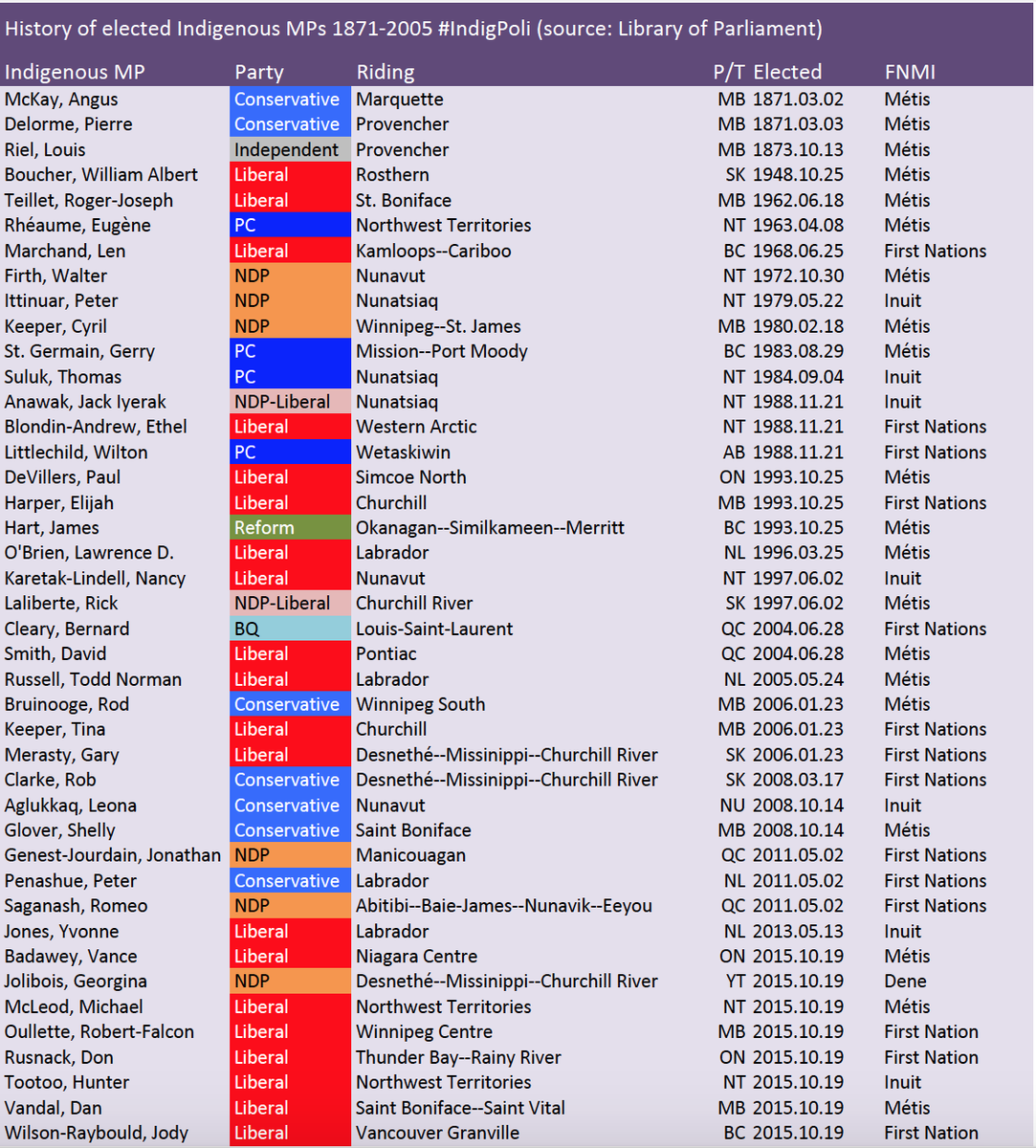
@IndigPoli has been providing news and updates about indigenous candidates throughout the federal election process.  The following table is taken from its Twitter feed, outlining the 42 MPs elected from First Nations, Inuit, Dene, and Metis ancestry since Confederation:

That’s 42 indigenous MPs over 148 years –  10 from the 2015 election alone (8 new).  See CBC story.

1960 / 1949

Status Indians right to vote was recognized by Parliament in 1960, only 55 years ago, and 93 years into Canada’s existence.  Prime Minister John Diefenbaker’s Progressive Conservative government was in power at the time, and when Len Marchand was elected in 1968, he thanked Diefenbaker in Parliament for doing what previous federal governments had failed to do.

Screen Shot 2019-02-28 at 3.26.12 PM.png

Hon. Len Marchand’s autobiography

British Columbia had done so in 1949, whereupon Nisga’a leader Frank Calder was promptly elected in the riding of Atlin to the BC Legislature and continued for 30 consecutive years.  He was the first status Indian to be elected to any legislature in Canada and ultimately the first aboriginal cabinet minister in BC history.

Frank Calder sparked the most important rights and title case in Canadian history when Calder (1973), argued by Thomas Bergerwent forward to the Supreme Court of Canada.  The Court ruled that title existed in a decision that reverberates today.

Screen Shot 2019-02-28 at 3.25.40 PM.png

Frank Calder

Why so few from BC?

Not a lot of First Nation candidates have run for office over the years and, clearly, not many have run in winnable seats.

I am not qualified to speak on the unique social, cultural, and financial barriers that many First Nations face in seeking office, but I am familiar with barriers that Canadians, in general, face when seeking office, and they are substantial for anyone when contemplating public office.  It’s both the general election and the party nomination that are the challenge.

One reason why First Nations have been under-represented is the dispersed nature of their population.  There are not many ridings in BC where First Nations form a large ‘bloc’.  And even when you look at the densest concentration of First Nations in a federal riding in BC – Skeena – the reality is that it is made up of many, many different nations, all with different traditions.

Look at Metro Vancouver or the GTA where we are seeing the election of MPs and MLAs from diverse backgrounds.  This is happening in part because of strength in numbers.  Their populations are concentrated in certain areas (eg. Chinese in Richmond, South Asians in Surrey) leading to the election of representatives from their community.  This hasn’t happened to a large extent in Canada, except the North.  It certainly hasn’t happened in BC.

Policies matter too, of course.  Haida leader Miles Richardson ran for the Liberals in Skeena in 2004 with high hopes but finished third to winning NDP MP Nathan Cullen.  Cullen has just been elected to his fifth term and enjoys strong support in First Nation communities.  While a person’s background help, winning candidates usually have to swim with the tide of opinion in their riding.

I worked hard for Marion Wright, a former chief on the North Island.  She fell short in the 2009 election, despite our hopes.  She’s yet another example of a First Nations candidate that would have made an impact, however, she ran up against issues that favoured the NDP.  While improving the party’s standing among First Nations, she lost most FN polls.  Marion tragically passed away not long after that election – she had a lot more to contribute.

One of the keys to Jody Wilson-Raybould’s success is running for the right party in the right riding at the right time.  She was a good candidate, but also had the benefit of swimming with the tide.

Len Marchand first won in 1968 amidst ‘Trudeaumania’ and built the support necessary to hang on in tougher elections in 1972 and 1974.  In 2015, Trent Derrick of the NDP had a chance in Cariboo-Prince George for the NDP but had the national momentum drain away.  If there are more First Nations candidates in viable seats, then more will be elected, simple as that.

Prescriptions

I wrote a term paper in university based on Len Marchand’s work in the Senate concerning aboriginal representation.  Basically, Len argued that – at that time- aboriginal Canadians merited about 3-4% share of the House of Commons based on population but due to the dispersal of its population, did not reach that level.  He argued for guaranteed representation based on the aboriginal population in Canada.  It was hard not to agree with the idea.  We have guaranteed representation for PEI for pete’s sake.  Guaranteed for Saskatchewan.  Guaranteed for Quebec.  Guaranteed for Nova Scotia and New Brunswick.  Special deals here.  Special deals there.

Geographic deals are one thing, but the idea of parliamentary seats based on background seems to go against the grain in Canada.  Perhaps this election is showing guaranteed representation may not be necessary, though there is still a long way to go before First Nations are represented in proportionate numbers.

The State of Maine has had two non-voting seats on the floor of the Assembly for the Penobscot and Passamaquoddy tribes since the early 1800s.  Is this a potential model – to provide a stronger voice for aboriginal people on the floor of the House if the numbers of elected members are not proportionate to their population?  (In 2015, the Penobscot and Passamaquoddy decided to vacate their longstanding seats over their concerns with the Maine government.)

First Nations have strong leaders at the community level, engaging with the federal and provincial governments on a nation-to-nation basis.  The argument that representing one’s nation is more impactful, instead of being a small part of a larger parliamentary institution must be compelling.

One thing is certain, more aboriginal people voted this election and more were elected.  Parliament will be better informed by those perspectives as a result.  Len Marchand and Frank Calder have shown the type of impact they have had within these institutions.  Now it’s Jody Wilson-Raybould’s opportunity to blaze a new trail, 148 years in the making.

First Nations representation: following in Len Marchand’s footsteps

In 1968, Len Marchand became the first “Status Indian” to be elected to the Parliament of Canada, from the riding of Kamloops.  He went on to become the first to be a member of the federal cabinet as well.

Screen Shot 2018-04-20 at 2.57.05 PMOnly eight years before, Len – along with all Status Indians – was ‘granted’ the right to vote by the Parliament of Canada.
1960.  Can you believe that?  That’s not that long ago.

Prime Minister John Diefenbaker was in power.  His government took action where previous Liberal and Conservative governments had not.

An agronomist by training, Len’s political activism led him to elected office in 1968, 1972, and 1974 as a Liberal.  He was swept out in 1979 when the Liberals were defeated.  He was the last federal Grit to be elected from the BC Interior.  We’ll see if that changes tonight.

To my knowledge, Len was the last First Nations person to be elected from BC as well.  41 years ago. (note: I’m distinguishing First Nations from Metis)

This election, there are First Nations candidates that could take a seat in Parliament from BC.  Here’s a list of all aboriginal candidates in Canada for each party.

Jody Wilson-Raybould stands an excellent chance of being elected from the riding of Vancouver-Granville.  A lawyer, former Crown Prosecutor, and former Regional Chief for Assembly of First Nations.

Trent Derrick of the NDP appears to have a solid chance at the riding of Cariboo-Prince George.  The NDP have two other First Nations candidates – Carleen Thomas in North Vancouver and Kathi Dickie in PG-Peace River-Northern Rockies.  Thomas and Dickie are longshots to win.

The issue of why there are not more First Nations elected from BC to the Parliament of Canada and the BC Legislative Assembly is a topic for a future blog post, one that I intend to take on properly after the election.  Len and others have done a lot of work in this area and, this election, there is increased advocacy from indigenous groups compared to previous elections.

When one looks at the career of Len Marchand, you realize the tremendous potential for First Nations perspective to inform federal and provincial decision-making.  While this insight is presented in other forums and bilaterally from First Nations to government, having that insight on the floor of the House, in the caucus room, and at the cabinet table is something that would strengthen our parliamentary institutions.

Postscript:

Len’s book “Breaking Trail” is a great political bio and record of an era of politics from the 1960s through the 1990s.

Over 50% shades of grey in Transit vote turnout

Elections BC released voting information from the transit referendum, er, plebiscite.

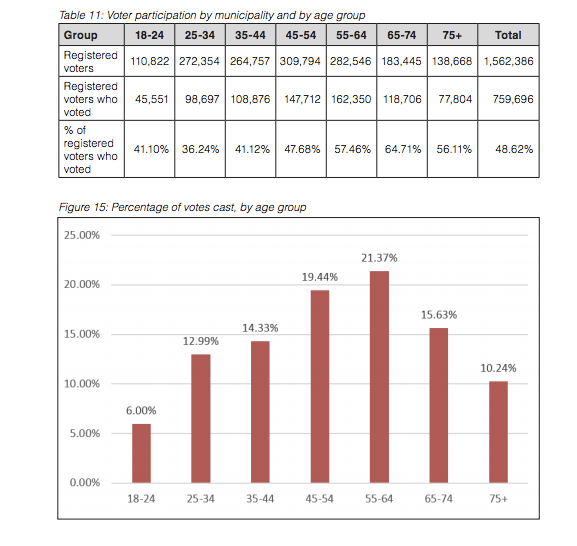
The published turnout rate ranges from a low of 36.24% among 25-34 year olds to 64.71% among 65-74 year olds.  This is consistent with the 2013 provincial election in terms of older people voting at a higher rate than younger people.

Why are 18-24s voting at a higher rate than 25-34s?  They’re not.  Turnout rate is based on % of registered voters but fewer 18-24s are registered to vote.  Base it on actual population and you will see a lower number.  Turnout typically peaks at 65-74 age then declines post 75, though still high relative to under 50 crowd.

Screen Shot 2015-09-22 at 4.15.26 PM

It’s interesting to see the share of voters from each age group – this is more important.  Over 47% of the transit vote was over age of 55.  They are punching above their census weight while the opposite is true of younger voters.  About one-third of voters were under age of 44.

Bear this in mind when reading the polls.  Parties or candidates with high support in 18-34s may not sustain that support on Election Day while parties with strong support among plus 55s can surprise.  Where have I heard that before?

Facing down BC history in #elxn42

Every day, we are bombarded by polls and seat forecasts that tell us how we are going to vote, even if “we” haven’t made up our mind. In BC, there are three patterns that have defined our voting over the years and the party that breaks the mold this time may hold the key to forming government.

  1. When we get mad at Ottawa, we don’t forget easily

BC fell in love with Pierre Trudeau in 1968 and sent 16 of 23 Liberals to Ottawa.  Trudeaumania was not as deeply felt in the rest of Canada as it was here – BC embraced it.  The bloom was soon off the red rose and by the late 1970s, western alienation was in full swing. Memories of the middle finger in Salmon Arm, the collapse of the economy in Western Canada, and other crimes, real or imagined, led to a lost generation for Liberals in BC.  The same can be said for the Progressive Conservatives.  BC had its first homegrown prime minister in 1993 when Rt. Hon. Kim Campbell took the reins, but she was carrying the baggage of the deeply unpopular Mulroney government that had alienated BC over constitutional issues, perceived regional favouritism, and the imposition of the GST. The soiled PC brand was wiped off the political map.  Harper’s plurality in BC today is a direct descendent of Preston Manning’s Reform movement built on western rage.

  1. When we remember BC NDP governments, we don’t vote NDP.

As memories fade of past NDP governments, support rises.  The NDP were hammered in 1974 during the Dave Barrett government.  They lost in strongholds like Port Alberni, Prince Rupert, and East Vancouver. The NDP regained support federally in 1979 and were the #1 or #2 party until 1993 when they collapsed again in their core areas.  The 1993, 1997, and 2000 elections took place amidst the NDP’s decade of power from 1991-2001.  Due to a very unpopular provincial NDP government, the federal slate was reduced to a rump group. Since 2003, they have been gathering strength federally.

  1. We’re supposedly a small ‘l’ liberal province, but we usually don’t vote for the federal Liberals.

BC is regarded as the California of Canada. Marijuana dispensaries more numerous than Tim Hortons’, craft beer flowing in the streets, strong environmental values, and permissive attitudes on social issues – shouldn’t BC be a bastion of Big-L Liberal support?

Actually, the values change when you cross Boundary Road and definitely when you go beyond Hope. There are also key values differences in BC’s emerging multicultural communities. Liberals over the years have mainly been fenced into a mainly academically oriented, income-enriched enclaves in, and near, Vancouver and, occasionally, Victoria.   Voters in the suburbs and resource communities have looked primarily to the Conservatives and alternatively to the NDP in recent elections. Middle of the road fuzziness has lost out in the rough and tumble of BC’s polarized political climate.

How do these factors stack up for the parties today:

  • Justin Trudeau’s job is to break out of the urban core and alter a generation of voting patterns. Like his father, he has an unconventional appeal and represents a fresh opportunity compared to the failed campaigns of Stephane Dion and Michael Ignatieff. His challenge is to have his message resonate in the suburbs, sounding less like an ivory-tower liberal and more like Main Street. Strong retail Liberal candidates like Sukh Dhaliwal in Surrey have bucked the trend in the past, but he’s been an exception.
  • Thomas Mulcair benefits from having as much distance from previous NDP governments as possible, however, he may be haunted by failed NDP elections in BC where they were unable to be clear about balancing the economy and the environment. His job is to keep the Liberals fenced off, and drive voter anger about the Conservatives, hoping voters have a slow burn over the next five weeks.
  • Stephen Harper faces a tougher BC scenario than any election he has led since 2004. Simultaneously demonizing the Liberals and NDP will be taller orders this time, while he faces a version of voter anger directed at him. He will likely now double-down on direct appeals to business-oriented voters and to populist voters that do not take their direction from media and political elites. The prime minister of Canada will run an, ironically, anti-establishment campaign in BC.

This election, BC is truly a key battleground that could determine the outcome on Election night. The future government may be decided who best conquers historical forces.