Unknown's avatar

Posts by Rosedeer

Mike is a communications and public affairs consultant based in Vancouver. He is a former Chief of Staff and campaign manager for the Premier of BC. He's a lifelong British Columbian with a passion for his province. Online: @BCMikeMcD and https://www.linkedin.com/in/bcmikemcd

Brexit: Polls are split, but Market has decided

Updated (3 hours before polls close, June 23)

Interesting piece in The Telegraph that shows slight lead for Remain.

There will not be an election-style exit poll, but YouGov plans to release an election day poll at the moment the polls close (2pm PT / 5pm ET).  If there is going to be a shocking outcome, the first glimpse may be right then.

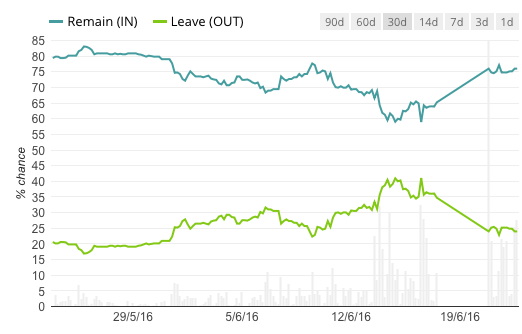
Gamblers are 84% certain of a Remain victory.  Do they know something we don’t know?  They are probably reading the polls as their main source of information.  If the polls are wrong, they’re wrong. UBC’s Sauder School Election Prediction market is made up of bettors betting real money to predict election outcomes.  In 2013, 85% predicted an NDP majority government; in 2015, only 20% predicted a Trudeau majority.  So, a sucker is born every minute.  We’ll see if the Brits are better bettors.

Professor John Curtice reiterates today that the polls can’t be trusted and it’s basically a crapshoot.  The public pollsters notoriously got it wrong in May 2015 and it was Curtice who conducted the election day exit poll that predicted the majority no one expected.  We might just have to wait until the votes are counted!

———-

John Curtice (@whatUKthinks), the polling expert who shocked the UK when he predicted a Conservative majority one minute after the polls closed in the 2015 General Election, says Brexit is too close to call.

The markets and the bettors are predicting a victory for Remain.  Political betting analyst Mike Smithson (@MSmithsonPB) has provided data that shows gamblers moved toward Leave about a week ago, but there was a sharp upturn for Remain after the Jo Cox murder.

Figure 1: Remain is a better bet for 75% of UK bettors.
Screen Shot 2016-06-22 at 8.58.00 AM.png

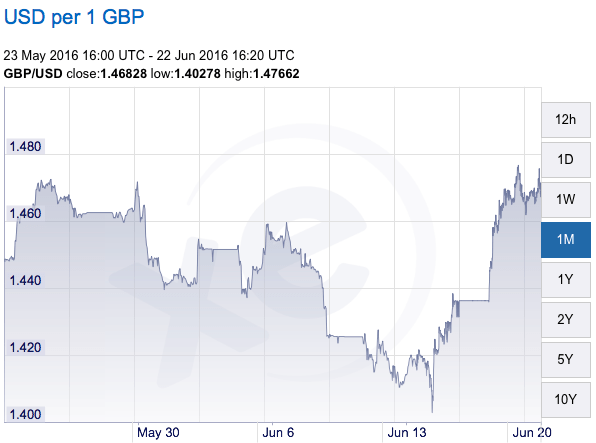
What are the markets doing?  British Sterling surged over the past few days, pricing in a Remain outcome.

Figure 2:  GBP climbs in final week
Screen Shot 2016-06-22 at 9.23.28 AM.png

And finally, what are the polls saying?

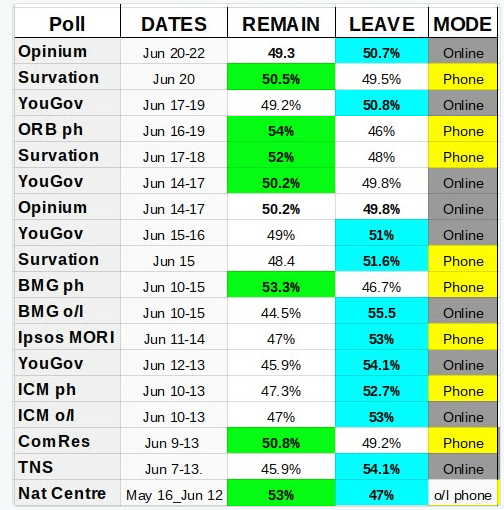
Figure 3: Compilation of Brexit polls (@MSmithsonPB)
Screen Shot 2016-06-22 at 8.58.29 AM.png

There has been a slight advantage for Remain via Telephone surveys and a slight advantage for Leave via Online surveys. While the markets and the bettors have turned toward the Remain camp as the likely outcome, those responding to polls are still very divided.

YouGov’s detailed tables reveal some of the underlying divisions in British society concerning Brexit.

The numbers shown in Figure 3 above are Decided support, however, as YouGov reminds us, there are still undecided voters (9%) and those who say they won’t vote (4%).  On decided vote, YouGov has it at 44 Remain, 43 Leave.

According to YouGov, here are some of the dividing lines:

Remain voters

  • Labour (64%) and LibDem (59%) voters
  • 18-24s (64%) and 25-49s (45%)
  • London (50%) and Scotland (56%)
  • Upper/Middle class – ABC1 voters (53%)

Leave voters

  • Conservative (55%) and UKIP (95%) voters
  • 50-64s (49%) and 65+ (58%)
  • Rest of South (45%); Midland-Wales (51%); North (47%)
  • Skilled working class/ working class/non-working -C2DE voters (52%)

When asked who is most certain to vote, Remain was at 79% and Leave at 84%.

On the dividing lines, there is a fundamental generational difference.  The range between young and old is stark.  The Euro debate, and underlying views on immigration, shape partisan leanings as evidenced in the Party ID splits. Class is also significant.  Then in Scotland, attitudes are tied somewhat to Scottish identity – leave Britain, but stay in EU.

But who will vote?

One would expect a high turnout.  YouGov indicates a tilt toward Leave voters.  Young people are expressing a strong preference for Remain but election turnout studies consistently show they vote at a lower rate.  Will they close the gap, like they did in Canada’s federal election, in the Brexit vote?  Will lower income voters vote at the same rate as higher income voters?  How will the UK’s sizeable immigrant communities vote and will they turnout to vote?  We don’t know this from the YouGov poll, possibly because it’s online which is typically less representative of people who don’t speak or read English well.  Telephone surveys are better in including those populations which may explain a slight leaning to Remain.

Going back to John Curtice, he is the most credible voice in the UK on polling and he believes it’s too close to call.   Curtice says the result could split the difference between the aggregate of phone polls which have Remain at 51% and the aggregate of online polls that have Leave at 51%.  A cliffhanger like the Quebec referendum of 1995.

This process ends in a vote and an outcome, but this discussion of the cold, hard numbers comes just days after a shocking murder of Labour MP Jo Cox.  This is no ordinary vote.  The referendum campaign has exposed the fault lines of UK society.  The stakes are extraordinarily high, especially in the context of a campaign that appears to be a photo-finish.

I’ll bet on Remain, based on voters pulling back due to perceived risk, like they did in Quebec in 1995 and in the recent Scottish referendum.  We’ll see if the gamblers and traders got it right.


Brexit the latest chapter in year of protest

“No10 panics as Leave surges”, shouts today’s Daily Telegraph.  “Massive swing to Brexit“, screams another.

With only 11 days until the Brexit campaign reaches its conclusion, momentum appears to be swinging at a very inopportune time for the Remain campaign.  A new poll shows a 55-45 gap in favour of Leave (adjusted for voter turnout, it’s 53-47).  UK voters appear open to following a narrative that has developed over the past year on both sides of the Atlantic – defying the establishment.

Brexit

The papers and TV news are filled with Remain campaigners issuing dire warnings about the implications of leaving the EU.  Former prime ministers Tony Blair and John Major said peace in Northern Ireland was at stake.  BBC News discussed an open letter expressing concern for science funding.  Prime Minister David Cameron is visiting job sites to underscore the threat to employment.  Former Labour leader Ed Miliband exhorted Labour supporters to get behind Remain.

It’s a robust campaign.  The Remain campaign is backed by the leadership of the four major political parties – governing Conservatives, Labour, the Scottish Nationalists, and the Lib Dems.

Significant voices in the Conservatives and Labour are advocating for Leave, including former Mayor of London Boris Johnson, cabinet ministers, and Labour MPs, not to mention UKIP, which garnered 13% of the popular vote in last year’s general election and wholeheartedly embraces a Brexit.   Other than UKIP, the Leave campaigners are bucking against their own parties, and while there is an aroma of opportunism, there are also points given for authenticity.

There are some interesting divides at play. There is an elite/populism divide.  The insiders favour Remain while the outsiders look to Leave.  The pro Euro faction of Labour obviously favours Remain but a significant bloc of Labour voters are going the other way.  Labour was particularly vulnerable to UKIP in last year’s election as working-class white voters outside London looked for a new vehicle for protest.  There is a generational divide.  Polls claim that young people are strongly in favour of Remain while plus 55 year old voters favour Leave.

Some constituencies are not bearing as much fruit for Remain as previously thought. Columnist Stephen Bush writes that hoped-for support from liberals and multicultural communities for Remain is less than certain:

The [Labour] Party always knew that it had a problem with persuading white voters in its small-town heartlands to back staying in the European Union.  It now appears that they have a problem persuading middle-class liberals in big cities to turn out to vote, and that the party’s large ethnic minority vote is more hostile to the European project than either the Labour leadership or the Remain campaign ever expected.

We’ve seen this movie before in Canada when a cross-partisan alliance (of elites) fails to mobilize their parties’ followers.  The national referendum on the Charlottetown Accord in 1992 is a shining example where dire warning were made about the future of Canada if there was a No vote.  The outcome was actually “Hell, No”.  Canada survived.

Last year’s transit referendum in Metro Vancouver was another similar example.  Everyone supported Yes except the people.

The 1995 Quebec referendum and 2014 Scottish referendum offer more insights.  Dire warnings were made, and heeded, by voters.  There were moments in those campaigns where the Yes campaigns looked like they would succeed.  In Quebec, the ultimate margin was razor thin.  A key difference was that these campaigns advocated for independence.  The EU referendum is the reverse – “yes” means status quo.  Voting “no” means change.  To mobilize grumpy protest voters, it is arguably easier to coax a “no” than a “yes”.

In all cases, emotion is key.  Bombarding voters with facts and figures from self-interested elites is not the path to success when contrasted with fears over migrants or anger over EU spending.

In the Quebec example, while there were many factors at play, a late-campaign emotional outpouring from Canadians provided much needed momentum.  The federalist forces had their backs against the wall and they rallied, literally, in an historic and emotional show of force.

Can the Remain campaign muster a cogent emotional argument in the next 11 days?  In the past year, the success of Donald Trump, Jeremy Corbyn, and Bernie Sanders provides striking examples of the resolve of voters outside the establishment to go their own way and absolutely tune out traditional voices.  Remain will need to change up their playbook to reach voters that are turned off as much by the messengers as they are by the message.

Over pints at a pub here in the UK, I talked with a collection of university students.  They are incredulous that the UK could vote to Leave.  Their modern outlook sees the opportunities that the EU brings.  The Remain campaign will need to draw on generational differences and mobilize this group of voters that has been typically less likely to vote.

Will the UK vote to Brexit? Most here think not but the next week will be critical in swinging the momentum either way.  As has been said many times, campaigns matter.


Manitoba Election cheat sheet

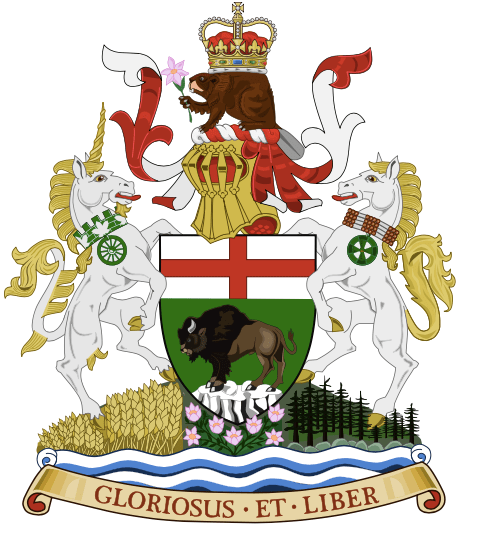
“Glorious and Free” is the Manitoba motto.  Free of the NDP by midnight Tuesday, I’ll bet, though not very gloriously.

Despite some late controversy over the Manitoba PC leader’s sojourns to Costa Rica, available evidence seems to indicate it’s the NDP that will be heading to sunnier climes come Tuesday night.  The recent TV debate did nothing to motivate NDP and Liberal voters and, if anything, opened up the Greens as a protest vehicle for centre-left voters.  For British Columbians, some parallels to 2001.  Voters seem focused on getting the job done despite reservations with the leading party.   See my earlier analysis here.

Screen Shot 2016-04-18 at 10.32.51 PM

They have unicorns in Manitoba – maybe the NDP have a chance?


In 2011, Greg Selinger’s Manitoba NDP won 45.9% of the popular vote and elected 37 MLAs.

Hugh McFadyen’s PCs won 43.5% of the popular vote and elected 19 MLAs.

The Liberals held the seat of their then-Leader Jon Gerrard and received 7.5% of the popular vote.

While the PCs won rural (non-Northern) Manitoba by 22 points, they couldn’t crack Winnipeg. The NDP harvested 51% of the votes in Winnipeg, powering their majority and added to their seat count with their base of support in Northern Manitoba where they took 61.4% of the vote across five seats.

Table 1: Popular vote by region, 2011 MB election

LIB NDP PC
North 5 seats 4.71% 61.38% 32.44%
Rest of MB 21 seats 4.43% 35.69% 57.84%
Winnipeg 31 seats 9.60% 50.88% 35.67%

The following table ranks the ridings in order of percentage of NDP vote from the 2011 election.  The NDP scored 73.2% in The Pas.  They won 8 seats by over 60% and a further 25 seats by over 50%.  The remaining four seats were in the 45-49% range.   In many jurisdictions like BC, Alberta, and federally, you will see instances of elected members with 30% or less.  Manitoba has been very polarized.

The PCs look poised to win a bushel of seats from the NDP in that group from 45% to 60% (NDP vote in last election). The NDP seats in the plus 60% range may hold.

High profile NDP candidate Wab Kinew, embattled by campaign controversy, is running in Fort Rouge against the Liberal leader Rana Bokhari.  This would be a seat that the NDP ought to lose given the trend in the numbers.  The Liberal leader is out of the picture, it seems. So the PCs could emerge as the winner here.

The Green Leader James Beddome is seeking a seat in Fort Garry-Riverview. A bit of a stretch to see a Green win, but not a surprise to see a decent second.

In the table below, NDP supporters will not want to see any PC wins until much further down the list.  A PC win in a riding that was plus 60% for the NDP last election would be a very bad sign.

Table 2: Seats in order of NDP % of the vote in the 2011 election

Electoral Division Member Elected Party NDP%
The Pas WHITEHEAD, Frank NDP 73.21%
Point Douglas CHIEF, Kevin NDP 72.88%
St. Boniface SELINGER, Greg NDP 68.57%
Thompson ASHTON, Steve NDP 68.20%
Minto SWAN, Andrew NDP 66.00%
St. Johns MACKINTOSH, Gord NDP 65.55%
Concordia WIEBE, Matt NDP 62.72%
Wolseley ALTEMEYER, Rob NDP 60.25%
St. Vital ALLAN, Nancy NDP 59.80%
Kildonan CHOMIAK, Dave NDP 59.20%
Burrows WIGHT, Melanie NDP 59.01%
Logan MARCELINO, Flor NDP 58.09%
Assiniboia RONDEAU, Jim NDP 58.00%
Transcona REID, Daryl NDP 57.92%
Flin Flon PETTERSEN, Clarence NDP 56.84%
Kewatinook ROBINSON, Eric NDP 56.80%
Rossmere BRAUN, Erna NDP 56.38%
Swan River KOSTYSHYN, Ron NDP 55.82%
Selkirk DEWAR, Greg NDP 55.59%
Fort Garry-Riverview ALLUM, James NDP 55.29%
Radisson JHA, Bidhu NDP 54.95%
Dauphin STRUTHERS, Stan NDP 54.78%
Riel MELNICK, Christine NDP 54.69%
Brandon East CALDWELL, Drew NDP 54.68%
Elmwood MALOWAY, Jim NDP 54.15%
Fort Richmond IRVIN-ROSS, Kerri NDP 53.16%
Seine River OSWALD, Theresa NDP 52.88%
Dawson Trail LEMIEUX, Ron NDP 52.24%
Southdale SELBY, Erin NDP 51.84%
The Maples SARAN, Mohinder NDP 51.49%
Gimli BJORNSON, Peter NDP 51.43%
Fort Rouge HOWARD, Jennifer NDP 50.95%
Interlake NEVAKSHONOFF, Tom NDP 50.24%
St. James CROTHERS, Deanne NDP 49.61%
Brandon West HELWER, Reg PC 46.72%
Kirkfield Park BLADY, Sharon NDP 46.61%
Tyndall Park MARCELINO, Ted NDP 45.00%
St. Norbert GAUDREAU, Dave NDP 44.94%
River East MITCHELSON, Bonnie PC 43.92%
Portage la Prairie WISHART, Ian PC 39.14%
Lac du Bonnet EWASKO, Wayne PC 38.42%
St. Paul SCHULER, Ron PC 37.26%
Riding Mountain ROWAT, Leanne PC 34.41%
Arthur-Virden MAGUIRE, Larry PC 30.09%
Charleswood DRIEDGER, Myrna PC 29.88%
Fort Whyte McFADYEN, Hugh PC 29.49%
Spruce Woods CULLEN, Cliff PC 28.47%
La Verendrye SMOOK, Dennis PC 26.02%
Lakeside EICHLER, Ralph PC 25.84%
Tuxedo STEFANSON, Heather PC 25.30%
Midland PEDERSEN, Blaine PC 23.56%
Emerson GRAYDON, Cliff PC 19.60%
Morris TAILLIEU, Mavis PC 19.26%
River Heights GERRARD, Jon Liberal 17.74%
Agassiz BRIESE, Stu PC 17.12%
Morden-Winkler FRIESEN, Cameron PC 11.38%
Steinbach GOERTZEN, Kelvin PC 7.60%
 NDP in MB 45.94%

Manitoba: NDP toast; Libs failure to launch

With the April 19th provincial election looming, the Manitoba NDP is in a dire situation.  It’s not much better for the Liberals.

The PCs have a substantial lead according to most polls.  They have maintained a comfortable margin over the NDP.  Earlier in the campaign, the NDP may have been more preoccupied with the Liberals cannibalizing their vote.  Instead, the Liberal leader has tanked and it hasn’t helped the NDP much.

Figure 1: Depiction of NDP support in Manitoba (second slice for Liberals)11820555

It coulda been ’88 all over again

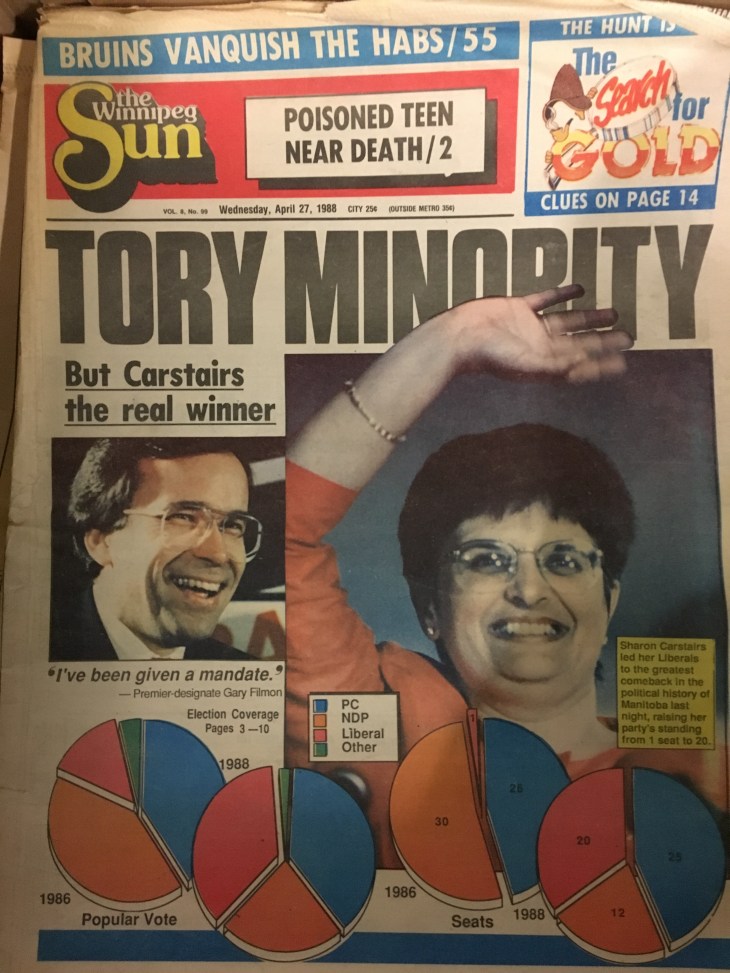
I campaigned for Sharon Carstairs in 1988 when she zoomed from one seat to twenty and Official Opposition status.  It was a Prairie brush fire.  She darn near won the election, and did in fact force a minority government.  The election had major national implications.

Like the 2016 election, there was a deeply unpopular NDP government.  There was a Liberal Party that was rising in the polls.  And a PC leader that had mixed reviews.  The NDP lost a vote in the Legislature (defeated by their own Speaker) precipitating an election.  Premier Howard Pawley resigned and called a leadership convention, which elected Gary Doer.  Doer, against common practice, was not sworn in as Premier.  He led the Party into the election to a third-place finish.  At least renewal in the NDP was underway.

This election has been far different for the NDP.  The incumbent Premier Greg Selinger faced an internal revolt and beat back the dissidents in a leadership review and limped into the election.  Renewal postponed.

The PCs in 1988 were led by Gary Filmon.  Nice guy.  Bland.  Didn’t set the world on fire.  He narrowly lost to the NDP in 1986 (30 seats to 26).  In 1988, the NDP vote was collapsing but voters weren’t sprinting to the PCs.  Would Filmon get them over the finish line?  If not, political career over.

Enter Sharon Carstairs.  She held her own seat in the Legislature, a minor miracle for a Liberal on the Prairies to be elected in the 1980s.  She built the Party up and stood out as a strong opponent of the Meech Lake Accord, aligning with prominent national opponents  like Jean Chretien.

As a Young Liberal in the day, I drove across the Prairies with my buddy Iain in his Ford Escort to support an improbable breakthrough.  We door-knocked for Liberal candidates like current MPs Kevin Lamoreux and Jim Carr, and former BC Liberal MLA Gulzar Cheema – all who ran in that campaign.  And many others too – let’s just say, there were a lot of “characters” running in that campaign.  Current MP Terry Duguid was the Liberal executive director then.

Carstairs seized the agenda during the TV debate and never looked back.  Momentum that was building, exploded (Gordon Wilson followed this playbook in the 1991 BC election).  She raced to the top of the polls.  When the dust settled, Carstairs won much of Winnipeg, but was held off by the PCs who used their rural muscle to win a plurality of seats, albeit a minority.

Figure 2: Coveted political artefactIMG_4154


Carstairs strong opposition to Meech Lake pushed the Filmon government into taking a much tougher position.  The three leaders – Filmon, Carstairs, Doer – were all in Ottawa for the constitutional showdown in June 1990.  They brought the final deal home to Manitoba where Elijah Harper defeated it, and in doing so, killed the Accord.  Do elections matter?  In this case, the Liberal surge in 1988 changed the course of Canada’s constitution.  Meech may have happened with a Filmon majority.

What’s up with 2016?

So, why isn’t it happening this time?  The conditions are there.  Deeply unpopular NDP with a lot of of centre-left voters shopping for an alternative.  The PC leader Brian Palliser is perceived as less moderate than Gary Filmon.  His leadership numbers aren’t bad but they are not great either.  And the federal Liberal brand is far, far stronger in 2016 than it was in 1988.

It boils down to the Liberals.  Sharon Carstairs was a crackerjack leader.  She ultimately could not sustain the growth in Liberal support, but she was the right leader at the right time in 1988.  From my perch going from riding to riding, I detected real enthusiasm from the grassroots and strong leadership in the campaign.  It was loose, it was fun, and everyone was going with it.

This time, the Liberal leader Rana Bokhari has struggled.  Mainstreet polled following the TV leader’s debate on April 12th.  She was a minus 40 on impressions; NDP Premier Greg Selinger was minus 32.  Brian Palliser was a net zero.  That’s a lot of collective disappointment for the voters.  The Green leader James Beddome scored the best.  Her high polling numbers pre-writ masked underlying weaknesses that have been exposed during the writ period.  In 1988, had social media existed, I’m pretty sure some of the guys who got elected as Liberals would not have made it to the ballot box (I could tell you about the guy with mirrors on his ceiling).  In 2016, the Liberals lost six candidates, which blows you off message pretty quickly.  And was there a message?  Not apparently.  Compared to Carstairs, she wasn’t ready.

Palliser also has the good fortune of not having a federal Conservative government in power.  Filmon was plagued by Brian Mulroney who had moved a huge CF-18 contract from Manitoba to Quebec.  If there is a Harper hangover, it hasn’t hurt him too much.

After 1988, Filmon moved to occupy Carstairs’ territory on the Constitution.  He called an election in 1990 and secured a majority, and repeated the feat in 1995.  Gary Doer hung in there, losing three elections before he won three of his own.   The Liberals faded into the background.  With the federal Liberals gaining 45% of the vote in Manitoba six months ago, this was to be their time again after a 27 year frost.

Now, with both the NDP and Liberals performing poorly, and the Greens highly unlikely to convert growth into seats, this has the makings of a very strong PC majority. The NDP should retain a nucleus of members.  It doesn’t look like an apocalypse along the lines of New Brunswick 1987, Canada 1993, or BC 2001.  It may look more like Saskatchewan.  Core NDP seats in Winnipeg and Northern Manitoba should be held even if their popular vote dips as low as 25%.  As for the Liberals, they will look back on missed opportunity.

Update: Mainstreet released a poll April 16th that showed the race at 55% PC; 26% NDP; and with the Greens ahead of the Liberals in Winnipeg, indicating that protest voters may have found a new home.  Gordon Campbell’s BC Liberals had 57% in 2001 and took 77 of 79 seats.  I think the NDP in Manitoba will do better than the BC NDP did in 2001 which will save core seats.  They do better with older voters (who vote).

Green Leader James Beddome is running in Fort Garry / Riverview, a seat that went 55% NDP in 2011 but they will likely lose next week.  Voters went federal Liberal in 2015.  So, given his strong debate performance and momentum, it is not out of the question that the Greens win a seat.  The Alberta election saw an Alberta Party member elected along with a lone Liberal.  BC has a Green and an independent provincially, along with a federal Green MP.  Beddome’s riding is adjacent to River Heights which used to send Sharon Carstairs to the Legislature.  It will be a steep hill for the Greens to climb but Beddome will likely do respectably.


NDP between a ROC and a hard place

Until 2011, the NDP was scarcely a factor in Quebec.  Jack Layton redrew the federal political map in that election.

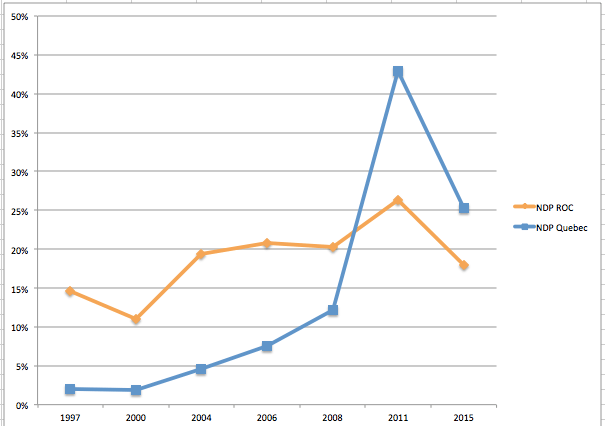
The NDP had been on a slow but steady climb in Quebec under Layton, starting with barely 1% of the popular vote and reaching double digits (barely) in the 2008 election.  The meteoric rise in 2011 masked the fact that NDP gains in the Rest of Canada (ROC) were not as spectacular.  The NDP had nested in the 15% to 20% range from 1965 to 1988 before crashing in the 1990s.  Their historic vote was almost entirely in ROC.

The general elections of 2011 and 2015 are the only two in the NDP’s history where the popular vote was higher in Quebec than ROC.  In 2015, ROC fell back to 18% – in its traditional zone as third party.

Chart 1: NDP popular vote (%) in Quebec and Rest of Canada (ROC)Screen Shot 2016-04-12 at 10.43.22 AM.png

Now, with Thomas Mulcair on his way out, does the NDP have a future in Quebec?  It was Mulcair’s by-election victory during the Layton era that helped spark NDP growth.  What will be left of the NDP post-Mulcair?  It risks turning its back on what has become, in the past two elections, a key base of support.

Layton’s high water mark in ROC was 26% (2011).  In order to govern, a new leader will need to eclipse Layton in ROC while renewing support in Quebec post-Mulcair.

A tall order indeed.  Though governing does not appear to be on the NDP’s mind.


US Primaries by County

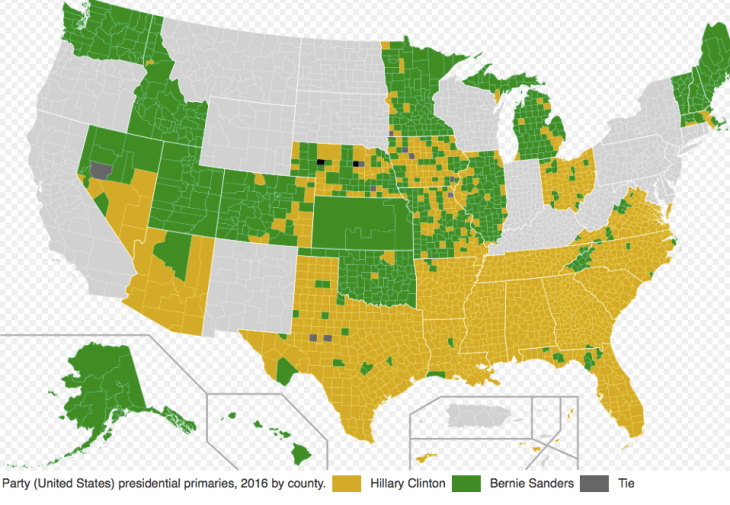
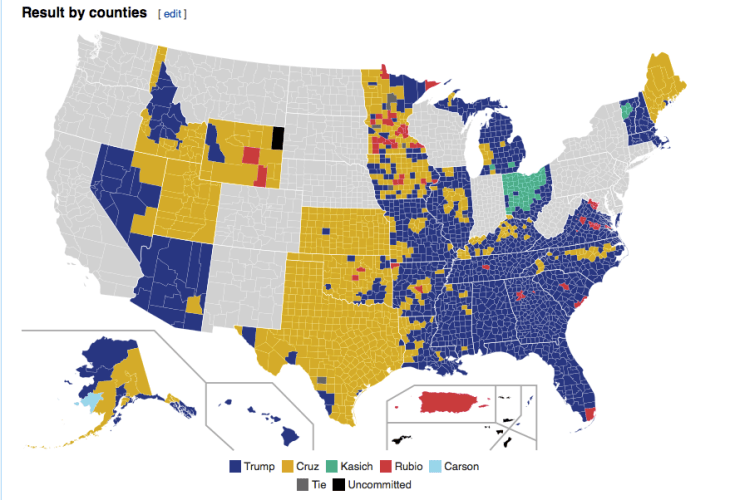
Here are the Republican and Democratic results – by county- thus far, as found on Wikipedia.  The South is a huge power base of delegates for both Hillary Clinton and Donald Trump.

The Democrats:

Screen Shot 2016-03-28 at 9.17.03 PM.png

The Republicans:

Screen Shot 2016-03-28 at 9.14.29 PM.png

Interpretations of the Calgary-Greenway By-election

Yesterday’s provincial by-election in Calgary-Greenway has contradictory interpretations.

fork

Interpretation of Calgary-Greenway is not straight-forward

It was a four-way race ranging from 27.7% for the winning PC candidate to 20.2% for the fourth-place NDP.  It’s rare to see four candidates place above 20%.  I could not find one such example in the 2015 federal election, unless you count Nanaimo-Ladysmith where the four-way race had the 4th place Greens at 19.7%.

In Calgary-Greenway, when only 7.5% separates 1st and 4th, it’s hard to see it as Earth-shaking.  Nevertheless, the PCs won and a win is a win.  Therefore, interpretation #1 is that the PCs are alive, that they must still be reckoned with, and the NDP’s relegation to fourth is a sign of their demise.

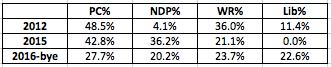
Interpretation #2 is that the Centre-Left (NDP/Liberal) has made major gains in this riding since 2012 and further reduced the PC-Wildrose combined vote from 2015.  In 2012, the NDP-Liberal vote in this riding was a combined 15.5%; in yesterday’s by-election it was 42.8%.  It rose from 36.2% in 2015 and given that that was solely the NDP vote, one can see how the NDP benefit from no Liberal in the race.

Table 1: Popular vote of parties in 2012 General Election (GE), 2015 GE, and 2016 by-electionScreen Shot 2016-03-23 at 10.42.06 AM.png

As Table 1 shows, the NDP was actually five times higher than its 2012 vote and the Liberals have doubled from 2012.  There is a lot of talk about PC-Wildrose cooperation, but the centre-left should probably be viewed in the same way.  Not that there is an imminent merger, but there is a competition for like-minded voters.  The Liberals bothered to show up to the by-election after missing the 2015 GE and their impact was significant.  That may be in part a result of local candidate influence, but I’m not sure how many saw the Liberals competing to win the seat.

Table 2: Raw vote of parties in 2012 GE, 2015 GE, and 2016 by-electionScreen Shot 2016-03-23 at 10.42.15 AM.png

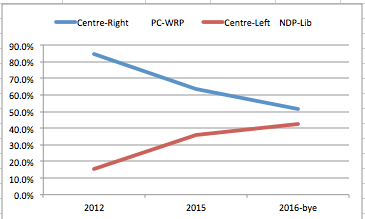
The 2012 GE and 2016 by-election are interesting comparisons because the overall number of voters is very similar.  It shows the overall reduction in votes for the PCs and Wildrose (centre-right) and the significant increase for the NDP and Liberals (centre-left).  Let me nail this point a little harder in Chart 1 below:

Chart 1: Combined popular vote of PC-WRP (blue) and NDP-Lib (red)Screen Shot 2016-03-23 at 11.02.12 AM.png

Unlike the recent BC by-elections in Coquitlam-Burke Mountain and Vancouver-Mt. Pleasant, turnout in Calgary-Greenway as a percentage of the previous election was relatively high, and as noted, about the same as the 2012 GE.  The by-election turnout was about two-thirds of the 2015 GE turnout while the BC by-elections were about 40% of the previous GE.  That indicates a higher interest and engagement in the outcome and its possible impact on the next election.

If I was a PC or Wildrose strategist, I would interpret this result with some nervousness.  The pool of centre-left voters in this by-election was almost evenly split.  The voter pool that existed in 2015 massively went toward Rachel Notley’s NDP.  This is basically the Justin Trudeau/federal NDP vote bloc.  The Stephen Harper vote bloc was much larger provincially, but is also split.  A consolidated centre-left offering (whereas those voters group behind one strong alternative) appears still able to defeat a split PC/Wildrose offering.

In reality, it is more complicated than described above.  Voters move around between parties with more fluidity – a Liberal may never consider NDP and a PC may never consider voting Wildrose, and vice versa.  But the by-election does show that the situation has become more, not less murkier as a result of Tuesday’s outcome.  It’s too early, much too early, to write off the Alberta NDP.

Finally, it must be noted that – probably for the first time in Canada – there was a competitive four-way race between four South Asian candidates.  This may well have created a dynamic that disrupted prevailing provincial political currents.  I’m not close to the ground so I defer to others and invite comments.  Regardless, the fact remains that the market share for the Centre-Left in this riding has increased sharply since 2012.


Flashback: A week in Ottawa in 1986

Thirty years ago this month, I was given the opportunity to participate in the Forum for Young Canadians.  The name speaks for itself – for one week in Ottawa, young Canadians from all over Canada came together to learn about Canada’s institutions and learn from each other.

Forum is one example of the power of bringing young Canadians together. In my case, it led to many lifelong friendships and it opened my eyes to the breadth and depth of our federation.  It also opened my eyes to the potential of contributing to the life of Canadian institutions.

How many young people were inspired to be a part of public service that week?  Well, it certainly fuelled my engine in terms of politics and government.  I was already hopelessly hooked as a teenager (an oddity), but I certainly came home with an even bigger appetite.

IMG_4015

There were a lot of kids from all over Canada.  In the photo above , you will also see Cyrus Reporter, Senior Advisor to Prime Minister Justin Trudeau.  All the way from Merritt, BC.

And Stuart Hickox, the Executive Director of ONE.org in Canada, Bono’s initiative to combat extreme poverty in the world.  My volunteer work with ONE stems from meeting Stuart at Forum 30 years ago, where he traveled from Winsloe, PEI.

I met lifelong friend Kimball Kastelen, who I cajoled into joining the BC Liberal Party and he made it to the ballot in 1991, placing a strong second in Kamloops.


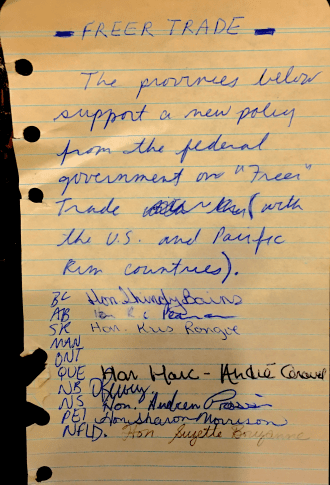
At the end of that week in Ottawa, there was a FFYC Freer Trade document
mock First Ministers’ Conference held with students forming provincial delegations and selecting a premier from amongst their ranks.

Kimball and I didn’t have a lot to do so we decided to promote a free trade agreement.  For the balance of the day, we lobbied provincial delegations and managed to secure the agreement as one of the conference’s top priorities, with 8 of 10 provinces agreeing. Typically, Ontario refused to part with its protectionist ways but Manitoba was being hopelessly ideological.  In any event, we got it done.  (Brian Mulroney was a little late to the game with his free trade agreement).

Yes, I know.  Hopelessly geeky. No, not the fact that we were earnest students.  The fact that I would keep this piece of paper for 30 years!

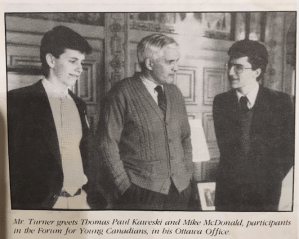
With my Liberal heart beating inside me, the other mission that week was to pay homage to my Leader, Rt. Hon. John Turner in his 4th floor Centre Block office.

Screen Shot 2016-03-18 at 10.22.12 AM

His ever attentive constituency assistant, Diane (Wells) Ledingham, arranged for me to crash a meeting between Mr. Turner and one of the Forum participants from Vancouver Quadra, Tom Kaweski, who despite my interloping, remains a lifelong friend.

Think about that.  A former prime minister, then serving as Leader of the Opposition, making 15 minutes to shoot the breeze with two teenagers from BC.  I’m not sure that happens as much anymore – maybe it does.  But it sure made an impression on me.  Mr. Turner, resplendent in his red cardigan, showed us around his office, including the secret panel where apparently MacKenzie King would hide from people demanding to see him.

It was a different time.  There was virtually no security on Parliament Hill.  We wandered the tunnels and hallways freely.  There was no email or social media.  There were no cel phones.  Fax machines were new!  When our week concluded, those of us who stayed in touch sent each other handwritten letters.  Believe it or not Millennials, that’s how it used to be done.

Of those fresh-faced youngsters in the group photo, I’m not sure where most of them ended up, but I assume many are leaders in their community, academia, government, business or NGOs.  In any case, I expect that that week in Ottawa 30 years ago was as  formative experience in their lives as it was for me.

I don’t think Canada can have too much of these programs.  The more interaction among young people from different regions and walks of life – the better; the more exposure to federal institutions – the better.

It’s good to see Forum continuing their good work.  It remains a great program for young people today and in the future.


John Dyble: Quiet Strength at the Heart of Government

John Dyble’s pending retirement wasn’t front page news, which is the last place he would want to be anyway.

For five years, John has been Deputy to the Premier and Cabinet Secretary – the head of the BC Public Service.  It’s an incredibly demanding job.  On a day-to-day basis, there are 18-19 ministries that must have oversight along with crown corporations, like BC Hydro and ICBC, that are among the largest companies in the Province.  Managing the cabinet process alone is a daunting task – as Cabinet Secretary, he was responsible for flowing the agenda of government through the cabinet committee process to the Cabinet Table.  Then there’s the constant public scrutiny and the persistent howls of stakeholders.  Overall, the job looks over  a $50 billion-plus enterprise, led by a humble, dedicated, career public servant.

There are no 7-figure salaries or major bonus packages for guys like John Dyble.  He could run circles around many in the private sector, but he, like many in the public sector, do what they do because of their commitment to public service.

I recall the time that John was hired by Premier Christy Clark.  Following her leadership win in 2011, there was a brief transition period where a cabinet had to be constructed, a caucus had to be consulted, and senior appointments had to be made.  Most importantly, the question of who to lead the public service.  John was an inspired choice that complementedjohn_dyble_large the Premier’s leadership abilities.  The Premier needed to bring her party and caucus together after coming from the outside to win.  She needed stability, competence, and strong execution at the centre of government to provide her with the ballast needed as she set out to establish new direction.    John had a reputation of getting things done whether it was Transportation, Forestry, or Health Care.  He was highly regarded by his peers.  That he had been a Deputy Minister to Kevin Falcon recommended him further.  Kevin was a very able minister who had a busy agenda – he didn’t stand pat.  That a deputy could keep pace with Kevin is noteworthy, let alone the accomplishments that took place.  John’s appointment was an important signal that the Premier would choose the best, regardless of who he or she had worked with.  After all, John has never been a partisan – he served NDP and BC Liberal governments and found creative and effective ways to meet the public policy goals for the government of the day.
When the Premier interviewed John for the role, he met with me afterward.  Holed up in a downtown hotel, John and I talked at some length as the sun went down.  Our conversation literally got darker until I basically couldn’t see him in his chair.  That was the last time I was ever in the dark with John Dyble.  We had a great relationship where, as the Premier’s first Chief of Staff, I had complete confidence in his ability to handle his side of the ledger, and he let me handle my side but we kept each other in the loop and pushed back at each other, respectfully, when necessary.

A key part of John’s legacy has been the disciplined management of government.  Perhaps not fully appreciated at the time, the Premier’s leadership platform called for running a tight ship.  Her fiscal plan received top marks from the Canadian Taxpayers Federation.  She spoke, bravely, during that leadership campaign about the need to wrestle health care spending increases to the rate of economic growth – so that we could afford quality public health care, and other critical services, into the future.  Over the past five years, Premier Clark – and her Finance Ministers – have met and exceeded expectations in terms of balancing the budget and setting a course for lower debt/GDP and ultimately creating a sturdy platform by which BC now leads the country in economic growth.  That takes discipline from the top.

Earlier in the Premier’s mandate, the Jobs Plan was launched.  This process brought laser-like focus to economic development within government.  The implementation of the Jobs Plan, and the buy-in it received across government, required a lot of heavy lifting.  The LNG strategy was another example of how John could harness the public service to ensure focus behind a critical policy goal.  These don’t even begin to record John’s accomplishments on the job.

The Premier’s Office is a lean operation.  It is not like the federal government’s Privy Council Office nor the “Cupcakes” of previous BC governments, where there was a more centralized policy approach.  BC’s public service is quite decentralized, therefore, those directing traffic at the centre are stretched.  In physical terms, the 2nd floor of the West Annex is where that happens and it is not a large workspace – kind of shocking actually how much goes through that floor considering the magnitude of their responsibilities.  Despite these modest resources, John and his team have proven adept at reaching public policy goals.  Compare BC to other provinces over the past five years.

The job is a gruelling one, made even more challenging by health issues that John has combatted.  He’s tough and resilient, qualities that are very appealing to the Premier.  But he’s not your showy “Tough Guy” tough guy; he’s quiet and leads by example – humble.

With the recent retirement of both Peter Milburn as Deputy Minister of Finance and Dan Doyle from full-time role as Chief of Staff, John Dyble’s departure marks an end to an impressive trio of Transportation Men who helped guide government from 2011-2016.  All three having served as Deputy Minister in Transportation, all three playing different but critical roles for Premier Clark.  Collectively, they have made an outstanding contribution.

And individually, John Dyble’s accomplishments stand well on their own.


A deeper dive on BC By-election turnout

My post on by-election turnout earlier this week was picked up in the Vancouver Sun and Globe & Mail, proving that there’s a lot of interest in apathy.

In my earlier post, I stopped at 2004 in terms of comparing turnout to past BC by-elections.  Because I couldn’t help myself, I have now gone back to 1981 to see how engaged BC voters have been when it comes to mid-term voting.  If you’re not a political junkie, avert your eyes.  This is really geeky stuff.

obit-bill-bennett

Bill Bennett was successful in electing a government member in the 1981 Kamloops by-election.  It hadn’t happened since 1966 and it hasn’t happened since, unless the candidate’s name was Christy Clark.

This week, turnout in the two by-elections was less than 22% of eligible voters.  Put another way, the turnout was only 39% and 41% of the voters who voted in the 2013 general election.  In Coquitlam-Burke Mountain, less than 8,000 voted in the by-election compared to about 20,000 in 2013.My review of 15 by-elections between 1981 and 1999 shows a much higher turnout by comparison.

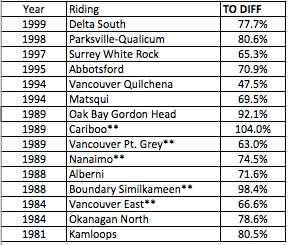
Only one by-election had less than half the voters of the previous general election – that was in Vancouver-Quilchena in 1994 when Gordon Campbell was elected to the Legislature for the first time.  He won in a cakewalk so arguably voters didn’t see a lot of reason to vote.

Table 1: Turnout in by-elections compared to preceding General Election.  Asterisks (**) indicate a two-member seat.  Until 1991, BC had some riding that had two members with voters having the choice to vote for two MLAs on their ballot.

Screen Shot 2016-02-04 at 9.38.09 PM.png

The other 14 by-elections saw a turnout of at least 63% of the previous general election.  Most of these races had a compelling storyline.

1981 Kamloops – The Socreds fought to hold their seat at a time when the margin in the 57(!) seat BC Legislature was razor-thin.  1984 Okanagan North – the then-unpopular Socreds succumbed to the NDP in a strong Socred seat.  The Socreds regained the seat in 1986.  Both of these by-elections had a turnout rate of about 80% of the previous election.

During the Vander Zalm years, there were six by-elections created by the departure of four Socreds and two NDPers.  The NDP took all six by-elections.  Turnout was high relative to current-day by-elections.  At the height of Vander Zalm’s unpopularity, almost as many people voted in by-elections in the Cariboo and Oak Bay as voted in the preceding general election.  They showed up with their pitchforks!

Turnout was at 65% to 70% of the previous election in three Fraser Valley by-elections between 1994 and 1997.  While the governing NDP did very poorly, they were not really at issue in these by-elections.  It was a brawl-for-it-all for the Free Enterprise mantle between the BC Liberals and the Socreds (1994), and the BC Liberals and Reform (1995 and 1997).  There was a lot at stake and voters, for the most part, turned out.

The Parksville-Qualicum 1998 by-election was more of a BC Liberal-NDP fight with Judith Reid eclipsing former (and future) MLA Leonard Krog.  This by-election was a verdict on Glen Clark at the time and had a turnout that was double of this week’s Coquitlam by-election.  Pitchfork time again.

In 1999, it was another BC Liberal-Reform fight when Bill Vander Zalm mounted his political comeback.  The BC Liberals rallied to win 2:1, with about twice the turnout of this week’s Coquitlam by-election.

The 1981-99 era had a lot of by-elections with high stakes and high turnout.  Even the low stakes by-elections had higher turnouts.  Why is it different now?  Perhaps voters are harder to get in a distracted world.  Media sources are more fragmented.  Voters are not herding toward BCTV (sorry Keith) like they used to, nor are they all opening the door in the morning to retrieve the morning Sun and Province like days gone by.  Fragmentation aside, the mainstream media seemed to great the by-elections with a collective yawn this time.  With less media interest, there is inevitably less chatter about politics at coffee-time and over the backyard fence and, ultimately, less turnout.

This all serves to reinforce my view in the earlier post that, unlike the Zalmy 1980s and Parksville in 1998, this week’s by-elections were not pitchfork-carrying affairs.  Low turnout indicates a lack of urgency and lack of consequence.  The turnout, and margin of loss, in Coquitlam-Burke Mountain was lower than in the neighbouring Port Moody-Coquitlam 2012 by-election.  The BC Liberals regained that seat, so there’s no reason to suggest they can’t do the same next year.  We’ll see.