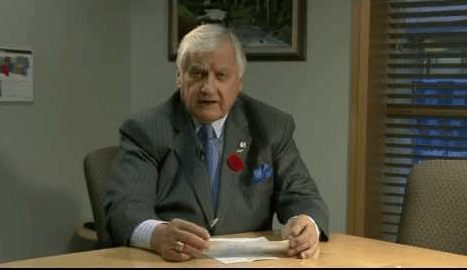
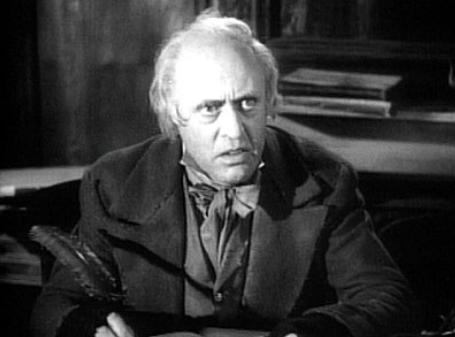
Monday’s by-elections can be viewed as a win for the governing Liberals. They held two seats and won a third from the Conservatives. In answer to my November 20th post, the voters in South Surrey-White Rock gave like Santa to the Liberals and passed out votes like Scrooge to the Conservatives.
That present is from South Surrey-White Rock
By-elections are a great opportunity to send a message. If the government is screwing up, why not vote against them and shake it up? Evidently, there’s not a lot of voter anger in South Surrey-White Rock.
In Monday’s by-elections, the only riding where the Liberal popular vote actually went up was South Surrey-White Rock, which was the only place the Conservative vote went down.
Andrew Scheer’s Conservatives can take some consolation that they reduced the margin-of-victory in Scarborough-Agincourt from 13.9% to 8.9%, and they scraped themselves off the basement floor in Newfoundland, though they haven’t found the stairs yet. In Saskatchewan, like Alberta, they ran up the score, which is nice, but not very meaningful. As for the Liberals, I doubt they are too concerned about the ridings where they slipped. In all three cases, the result looked inevitable, and tough to motivate voters in that case.
South Surrey-White Rock should sting a bit for the Conservatives. This was a safe seat in 2011 and for decades before that. In 2011, a backbench Conservative MP edged the Liberal 53% to 19%. That’s a remarkable turnaround in six years.
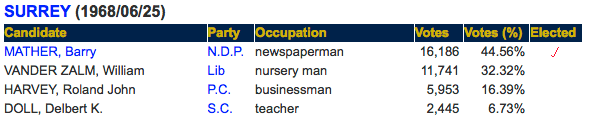
The notion of a Liberal win was unthinkable in the summer of 2015. Liberal strategists had a hard time believing the numbers they were seeing from that riding, against Dianne Watts no less. They almost beat her despite sacking their candidate halfway through the campaign. The Liberals had no history of winning there. They couldn’t even win in Surrey during Trudeaumania I when they took two-thirds of the seats in BC – and the Liberal candidate was “nursery man” Bill Vander Zalm. Trudeaumania plus the Zalm? How could they lose?
So, there has been a change in South Surrey-White Rock and it remains to be seen if it will be a sea change. Liberals may have a bit of deja vu when it comes to winning federal by-elections in BC. In 1998, a Reform MP resigned in Port Moody-Coquitlam and, very similar to South Surrey-White Rock, the Liberals ran a popular mayor, Lou Sekora, while the Reform Party ran a parachute candidate from Langley. Sekora won in a riding the Liberals had not held in a long, long time. In 2000, a young whippersnapper by the name of James Moore defeated Sekora and went on to hold the seat for 15 years.
Lou Sekora: lost to a young whippersnapper
Let’s not forget about the NDP. In Monday’s by-elections, their share of vote dropped in all four races. While none of these seats were NDP targets, they certainly did not demonstrate any grassroots enthusiasm for the new NDP leader.
Congratulations to Gordie Hogg and the Liberals. We’ll see if success in South Surrey-White Rock is fleeting or not. Andrew Scheer and the Conservatives did not collapse, on the contrary, they made some incremental progress. But where it mattered, they could not rally their base to withstand a vigorous effort by the Liberals. Now that the government is in the back nine of its mandate and showing its resilience, Scheer will not be able to count on the government losing the election – he will have to try to find a way to win it. A tall order for any Opposition.
A federal by-election has been called for December 11th in South Surrey-White Rock, which will provide an interesting read of the political thermometer two years out from a general election.
Traditionally, this area has been inhospitable to Liberals. In fact, I can’t remember the last time the South Surrey-White Rock area had a federal Liberal MP – not in my lifetime. They took a pass on Trudeaumania (and candidate Bill Vander Zalm!) in 1968, electing an NDPer. At that time, Surrey and White Rock were encompassed in one riding – how times have changed. Since 1974, the Conservatives have owned the riding. Voters were Scrooge-like toward my old friend Reni Masi (later elected as MLA) who ran twice as a Grit in the area, but gave like Santa when it came to voting for Progressive Conservative Benno Friesen.
On December 11th, will South Surrey-White Rock voters continue to be Scrooge-like toward the Liberals? Or give like Santa?
Gordie Hogg tried in 1993, unsuccessfully, as a Chretien Liberal, losing to upstart Reformer Val Meredith. MLA Wilf Hurd resigned his seat to try it on as a Fed Lib in 1997 and lost; Hogg then took Hurd’s seat in the Legislature and served for 20 years.
Will this time be different? After a brief two-year stint in Ottawa, Conservative Dianne Watts resigned her seat to contest the BC Liberal leadership. If successful in her quest, she will be on a very short list of people who have served as Mayor, MP, and MLA. In the meantime, Gordie Hogg may do the same if elected on December 11th, becoming the first to do so since (I think) Gerry McGeer, the former mayor of Vancouver, who accomplished that feat, plus senator.
The Liberals are bullish and must be encouraged by not only Hogg’s candidacy, but a strong turnout for PM Justin Trudeau last week in White Rock.
Let’s take a look at 2011 and 2015 numbers for BC and South Surrey-White Rock:
The Conservatives hung on in 2015 – barely. Despite Dianne Watts’ profile as longtime mayor of Surrey, the Conservative vote dropped from 52.9% to 44%. Taking a closer look, however, it appears that Watts ran ahead of the curve, salvaging the seat. In 2011, the Conservatives ran 1.16X the BC popular vote, whereas in 2015, they were 1.47X ahead.
The Liberals were shot out of a cannon in 2015 compared to 2011. The Liberal vote in BC increased 2.63X, but in South Surrey-White Rock, the gain was only 2.18X. Had the trend been replicated there, Judy Higginbotham would be the MP. There are extenuating circumstances – Judy wasn’t supposed to be on the ballot. The longtime Liberal warrior jumped in when the initial candidate was ejected mid-campaign for a since-forgotten gaffe. Arguably, the Conservatives benefited from that bit of luck. At the outset of the campaign, it must have looked like they would cruise to victory with Watts and, by the end, they were in an unexpected fight of their life. It’s one of the few toe-holds they have left in Metro Vancouver.
With the Liberals leading the Conservatives by about five points in the BC popular vote in 2015 but losing this seat, it stands to reason that the Liberals need to be as popular relative to the Conservatives in BC now in order to win the by-election, and trust that Gordie Hogg’s profile in the area lifts them a few additional points over former MP Kerry-Lynne Findlay, who has parachuted in.
The NDP is not a factor here. I’m sure that strategists at Big Orange are devising ways to drive up Justin’s negatives in the by-election to aid the election of a Conservative.
The latest public polls (caveat emptor) are contradictory regarding federal party standings in BC. Angus Reid has a four-point CPC lead; Nanos has a six-point Liberal lead; and Abacus has an 11-point Liberal lead.
Then there is turnout. The 2015 general election had a 75% turnout. It was a high turnout election to begin with, but in South Surrey-White Rock, they have voting circled in their calendars – it’s an event. I would expect a drop in turnout like any by-election but not as steep a drop as other places. Older people will disproportionately vote in a by-election compared to a general election (I have no data at my fingertips to back up this claim, but I think it’s true). That should give the Conservatives a bit of help.
The Upshot:
The Conservatives had a stronger candidate in 2015 relative to 2011, and the Liberals had candidate trouble. The Conservatives over-performed; Liberals under-performed.
The Liberals have recruited a strong candidate in 2017; the Conservatives have a good candidate but she is not personally well-known in the riding. Advantage: Liberals.
The atmosphere in BC is the wildcard. The Conservatives have a new leader in Andrew Scheer – are they better or worse off than 2015? Likely worse off as Scheer is not very well-known or defined. CPC has to make the by-election ballot question about the Liberals and Trudeau, not about local representation.
To that end, just how damaging are the Morneau-small business tax changes? This riding should feel this issue more than most – it’s full of upper income, white collar professionals with a small ‘c’ conservative tilt. Many of the people who voted Liberal last time in South Surrey-White Rock are the type of voters that Scheer needs to attract. If anything, this by-election is a litmus test as to whether that issue – which dominated federal political headlines in August-September, has any teeth at the ballot box.
In three weeks, we’ll know if the voters are feeling like Santa or Scrooge when it comes to the mid-term government. For the Liberals, this is a seat they never win so they have little to lose so long as they manage expectations. For the Conservatives, it will be tough loss for a new leader, on the heels of losing a Quebec seat to the Liberals recently, though also an opportunity for momentum for a new leader trying to get established. Right now, the Conservatives look like they have their work cut out for them.
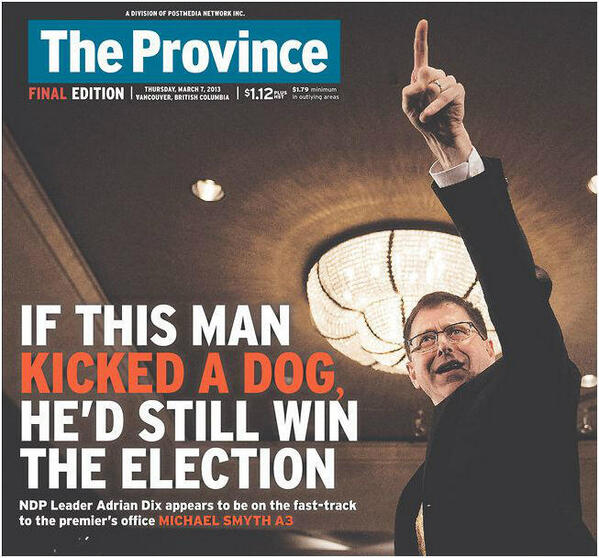
Here we go. The Vancouver Sun is trumpeting a poll on the front page that shows the NDP with a 10-point lead.
I could probably drive a truck through the methodology of this poll. But that’s not the point.
The point is: of course the NDP can win! That is an eternal truth of BC politics.
It’s a dogfight this time.
In February, I addressed the BC Liberal provincial council where all of the campaigners were in town for a pre-election briefing. I said there what I say now: the NDP get 40% of the vote before they get out of bed in the morning. Or 39% anyway. They are always lurking in the shadows.
In 10 of the last 11 BC elections, the NDP have hit the 39% threshold. They won an election with 39% in 1996. In the past three elections, it hasn’t been enough as the BC Liberals have finished about 4-points ahead each time. But we know they can win. I respect that and I respect them. They are tough adversaries.
An NDP friend of mine told me last fall that the only time he believed the NDP could win was when he talked to me! The NDP seemed down in the dumps. The set-up for the election is reversed this time – the underdog became the overdog and vice versa. Conventional wisdom is a powerful thing and most observers felt the BC Liberals were cruising to victory in 2017. I have never felt that this was going to be easy. My nickname “Eeyore” is borne from hard-luck lessons on the campaign trail over the years.
So, 10-point lead? My advice to BC Liberal followers and other interested voters is to believe this snapshot could be real, midway through the campaign.
What does this mean? The BC Liberals have led a lonely crusade to expose the NDP platform dare, which is to promise everything to everyone without the means to pay for it, and hoping they won’t get caught. Now, you would think the media and general scrutiny would increase, and in recent days, the NDP has been marked up a bit with more scrutiny about the role of the Steelworkers and nagging questions about how to pay for eliminating Medical Services Premiums. I also believe that voters see the NDP’s flashy, dashy promise to eliminate Lower Mainland bridge tolls as unrealistic – “how are they going to pay for it” and “nothing comes for free” are voiced by voters at the doors and in focus groups.
With two weeks out to election day – and four days until the start of Advance Polls – it is clear that the stakes have been raised in this election.
The next two weeks will be vigorous. There is a lot on the line. We should always campaign like we are ten points behind.
I feel good about a lot of things in this campaign. The response at the doors is good. Morale is positive. We have a great team of candidates and they are working hard. My view is that the Premier has out-performed John Horgan at the radio debate and on the nightly news. The BC Liberals have a strong core of seats and a resilient voter base. We’ve been here before and fought through it.
For those who believe BC is on the right track, take the Mainstreet poll as a serious wake-up call. Of course the NDP can win. Could election night be a 10-point NDP margin? 15-points in the Lower Mainland as this poll suggests? (I cannot resist point out that the poll does not reveal the number of interviews with key multicultural communities). I do not take these poll numbers literally, but I do not discount the potential of an NDP victory. John Horgan’s sensitive hands are dangerously close to the reins of the economy.
In 2013, while we knew where we were at, we snuck up on the NDP, media, and conventional wisdom and had an election night surprise.
In 2017, its eyes wide open. There will be no sneaky NDP win. The NDP can only win now if it is an an out-in-the-open fully considered decision. The overdog and underdog have now converged. It’s simply now a dogfight … and that’s fine with me. An out-in-the open fight over BC’s economic future and what it will mean to BC families.
When it comes to electing First Nations people from British Columbia to the Legislature or Parliament, all political parties have to do better.
The right of First Nations to vote was finally acknowledged in 1949 in BC (not until 1960 federally). Nisga’a Frank Calder was elected from the riding of Atlin in 1949, representing the CCF. He served most of the next 30 years as MLA from that riding. In 1972, he was the first aboriginal person appointed to cabinet in BC, though was later removed by Premier Dave Barrett. According to a biography of Calder, the NDP moved on from Calder, nominating another candidate in the 1975 election. Calder left the NDP, joined the Social Credit Party, and was elected for the last time. A recipient of the Order of Canada and the Order of British Columbia, Calder’s career deserves more attention, which included his leadership role in the Calder case, massively significant to the recognition of aboriginal rights and land claims.
Yet few others have followed in Calder’s wake. Larry Guno was elected as an NDP MLA from Atlin between 1986-1991 but did not run again. Until Melanie Mark was elected in the Mt. Pleasant by-election, there had been no First Nations representation since 1991 in the BC Legislature. I was hopeful that Marian Wright, a former Chief, would succeed for the BC Liberals in 2009 in North Island but she fell short.
The story federally from BC isn’t any better. Len Marchand was elected as a Liberal in Kamloops amidst the first round of Trudeamania in 1968. He held the seat twice, and until 2015, had been the only Liberal to represent a seat in the Interior for decades. Len went on to serve in the Senate. He passed away last year, but left a considerable legacy. In particular, he was a strong advocate for First Nations representation in Parliament. He made an important point – First Nations populations are scattered across Canada with diluted voting strength on a riding by riding basis. It was no coincidence that the only riding to elect a First Nations person was the one riding where First Nations had the numbers . Len thought that aboriginal people should have guaranteed representation based on their proportion of the population. It’s an interesting point and it remains to be seen if recent advances in representation make such a guarantee a moot point.
Today, there is a heightened awareness and advocacy for aboriginal representation in our institutions. Provincial legislatures are starting to see higher levels of representation as is the federal Parliament. Groups and networks have formed to promote indigenous representation.
But what about BC and this election? Premier Christy Clark has made it a priority to recruit First Nations leaders to run as candidates. She has three strong candidates running in seats held by the NDP that can be described as ‘swing’, meaning they should be close races. Former Haisla Chief Councillor Ellis Ross is running in Skeena; Wanda Good, who has served as a deputy Chief and an advocate for First Nations women, is running in Stikine; and former Nanwakolas Council president Dallas Smith is running in North Island.
The Premier took some flak for appointing Ellis Ross as candidate in Skeena. She did it because she felt she needed a leader like Ellis in the Legislature. She went out and recruited Wanda and Dallas to the team as well, and ensured they have local teams to support them. This week, the BC Liberals launched a 30-second TV spot promoting their First Nations candidates. The party is making the election of these candidates a priority.
The NDP nominated and elected Melanie Mark in the Mt. Pleasant by-election. Mark became the first First Nations woman elected to the BC Legislature which, like the election of Wilson-Raybould, was long, long overdue.
But then there is the curious case of the Fraser-Nicola riding. Chief Aaron Sam of the Lower Nicola Indian Band, a lawyer, sought the NDP nomination. NDP Leader John Horgan asked former MLA Harry Lali to stand down and make way for Sam. Lali refused. At this point, Horgan has a choice. He can override Lali and appoint Sam, or he can let it play out. Horgan let it play out and Lali, a four-term former MLA, got the votes.
Simply put, Horgan did not make the nomination of Chief Aaron Sam a top priority. If he wanted to make it happen, he could have. The NDP can claim ‘local democracy’ but its nomination process is already a shambles when it comes grassroots democracy. NDP minority-preference rules have already caused confusion and resentment in places like Columbia River-Revelstoke, Cowichan Valley, and Skeena. I understand Horgan’s choice. Nomination politics can be messy and Harry Lali would surely have not gone quietly into the night. It just means one less First Nations leader seeking a seat in the Legislature, which is too bad considering our history. It also means one less leadership moment for Horgan, especially at a time his party should be looking for renewal.
Premier Clark stuck her neck out and is proudly campaigning alongside three strong First Nations candidates. So far the Greens (including Deputy Leader Adam Olsen) and NDP have two First Nations candidates each, perhaps more will emerge. Let’s hope all parties in the future stick their necks out when necessary to get First Nations candidates on the ballot and into the Legislature. It would make a difference. From my side of the ledger, I hope to see Ellis, Wanda, and Dallas elected on May 9th.
The renewal dynamic had a new twist on March 18th when NDP members rejected Leader John Horgan’s chosen candidate, Lower Nicola First Nations Chief Aaron Sam, and opted for Harry Lali who first won in 1991, re-elected in 1996, did not run in 2001, elected in 2005, re-elected in 2009, and defeated in 2013. Lali’s candidacy puts a punctuation mark on my blog post.
—–
Andrew Weaver raised the issue of term limits for BC politicians. He assumes that voters can’t make up their own mind whether they want to keep their MLA or not. It’s not such a bad thing to have a bit of experience in the Legislature. I suppose Andrew Weaver would have had Winston Churchill sit out WWII! I can hear the cries of “Shame!” emanating from Oak Bay right now.
But renewal is important. Most voters would say that “new blood” is important for our public institutions. I certainly believe that. Last election, Premier Christy Clark made a strong statement by recruiting a lot of new, strong candidates. It was seen as one of the hallmarks of her success. Half of her caucus was newly elected in 2013, which is uncommonly high. This time, the Premier continues to recruit strong new candidates like First Nations leaders Ellis Ross, Wanda Good, and Dallas Smith; former Coast Capital CEO Tracy Redies; and former journalists Steve Darling and Jas Johal… just to name a handful from a very solid list.
Premier Christy Clark serving up some renewal with candidates like Dallas Smith (North Island)
How have the BC Liberals and NDP renewed themselves? The past three provincial elections have seen a level of stability in BC and provides a basis to compare:
2005: 46 BC Liberals vs 33 NDP
2009: 49 BC Liberals vs 35 NDP vs 1 IND
2013: 49 BC Liberals vs 34 NDP vs 1 IND vs 1 Green
In terms of renewal, you would think there would be more BC Liberals remaining from the class of 2005 than NDP since there were more BC Liberals elected. In fact, the opposite is true.
There are 15 NDP MLAs from 2005 running for re-election in 2017. That equates to 45% of NDP MLAs elected in 2005 still around to seek another term in office in 2017. Plus Jagrup Brar, who was elected from 2004-2013, is seeking to return. Harry Lali (1991-2001, 2005-2013) also now adds to this list.
The BC Liberals elected 46 MLAs in 2005 but only 9 remain today to run in the 2017 election. Thus, less than 20% of BC Liberal MLAs elected in 2005 are running today.
Thus, using 2005 as a point of reference, the BC Liberals have renewed at more than twice the rate than the NDP.
Another way to look at it is that out of 87 ridings today, only 18 BC Liberal MLAs seeking re-election in 2017 were elected prior to 2013. That group makes up only 20% of the BCL candidate slate, and only 43% of the current caucus (with the remainder having been elected in 2013). That is also a pretty good renewal rate.
The BC NDP have 20 MLAs who have been around since prior to 2009 that are seeking re-election, which is 57% of their current caucus. Their renewal rate is lower. NDP MLAs stick around longer, especially on Vancouver Island.
On Vancouver Island, there is only Michelle Stilwell seeking re-election for the BC Liberals and she was elected in 2013. The NDP have 8 MLAs that were elected in 2005 and going for their fourth term. That seems like the opposite of renewal and sets up a clear contrast between the parties. For those Canucks fans arguing for a rebuild of the team, that’s what is happening on the Island for the BC Liberals. After disappointing results in 2013, the BC Liberals have pressed reset, retooled, and relaunched with a slate of candidates that bring new energy. Same old NDP faces, for the most part.
Andrew Weaver’s motivation to renew the Legislature is a good thing. The BC Liberals have excelled at renewal compared to many modern political parties. Perhaps Dr. Weaver is surrounded on Vancouver Island by so many BC NDP MLAs seeking a fourth term that he sees term limits as his only escape. This time, there may be a cohort of first-term BC Liberal MLAs on the Island to ease his concerns… maybe even in Oak Bay.
Dave Holmberg passed away recently at age 75. If you do not live in Abbotsford, you may have never heard of him. To me, he was one of the good guys in BC politics. Not because we supported the same party, but because he epitomized the healthy convergence between community and politics.
I met Dave in the fall of 1993. He was supporting a young upstart candidate in an upcoming by-election in Matsqui – a bespectacled, balding country lawyer and school trustee, who was not yet 30 years old.
BC politics was in a time of upheaval. Gordon Campbell had been elected leader of the BC Liberal Party in September 1993. He sought a seat in a Vancouver by-election. Out in Matsqui, erstwhile Social Credit MLA Peter Dueck resigned, setting up a “free enterprise primary” between the declining Socreds and the upstart BC Liberals. The Socreds had held the seat for decades; the BC Liberals had won seats nearby in the 1991 election.
The BC Liberal nomination in Matsqui was hotly contested. The young country lawyer faced a polished, downtown Vancouver lawyer who had been an Abbotsford basketball star in his youth.
Dave went all-in on the young country lawyer. I remember going to the nomination meeting in a high school gym somewhere in deep dark Abbotsford. The country lawyer and Dave mobilized support, especially in the South Asian community, and pulled off, what was seen from the outside, as an upset. Over 23 years later, Mike de Jong hasn’t looked back, serving as Attorney-General, Forests Minister, Finance Minister, House Leader and a host of other senior roles.
Mike de Jong’s toughest campaign was the first campaign – the by-election. I was assigned as the party organizer (I was the only party organizer at that time) and I happily volunteered to move out to Matsqui for the duration. Dave was the campaign manager and, with the good graces of his wife Lee, I moved into his basement for a month.
Dave and his able communications man, Mark Rushton, built a team of strong locals, many who are still involved in the party today, like MLA Darryl Plecas. There was a feeling in that campaign of optimism and change. Grace McCarthy had returned to lead the Socreds and because of Dueck’s resignation, she had the opportunity to seek a seat and she took it. She actually lived in Vancouver but knew she wouldn’t have a chance defeating Campbell there. She counted on the Socred base in the Fraser Valley to breathe life into the party.
Looking back, we didn’t have the fancy systems you see in campaigns today. That campaign was a lot of blood and guts, shoe leather and moxie. While we certainly had a lot of out-of-town campaigners on weekends, there was a strong local core that Dave, Mike, and Mark drew into the campaign.
The campaign itself was exciting and heated. McCarthy was in the fight of her political life. We had momentum and could feel it. We had a great team feeling, with Dave as our campaign leader. We were all pretty amped up and probably more hopeful than we ought to have been. Out of 13,000 votes cast, we scraped by with a 42 vote margin. A win is a win is a win, as they say.
The Matsqui by-election result left a permanent mark. Grace McCarthy retired from politics and the Social Credit Party effectively died. In the immediate aftermath, expectations were sky high that the BC Liberals, under Gordon Campbell, would consolidate the free enterprise base. However, many on the right were not yet ready to join something called ‘Liberal’ nor one that was led by someone who had been mayor of Vancouver months earlier. In a shocking development (and I mean shocking), Social Credit MLAs Jack Weisgerber, Richard Neufeld, Lyall Hanson, and Len Fox bolted to the BC Reform Party. BC Reform was basically just a brand. It was not the same party as Preston Manning’s federal Reform Party that was surging at the time. But what it offered the four ex-Socreds was a fresh start without having to join the Campbell Liberals.
All of a sudden, there was a new BC political party, with official party status and a brand that resonated. The push to unite the free enterprise side of the spectrum was thwarted. Dave, Mike de Jong, Mark, and the local team had pulled off a great win and moved the ball down the field for the BC Liberals, but the Party could not punch the ball in for a touchdown.
A year later, there was another battle in the Valley when one of the two remaining Socred MLAs, Abbotsford MLA Harry de Jong, resigned. Dave and Mark were at it again, playing a strong behind the scenes role to help elect John van Dongen. van Dongen won by a few hundred votes over the BC Reform candidate, settling the matter of which party would be the primary force to contest the NDP in the next provincial election, but not quite finishing off BC Reform. As history shows, the NDP pulled a Trump in 1996 – losing the popular vote and winning the election. Though that election was a missed opportunity for the BC Liberals, the 1994 and 1995 Fraser Valley byelections played a pivotal role in reshaping the landscape of BC and helped set up the mandates that would follow. It’s hard to imagine how it would have happened without Dave.
Thinking about Dave the man, he was such a strong personality that you didn’t have to ask who was boss. He could come across as Jimmy Swaggart at a Richie Brothers auction, but that was an occasional entertaining public persona. Privately, he could be tough as nails when he needed to be, but always a great friend who was fiercely protective and loyal. And he was a helluva lot of fun. I didn’t know what to make of him at the start but, in short order, I came to respect him and enjoy him immensely.
One day, we were just talking about life. I was a young guy and liked talking to older guys who had some life experience. This was 1994 and he owned and operated Bobcat Country. He told me about the 1982 recession and how he almost lost everything – how they would go a month without a phone call at the dealership. He hung on, he fought, he held it together. It resonated with me, as my father had endured the same brutal hardships of a recession that we haven’t seen the likes of since.
On the lighter side, it was a cold by-election. There was a lot of snow, I recall. I remember getting his goat when he was used as target practice in the parking lot for snowballs. There was the time he found great delight after I returned to the campaign office ashen faced from a turkey slaughterhouse tour. Then there were the endless hijinks with Mark Rushton and the lectures we received from the office manager for the three of us endlessly scheming in the backroom. And it was very much a smoke-filled backroom.
Political life is full of Dave Holmbergs that get involved for all the right reasons. There are many outstanding community leaders like Dave I have had the pleasure to meet across BC. As a young person growing up in politics, I learned so much from these mentors.
It’s also instructive to see what a force Mike de Jong has been in BC politics over the past two decades. It’s local guys like Dave that are behind leaders like Mike. He wouldn’t be there without Dave, and he knows it.
The community knows Dave the best. Holmberg House, a local hospice, was funded out of his family’s generosity and sadness. Dave’s son and business partner, Dave Jr., succumbed to cancer in 2011. His countless good deeds will be remembered in the community, where it matters, but his impact on politics in BC is one of those unheralded stories that deserved to be told.
We’ve seen and read a lot about the 2016 US presidential campaign, and most of it is dispiriting. My mind has wandered back recently to 1968 where serious issues were tackled by serious candidates in both parties. Campaigns attacked the issues of 1968 head-on with passion and eloquence. Like today, it was a campaign no one could have predicted months before and it is a campaign I have revisited many times thanks to my family’s own fleeting connection to RFK during the Oregon primary.
This autographed campaign poster adorns my office wall, as it did my father’s. Signed by RFK at the Portland Zoo, May 24, 1968. Also signed by Astronaut John Glenn (faded ballpoint).
Senator Robert F. Kennedy sat on the sidelines in late 1967 and early 1968, unwilling to challenge President Lyndon B. Johnson for the Democratic nomination. As the Vietnam war deepened during LBJ’s presidency, so did RFK’s opposition but he did not want to be the object of polarization by taking on a sitting president with whom there was mutual enmity. Instead, Senator Eugene McCarthy (Minnesota) took on the mantle of the anti-war movement and challenged LBJ in the New Hampshire primary, finishing second but succeeding in exposing the President’s vulnerability. McCarthy was one of those Democrats who caught fire on college campuses and with righteous liberals, like Bernie Sanders.
With a split in the party now wide open, RFK decided to join the race, launching a frenetic, relentless campaign that would last 82 days.
Within weeks of RFK’s campaign launch, LBJ shocked the nation by announcing he would not stand for re-election. From March 31st on, RFK was locked in battle with two Minnesotans – the insurgent McCarthy and the establishment choice Vice-President Hubert Humphrey – for delegates to the 1968 Democratic convention to be held in Chicago.
Attacked for his opportunism by McCarthy, and resented by President Johnson and the incumbent Democratic Party establishment, RFK had a difficult path. He was 42-years old and seen as ruthless and ambitious. He brought the powerful Kennedy machine, the emotional punch of his brother’s unfulfilled presidency, but most importantly, he brought a fervent passion that matched the temper of the times.
His campaign was launched on the fly. It did not have a corporate headquarters in Brooklyn or Chicago like the major campaigns of today. Rather, it was launched out of a cannon, heading to states where primaries were being held and where he still had time to get on the ballot.
Some of the initial events were in Kansas, hardly what we would think of today as fertile Democratic soil, yet 15,000 students jammed the field house at Kansas State University to hear him speak about Vietnam, race, and poverty. He spoke, he took questions, there were hecklers, there was give and take. He was greeted by throngs at airports and parking lots by people with handmade signs. He went out of his way to speak on Indian reservations – it was a priority for him, even if it defied conventional political calculus. His campaign was followed by teams of print reporters following his utterances. The reporters would know when to board the campaign train or bus as almost every campaign speech closed with a quote from George Bernard Shaw, “There are those that look at things the way they are, and ask why? I dream of things that never were, and ask why not?”
Then, as the campaign turned into April, surprise struck again. On April 4th, Reverend Martin Luther King was struck down by an assassin’s bullet. It so happened that RFK was heading toward a rally in Indianapolis where about 1,000 were gathered, mostly from the black community. When he mounted the platform, he realized that they had not yet heard the news – no text messages or Facebook posts announced the news in those days. In what was one of his greatest moments he addressed the crowd, without notes, preaching against hatred, lawlessness, and violence, instead pleading for love, wisdom, and compassion. He spoke about the loss of Rev. King and speaking of the loss of his own brother by an assassin’s bullet. He quoted Greek philosophers. This was a man with considerable reach, to draw upon the words in the most volatile of moments. The video below is riveting.
Indiana was pivotal for RFK. It was not a natural constituency for his campaign. The Governor ran as a ‘favourite son’ candidate and had been the proxy for LBJ. He was backed by the major newspapers which ran negative Kennedy stories incessantly. McCarthy was also on the ballot and had his constituency of anti-war Democrats and college students. RFK stitched together a coalition of working-class whites and the black community, while tailoring his message to resonate with Indiana’s inherent conservative values. By the end of the Indiana campaign, the Kennedy motorcade would slowly drive through towns waving to crowds on the side of the road. His body-man would spend the entire day kneeling on the convertible’s back seat holding Kennedy while he leaned forth to shake hands. The campaign threaded the needle and the primary was won. Where JFK had settled on West Virginia as the narrative bedrock for his successful campaign, Indiana took on that role for RFK.
The campaign ultimately led to Oregon, a key primary state voting May 28th, one week before the massive California primary. Back in 1968, with fewer primary states, the California primary was extremely important, unlike today when the presidential primaries are essentially wrapped up by June.
The Kennedy campaign struggled in Oregon. It did not generate the passion and enthusiasm seen in other places. Crowds were polite and calm. Things were a little too good in Oregon to be ruffled by the anxiety and anger seething in other places in America. Senator McCarthy had traction and RFK was having difficulty keeping pace.
This is where the McDonald family from Haney, BC enters the picture. My father, Peter, organized (or rather, schemed) a family vacation down to Portland to coincide with the Oregon primary. The McDonald family (my parents, three sisters, and brother) crossed paths with the Kennedy family at the Portland Zoo on May 26, 1968.
I have heard the stories many times over the years from my parents and my older siblings. Their recollections provide an innocent glimpse into presidential campaigning in stark contrast to the events that unfolded a week later.
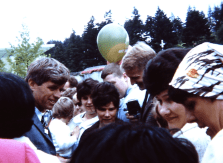
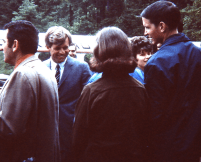
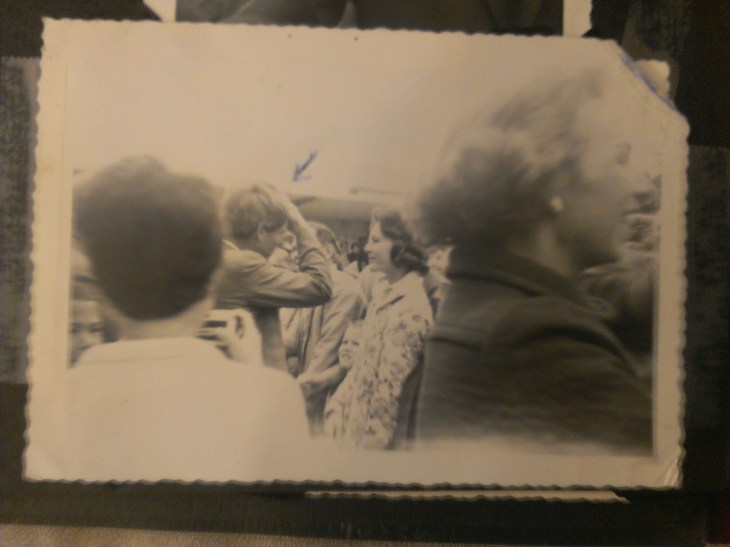
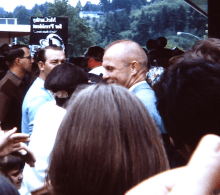
My siblings have remarked that the zoo wasn’t very busy that day and access to RFK was fairly easy – security was present, but not intrusive. There were handshakes and photos while the Kennedy family walked about the zoo. My sister Julia recalls that RFK said to her, “Is this your autograph book little girl?” She responded, “Yes. We live in Canada, but if we lived in the United States, my Dad would vote for you.” Family lore also suggests that my brother, Ian, was kissed on the forehead by RFK. Here are some McDonald family photos:
Ethel Kennedy in foreground, RFK chatting with voters (Julia McDonald scrapbook collection)
Not only was the Kennedy family campaigning, so was famous astronaut John Glenn. Glenn, who died this week at age 95, signed autographs and urged support for Kennedy. My sisters remember him as a class act.
My father collected my sisters together to meet Glenn. He asked where they were from and when hearing they were from Canada, my sister Julia recalls that he said he enjoyed hunting in Canada. Julia says that my mother’s recollection is that he told them to
study Science but attributes that to motherly-spin.
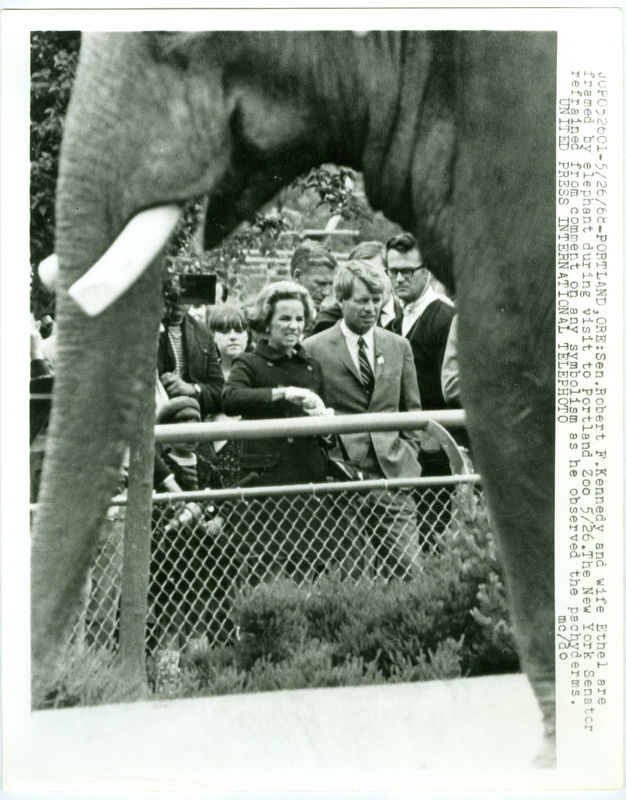
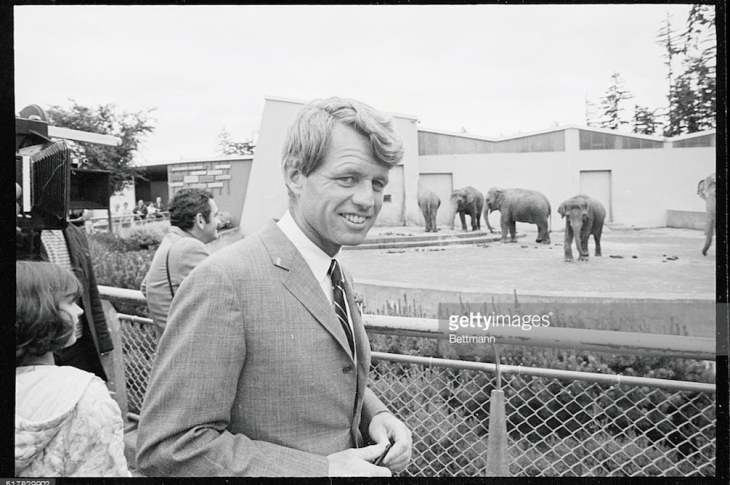
A great UPI photo of the Kennedy’s framed by a cooperative elephant. Michigan scholar Paul Lee notes that RFK has a rose pinned to his lapel, in honour of Portland – the “City of roses”
At some point, Kennedy was on the move toward the train that runs through the zoo. My father managed to get alongside him while they were on a staircase heading in that direction. Here is my dad, 35 years old, and having spent the 1960s as a very active volunteer for the Liberal Party. He was switched-on to politics, big time. He avidly followed the campaigns of Stevenson-Eisenhower, Nixon-JFK, Pearson-Diefenbaker, and was a delegate to the Convention that elected Pierre Trudeau. He managed campaigns, served as municipal councillor, and would soon be a provincial candidate. Add to that the atmosphere of upheaval in the US with the Vietnam War, the assassination of Martin Luther King a month earlier, and the rising voice of Baby Boomer student protest… What a moment!
So, here he was, Pete from Haney, on the stairwell with RFK. Family folklore advises me that the following happened.
Peter: “Senator Kennedy, I’m a big fan of yours… I’m from Canada”.
RFK: “Who the F8#k caahhhhhs”.
That may not be verbatim, but it’s close. RFK could be a little impatient.
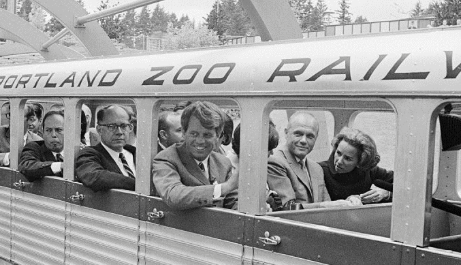
RFK in front row with John Glenn and Ethel Kennedy
Despite this terse brush off (well, it can be argued my Dad was in the way of actual Oregon voters), RFK and his family continued to the train with the McDonald family, undeterred, in hot pursuit. My family boarded the same zoo train as the Kennedy’s. As the train went around a bend, Ethel leaned out and looked backwards and waved to may family’s car near the back of the train. My sister Sara, then 11 years old, said “It felt like she was waving at us and we waved back. It was a big deal!” As the train slowly made its way around the zoo, it was about to collide with another force – the McCarthy campaign.
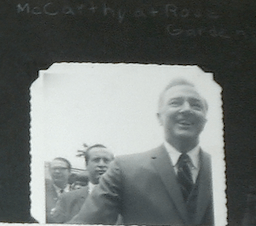
Senator Eugene McCarthy
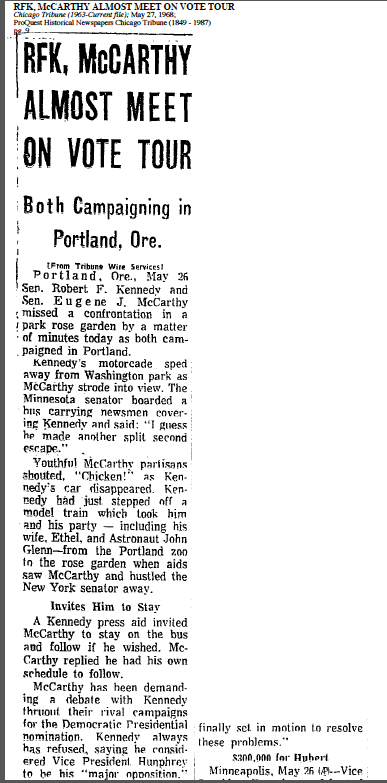
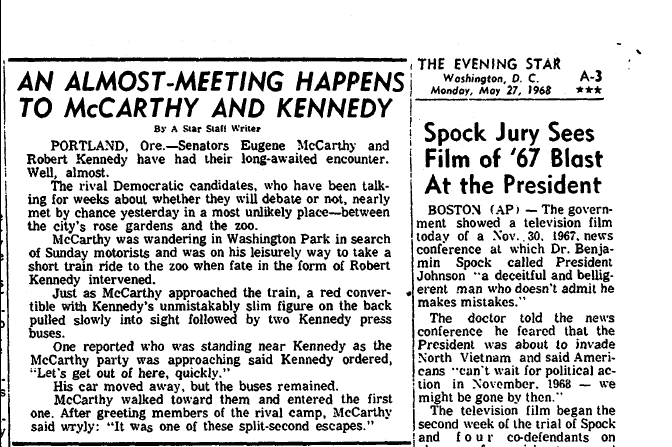
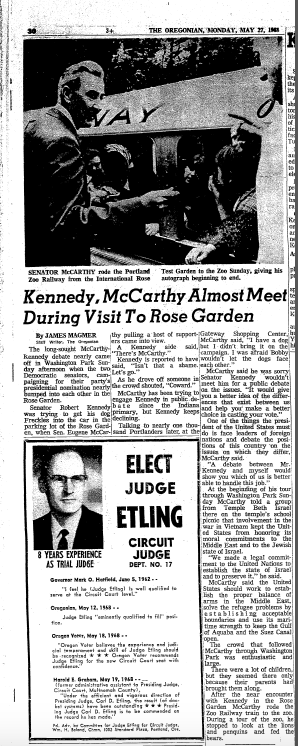
Senator McCarthy came to the zoo looking to challenge RFK to a debate. McCarthy was leading in the primary and had RFK on the defensive. As the train came to a stop, nervous Kennedy aides briefed their candidate that McCarthy was on the prowl and seeking a confrontation. An alert family member heard RFK say, “Let’s get the F*#k out of here”. My mother, Helen, recollects that the Kennedys literally disappeared in a cloud of dust, bodies everywhere sprinting to their motorcade. Sister Sara remembers Kennedy supporter Rafer Johnson, a US Olympian, scooping up Ethel and running with her in his arms to the motorcade and “threw her (as in really threw her)” into the car.
McCarthy missed Kennedy but jumped on the media bus, which was still parked at the curb, and took full advantage of the hasty departure by holding court with the national press. McCarthy went on to defeat Kennedy in the Oregon primary on May 28, 1968.
The McDonald family, no doubt exhilarated by this brush with fame and power, finished up its brief Oregon vacation and headed north up the I-5 back to sleepy Haney. A week later, they awoke to the news that Robert Kennedy had been slain in the kitchen of the Ambassador Hotel in Los Angeles after triumphing in the June 4th California primary. My mother recalls my then 7-year old sister, Sylvia, saying, “But how can he be dead when he was so alive?”
Six months after the assassination, Ethel Kennedy gave birth to her daughter Rory, on December 12th, 1968. My mother gave birth to me the next day on December 13th. Born hours apart, worlds apart, but connected for a few brief moments on the campaign trail at the Portland Zoo.
Unlike me, Rory did not have the privilege of knowing a father. And America will never know what could have become of the unfulfilled promise of Robert F. Kennedy, president or otherwise.
** UPDATE **
Since writing my blog post, I had the honour of receiving correspondence from Paul Lee, a scholar based in Highland Park, Michigan. Paul writes that he is working on a book on Bobby Kennedy’s “remarkable relationship” with non-“white” peoples. In his words, he is making the “critical interpretation of archival/historical photos, videos and sound recordings” a major part of his research.
He kindly forwarded additional information from that day at the Portland Zoo, including a 41-second black and white video and the UPI photo shown above. The video includes the visit from Senator McCarthy.
Paul brought to my attention that it was US Olympian Rafer Johnson who scooped up Ethel and carried her to the motorcade to evade Senator McCarthy. Our family recollection was that it was Rosey Grier, but I have corrected the record above thanks to Paul’s research.
I have been asked about the curt exchange between RFK and my father. This was considered out of character. However, having known my mother for 48 years, I am pretty certain that she has the straight goods on this one. It seems Bobby was just having a bad day… it happens!
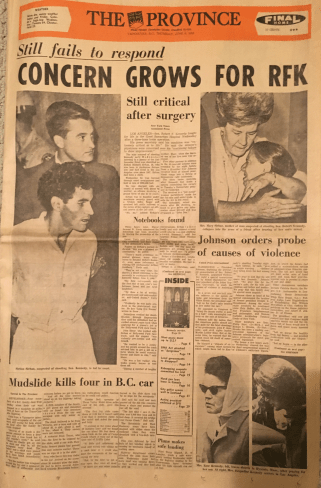
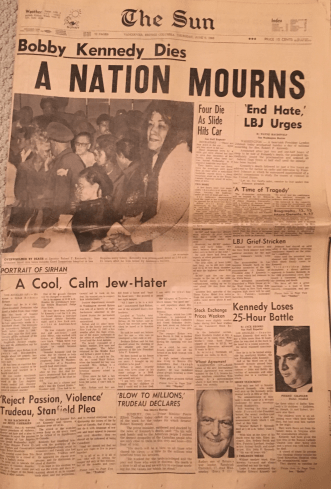
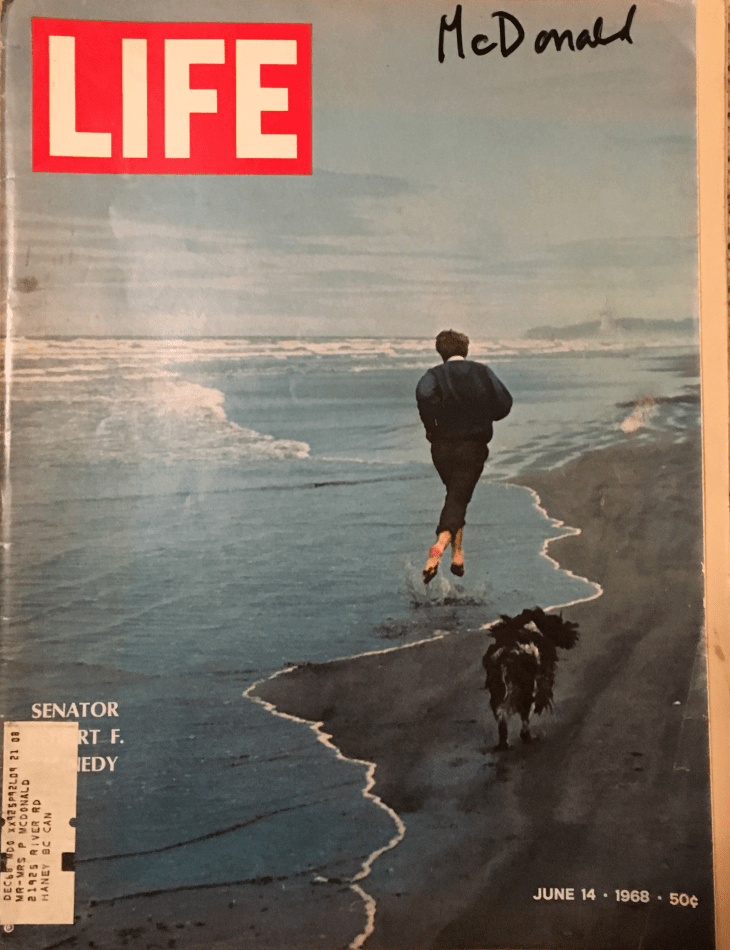
Old newspapers from June 1968: the Vancouver Sun, the Vancouver Province, and Life Magazine:
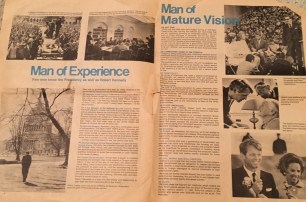
Kennedy campaign brochure:
More Background:
Video: Kennedy and Glenn on the hustings in Oregon with a voiceover of one of Kennedy’s famous speeches during the campaign:
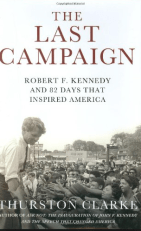
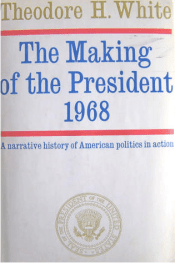
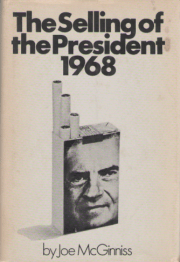
There are many excellent books about the 1968 campaign.
Two books focus solely on the Kennedy campaign. Witcover details the behind-the-scenes action leading up to, and taking place throughout the Kennedy campaign. Clarke captures the passion and excitement of the campaign trail.
Theodore H. White defined presidential campaign reporting and his 1968 edition covers both parties in detail.
This 1960 edition is viewed as one of the most important political books of the 20th century.
Joe McGinnis wrote this seminal work on how Nixon adapted modern advertising techniques to shape his candidacy. Nixon’s comeback after losing in 1960 and losing again in the 1962 California gubernatorial race was well-planned.
The key person behind Nixon’s strategy? Roger Ailes, late of Fox News. Thanks to Dick Drew, former owner of CKAY Radio in Duncan, BC, for recommending this book to me.
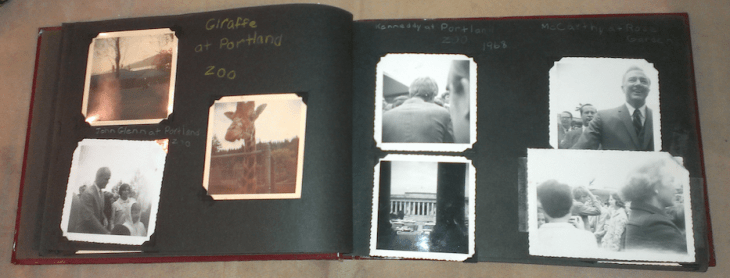
Julia’s scrapbook:
And finally, the full Julia McDonald scrapbook view. The giraffe gets a lot of attention:
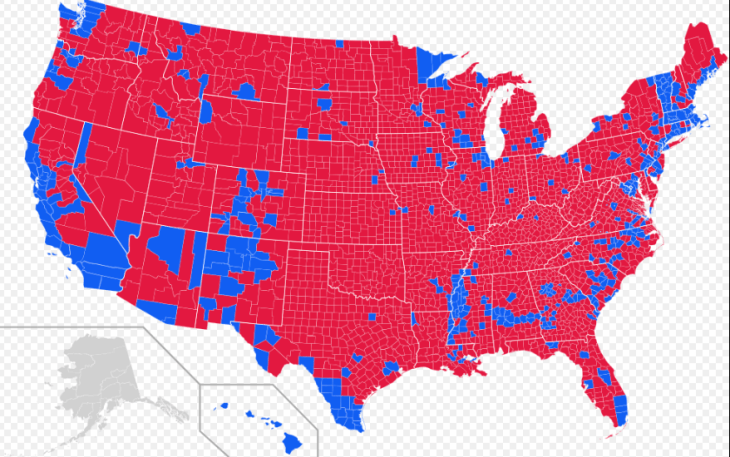
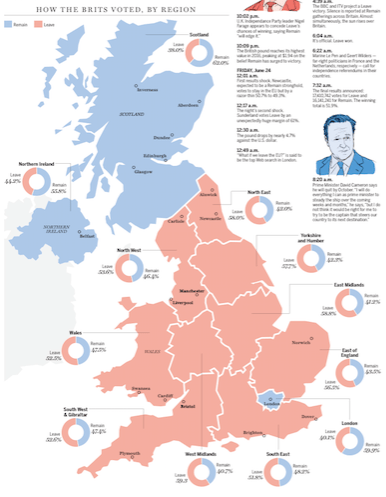
There has been much discussion about the ‘divides’ in the US election. Race, gender, and income status all play a part. I would add a cultural divide between Cities and beyond the Cities, which revealed itself in the US election and also in Brexit. In both elections, the popular vote was very close nation-wide but very concentrated (either way) at the local levels.
US presidential results by County:
Democrats mainly concentrated in big cities and university districts with notable exceptions of black and hispanic voting clusters, and some rural Democrats (eg. Vermont). In Democratic states like Washington, Oregon, and Illinois, you see the polarization where most of the geography went Trump while the major cities went with Hillary.
Brexit results:
Focusing on England itself, it was London (Remain) versus the countryside and regional cities (Leave).
After laying out all the reasons why Trump could win (for months and months), I blatantly ignored that evidence and confidently predicted (below) a decisive Clinton victory. The power of conventional wisdom and the ‘echo chamber’ was never greater than the past week in US election politics, only to be overcome by the voters who ultimately decide. For a matter of minutes, each voter is in charge – in the privacy of the voting booth. Each voter is equal – a single mother in Michigan or retiree in Pennsylvania has the same weight as a Hollywood celebrity or Wall Street trader. And the voters have proved, again, that they are very much in charge.
ORIGINAL POST:
Can Trump win? That’s the question on everyone’s mind.
Yes he can – he has a pathway. But I’m betting that Hillary Clinton will be the 45th President of the United States and it won’t be that close. In fact, I have put my money where my mouth is by betting $5 through BC Lottery Corporation’s online election pool (expires at 4pm Tuesday).
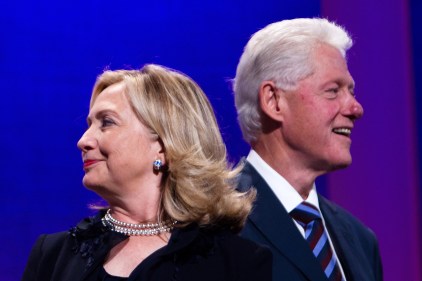
45th and 42nd Presidents of the USA
First, a few starting points to consider when watching the results:
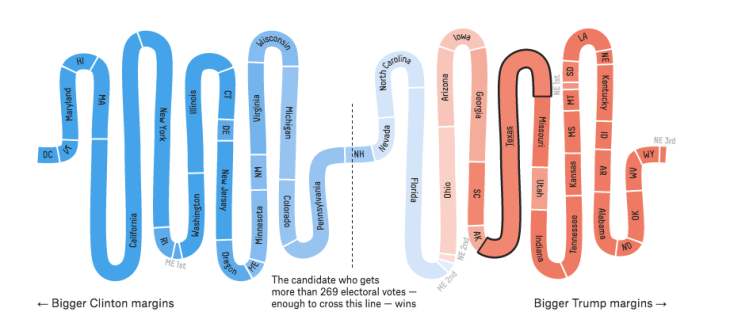
It takes 270 electoral votes to win. Just because a candidate wins the popular vote doesn’t mean they win the electoral college. Clinton gaining a higher popular vote in Texas or running up the margin in California is meaningless in terms of electoral votes. She needs to win states.
There has been a lot of early voting in places like Florida, where early turnout was much higher than 2012 and mostly before the FBI bombshell. That mitigates late-campaign swings to some extent.
No candidate in recent memory has been as much of a disruptor as Donald Trump. He is using social media as blunt-force trauma compared to Hillary Clinton’s better-resourced, data-driven approach. Trump has ‘macro-targeted’ and his winning scenario is moving non-university degree white voters en masse.
How many times have we been surprised lately? Justin Trudeau’s majority, NDP in Alberta, Jeremy Corbyn as UK Labour leader (twice), David Cameron’s majority then Brexit, the rise of Bernie, and the rise of Trump. The people will make up their own mind, thank you very much. Many voters simply don’t cooperate with polls. Will ‘cranky won’t says’ make the difference? That would be good for Trump.
The best available information
Obama’s campaign manager Jim Messina says the Democrats have run 63,000 simulations every night since Obama’s first run for president. The data available to the Democrats and the GOP is the product of hundreds of millions, if not, billions of dollars of investment. The public polls may be indicative but, obviously, not wholly reliable. This is why we mere mortals often get surprised.
Let’s take a look at the work of those trying to figure this out.
In Silver’s winding road to victory graphic, Clinton crosses 270 in New Hampshire and pads the margin with Nevada, North Carolina, Florida, and the Maine 2nd district.
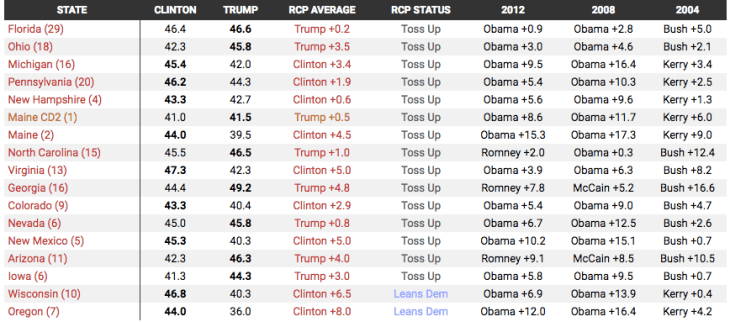
Huh? Isn’t Clinton supposed to be further ahead? RCP has Trump edging Clinton in Ohio, Florida, North Carolina, Iowa, and Arizona. New Hampshire is in RCP’s Clinton column but has been flipping and flopping all week like a halibut sun bathing on a Boston Whaler.
This nightly tracking poll (via online panel) has been a consistent outlier for months. If Trump wins, they are geniuses – they have been about 4-5 points to Trump’s favour consistently compared to most pollsters. This poll does provide a view of campaign momentum. The RNC convention (7/25), subsequent self-induced Trump collapse (8/12), Clinton health scare (9/17), Billy Bush tape (10/17), and post FBI surge (today).
Trump’s pathway
Building on my blog post last week (“Can Hillary lose? Not easily“), here are my revised prognostications going into Tuesday night.
The pathway for Trump to win 270 electoral college votes is not easy. It would look something like this:
Win all of Romney’s states (206). Right now, he is forecasted to do that but has been vulnerable in North Carolina (15) and Arizona (11). He seems to be pulling away in Arizona but NC is a toss up. Utah is another wildcard where independent Evan McMullin has been in shouting distance of Trump.
Consolidate consistent leads in Obama states (24). Trump has been leading for a while in two states where Obama triumphed in 2012 – Ohio (18) and Iowa (6). Now he’s up to 230 total votes with steps #1 and #2.
Win Florida (29). It would be very, very hard for Trump to win the White House without this state. The polls are close. Running total: 259.
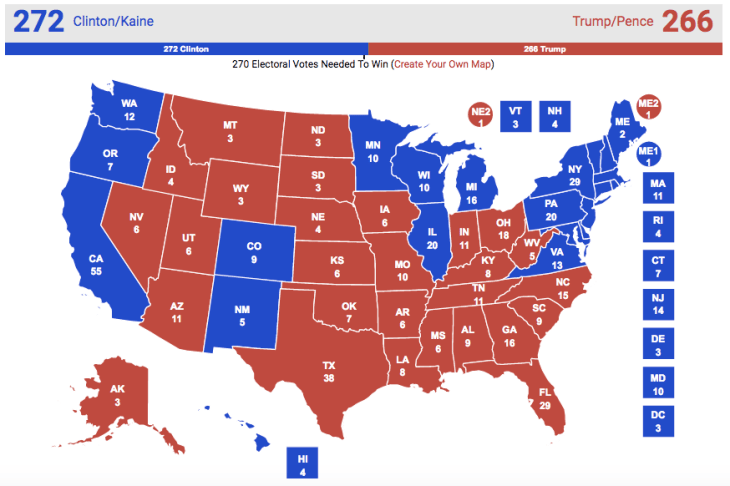
Find (11) votes from the following: New Hampshire (4), Maine 2nd district (1), and Nevada (6). That’s 270 right there in Steps 1-4. This is very similar to the RCP map above that has Trump at 266 – it’s just missing New Hampshire.
Hail Mary scenario – If Trump’s carpet bombing of previously considered safe Democrat states succeeds, it changes the calculation: Pennsylvania (20) and Colorado (9) could add to or replace Florida’s 29 votes; Michigan (16) or Wisconsin (11) would replace or add to the smaller states in #4 above. This would be white voters (college education or less) turning out “big time”. This scenario is a tall order, indeed.
My prediction
I have unreliable data like the rest of you. So this comes down to a gut feeling. Trump will not win all of the Romney states. I believe he will lose North Carolina due to my perception of Clinton’s organizational advantage. I’m shaky on that prediction, but I’m going with it.
Further, I believe Clinton will win Florida due to early voting and organization. Nevada should also be in Clinton’s column.
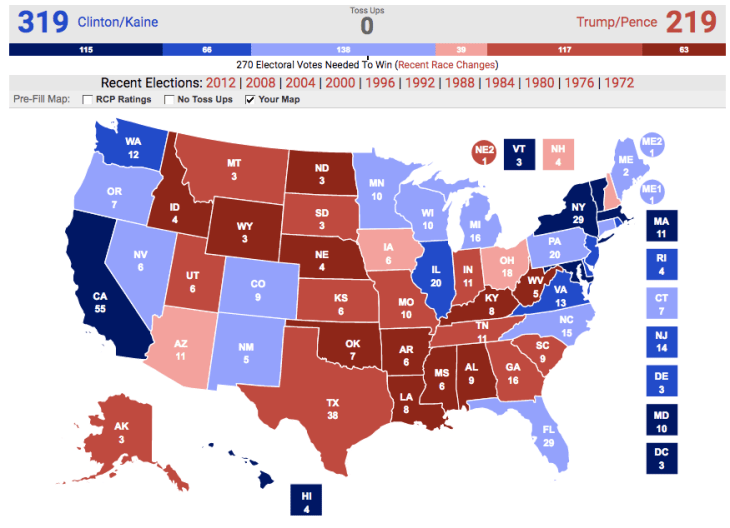
Therefore, Trump has 191 Romney votes, plus gains in Ohio (18) and Iowa (6), and I will throw in New Hampshire (4) for a total of 219 votes to Clinton’s 319. My sense is that the FBI-induced fever that plagued Clinton over the past week broke over the weekend. Her campaign’s inherent strengths and Trump’s weakness with non-white voters will be a deciding factor in close races. It will take an uprising in states where there is a higher proportion of white voters to elect Trump, IMHO. I’m betting the surprise on election night will be the size of Hillary Clinton’s margin of electoral votes, not a Trump win.
On Election night, channel flip over to Global TV’s BC1 news channel. I will be speaking to results with Global’s Keith Baldrey throughout the evening.
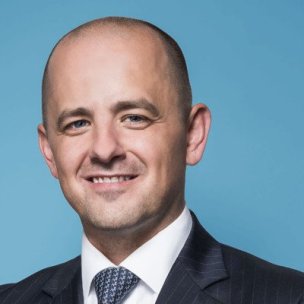
Have you ever heard of Evan McMullin? He’s an independent candidate for president running in Utah and he has a chance of winning the state. Mormons are not huge fans of Donald Trump. Top Mormon-Republicans Mitt Romney and former Utah Governor Jon Huntsman have openly opposed Trump.
The 40-year old McMullin is a former Republican staffer and former CIA operative. Born and raised in Utah, and a BYU graduate, he can certainly make the claim that he’s a home-grown, Mormon candidate. He likes to say that he was fighting terrorists while Donald Trump was judging beauty pageants.
Utah only has 6 electoral votes, so why is it important?
In a very close election, McMullin’s victory in Utah could deny Trump a majority in the electoral college.
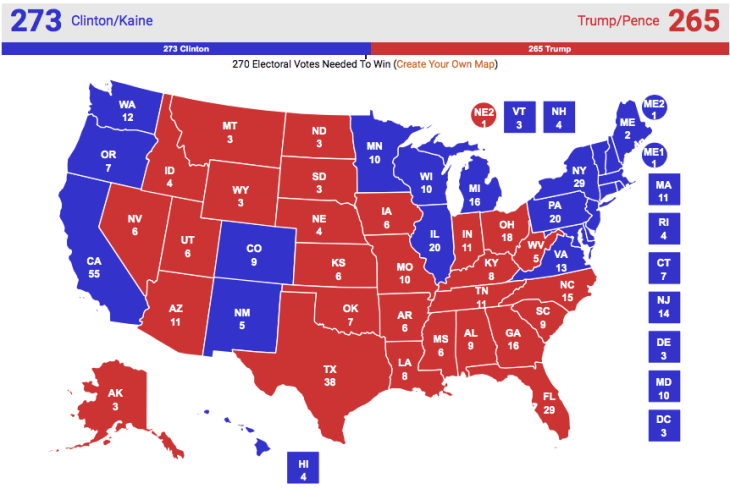
Today, RealClearPolitics “no toss up” map forecasts 273 votes for Clinton/Kaine and 265 for Trump/Pence (the inclusion of VP candidates in this discussion is important, further down).
Based on the map below, if Colorado swings to Trump, he would have 274 votes to Clinton’s 264. However, if Utah goes with McMullin instead of Trump, then it would be: Trump/Pence 268, Clinton/Kaine 264, and McMullin 6. No candidate would reach the magic number of 270 required.
This is where it gets really interesting under the 12th Amendment. The House of Representatives then elects the president and the only candidates eligible are those that received electoral colleges votes: Trump, Clinton, and McMullin in this scenario.
But it’s not a one member, one vote scenario. Rather, each state’s delegation receives one vote. California = Vermont in terms of voting strength. Crazy rules but they’re stuck with them.
The Republicans will most likely have a majority in more states than the Democrats . Representatives can vote for any of the three candidates so it’s highly likely Trump would become president, even if Hillary won more electoral votes (but less than 270).
However, the House is only voting for president, not vice-president. The Senate elects the vice-president.
There is a reasonable likelihood that the Dems could control the Senate. Or there could be a tie (in which case Vice President Joe Biden would break the tie since he would still be in office). RealClearPolitics has the Senate at 47 Dem; 46 GOP and seven toss-ups today. Thus, there could be a split ticket. Imagine Trump-Kaine.
In a further constitutional fantasy scenario, House Republicans could choose the ‘real’ conservative, McMullin, and catapult him to the presidency. Highly, highly improbable, but not unconstitutional.
Another possibility: Faithless Electors
Some states do not require their electors (that comprise the electoral college) to vote for the presidential candidate with the highest popular vote in their state. In practice, they almost always do. There have been cases of an elector going astray – a Washington Republican voted for Reagan instead of Ford in 1976, a Minnesota Democrat voted for John Edwards instead of John Kerry. But those stray votes were not material to the outcome.
It is possible that some electors could abandon their candidate and go another way. The pressure on them would be massive if they did so, and, indeed, very contrary to the wishes of the voters.
In the final analysis, I think Hillary is going to win though it’s getting pretty uncomfortable, and moreso since my last post.
Yet, as Al Gore knows, anything can happen even after the votes are counted.
ps. A fictional account of electoral college machinations was written by US political journalist Jeff Greenfield in his book “The People’s Choice”. A good read for inveterate political junkies.



![DALLAS'[1].jpg](https://rosedeer.blog/wp-content/uploads/2017/03/dallas1.jpg?w=730)








 Rosedeer