Floor crossings older than Canada itself

I had never heard of Leona Alleslev before she switched from red to blue. The Member of Parliament for Aurora-Oak Ridges-Richmond Hill becomes the latest in a long line of Canadian politicians who have crossed the floor to sit with a different political party than the one they were elected with.

sept-1701592-crop

MP Leona Alleslev with her new leader, Andrew Scheer. (iPolitics)

Most of the time, the end is nigh for that politician. Some are pushed by desperation. Some are motivated by pique. Others for genuine policy and ideological reasons. I’m not sure which category Alleslev belongs to.  Unlike some examples, it was not expected, it was not a public journey, and she didn’t lay any track or provide signals.  Thus, it’s fair comment to point out that she seemed like a happy Liberal not that long ago.

Floor crossing is older than Canada itself. Wikipedia informs us that, in 1866, an anti-Confederate politician in New Brunswick switched sides when he did not receive a desired cabinet post.  We could go back to WWI when many Liberal MPs left Wilfred Laurier and joined with the Unionist government under Robert Borden. Or to 1935 when British Columbia’s H.H. Stevens bolted the Conservative barn to form the Reconstructionist Party.

At times, a floor crossing can signal a sea change in politics. In the past few weeks, we saw Maxime Bernier jump out of Air Scheer without a parachute. The impact of this Xtreme floor crossing is yet to be known.

Some floor crossings precipitate or reflect foundational change. Réne Lévesque leaving the Quebec Liberal Party in the 1960s to form the Parti Quebecois is one of the most momentous moves in Canadian political history. It led to the election of the first Péquiste government in 1976 and a referendum on sovereignty-association in 1980.  Watch the documentary Champions to see Lévesque’s impact and his enduring rivalry with Pierre Trudeau.

a_365

Réne Lévesque: probably the most impactful floor-crossing in Canadian history (CBC)

In 1990, Lucien Bouchard spectacularly left the Mulroney government after the collapse of the Meech Lake accord, forming the Bloc Quebecois, and taking other Quebec PC and Liberal MPs with him, including Liberal MP Jean Lapierre. Bouchard led the Oui forces to the brink of victory in 1995, and shortly thereafter became Premier of Quebec.

The 1993 election saw the collapse of the Progressive Conservatives to two seats with Preston Manning’s Reform Party dominating Western Canada.  After Jean Chretien continually swept up in Quebec, PC Senator Gerry St. Germain was one of the first to attempt to unify the Conservative parties and changed his allegiance in the Senate from PC to become the first Canadian Alliance senator in 2000.  Later, eleven Canadian Alliance MPs left caucus to sit as the “DRC” – Democratic Representative Caucus when they couldn’t get along with Alliance leader Stockwell Day, and included some political heavyweights like the first Reform MP ever elected, Deb Grey.  The DRCs would morph into a coalition with Joe Clark’s (second-coming) PC caucus: the PC-DRC.  Ultimately, most everyone got back together under the leadership of Stephen Harper after new PC leader Peter Mackay agreed to merge the PCs with Stephen Harper’s Alliance.  Harper became the leader of the new Conservative Party and held Paul Martin to a minority in 2004 before winning his own minority in 2006.  (Joe didn’t cross, he stayed PC until the end). The key point is that floor crossing influenced the course of events between 2000 and 2004.

Some floor crossings reflect the ebb and flow of political tides.  Scott Brison was elected as a Progressive Conservative, but left when that party merged with the Alliance to form the modern-day Conservative Party. Brison is a senior Liberal cabinet minister today. One can argue that he represented a shift in Canadian politics where some Progressive Conservatives migrated to the Liberals.  Many politicians, like Bob Rae and Ujjal Dosanjh, sat for one party, then came back to run for another party later, reflecting how they had migrated through the political spectrum.

Provincially, MLAs in both the Saskatchewan PCs and Liberals crossed the floor to the new Saskatchewan Party in 1997, which has governed the province since 2007. The PCs were extinguished and the Liberals are in the wilderness.

In 2002, Yukon NDP MLA Dennis Fentie left his party to join the Yukon Party. A month later he was leader and later that year he became Premier, serving until 2011.

BC has had three significant floor-crossings that led to a restructuring of political support bases.  Leading up to the 1952 election, Conservative MLA WAC Bennett left that party and migrated toward to the Social Credit Party. The leaderless party won the plurality of seats in 1952 and Bennett became its leader (and, ultimately, Premier) after the election. Bennett governed for 20 years.

mcgeer-williams-bennett-and-gardom

Seismic shift in BC politics when three senior Liberal MLAs join Bill Bennett and the Socreds in 1974 (Vancouver Sun)

Then following his defeat in 1972, his son Bill Bennett, the new leader, recruited former Liberal leader and MLA Dr. Pat McGeer, Allan Williams, and Garde Gardom to join the Socreds, along with PC MLA Hugh Curtis. All four floor crossers would play major roles in Bennett’s government, which lasted 11 years. He also attracted former Liberal leadership candidate Bill VanderZalm to run as a Socred in 1975 too. Then in the 1990s, there was a two-step process. First, four Social Credit MLAs left the former dynasty in ruins when they turned away from the fledgling BC Liberals under Gordon Campbell, to join the BC Reform Party in 1994. Their defection ultimately benefited the ruling NDP – Glen Clark would win a majority in 1996 while losing the popular vote. Campbell corralled the Reformers after 1996 and remaining Reform MLA Richard Neufeld crossed the floor to the BC Liberals, marking the formalization of a de facto coalition.   Neufeld served as BC Liberal minister for seven years (now a senator) and the BC Liberals governed continuously for 16 years.

(A footnote to the 1975 example above is that Frank Calder, British Columbia’s first indigenous parliamentarian, lost his NDP nomination in the riding in Atlin.  Having been first elected in 1949, Calder brought his winning ways to the Socreds and was elected yet again. Four years later, he lost by one vote to the NDP’s ‘Landslide’ Al Passarell.  Passarell would later cross the floor from the NDP to the Socreds as well.)

Some floor crossings backfire spectacularly. Arguably, the WildRose defections to the ruling PC’s under Jim Prentice destroyed the political careers of those MLAs, like former leader Danielle Smith, and boomeranged on the Prentice government. It looked too cute, too orchestrated – the overdog overdoing it. Belinda Stronach’s floor crossing to the Liberals in 2005 helped save the minority Martin government for a time, but arguably galvanized Stephen Harper’s Conservatives in the forthcoming election in 2006.

Some leave and come home again. The most famous example is Winston Churchill going Conservative-Liberal-Conservative. The aforementioned Jean Lapierre left the Liberals to join the Bloc Quebecois upon the election of Jean Chretien as Liberal leader. He returned to the Liberals under Paul Martin and was a senior cabinet minister in his government. Then there’s Joe Peschisolido who was a Young Liberal that was elected as an Alliance MP then crossed the floor to the Liberals. After a stint out of politics, he’s back again as a Liberal MP. There to stay, presumably.  Gordon Wilson was Liberal leader in BC from 1987 to 1993.  He left, with fellow MLA and wife Judi Tyabji, to form his own party, the PDA, and won his seat again in 1996 under that banner.  He was recruited by NDP Premier Glen Clark to join the NDP cabinet in the late 1990s and then ran for the leadership of the NDP, unsuccessfully.  Since 2001, he has been out of elected politics, but he did go ‘home’ again in 2013 when he made an intervention in that year’s election campaign in favour of BC Liberal Premier Christy Clark (who once worked for him) and against NDP Leader Adrian Dix (who once recruited him).  Never dull in BC.

Some floor crossings weren’t mean to be. BC Liberal MLA John van Dongen left the BC Liberals over unresolvable disagreements. He joined the fledgling BC Conservatives, but within months, left them over unresolvable disagreements. Conservative MP Eve Adams defection to the Liberals on the eve of the 2015 election reeked of desperation.  Her career was soon over, at least for now.  A husband and wife both crossed the floor from the New Brunswick PCs to the Liberals in 2007, but by 2010 they were both out of politics.  One-term West Vancouver Liberal MP Blair Wilson got into some hot water and would eventually leave the Liberal Caucus to sit as an independent.  Just before the 2008 election, he migrated to the Greens to become their first ever MP in Canada.  He failed in his bid for re-election, as a Green.

Some cross and never look back, like Scott Brison. Dr. Keith Martin was elected as a Reformer in 1993 and ran for the leadership of the Canadian Alliance. He crossed the floor to the Liberals in 2004 and served as a Liberal until 2011. David Kilgour was a longtime Progressive Conservative MP. Even though John Turner was his brother-in-law, he stayed as a PC, but after Turner left, Kilgour crossed to the Liberals and continued from there.

Some floor-crossers are peripatetic.  Paul Hellyer was elected as a Liberal MP in 1949 and went on to be Minister of National Defence under Lester Pearson and a major contender for the leadership of the Liberals in 1968, placing second on the first ballot.    He fell out with Pierre Trudeau the following year and tried to form his own party.  He then crossed the floor to the PCs and in 1976, he ran for the leadership of that party.  He would return to the Liberals in 1982 and ran unsuccessfully for a nomination in his old seat in 1988.  He then formed another party, the Canada Action Party, and would try to merge it with the NDP.  At the age of 95, he may have another run in him, but for which party?

Countless others have gone to sit as independents only to return later.  Some are sent because they were naughty, others leave because they’re mad but come back once they’re happy. BC MLA Blair Lekstrom left caucus over the handling of the HST but came back after a leadership change.  MLAs and MPs who never leave, and feel that they are team players, can often be annoyed and upset when those that leave are welcomed back.  If handled properly, it can be seen as beneficial to the greater good that they return.  Alternatively, it can be seen as rewarding bad behaviour.

Surrey MP Chuck Cadman was elected as a Reform MP and carried on as an Alliance MP, but prior to the 2004 election, he lost his nomination.  He ran as an independent and won.  In 2005, battling cancer, he was pivotal in keeping Paul Martin’s minority government in power during critical votes, against the wishes of his former colleagues.

In the ‘timing is important’ category, David Emerson’s defection to the Conservatives days after the 2006 federal election effectively marked the end of his career in electoral politics.  The ink was barely dry on the ballots when he reversed course, causing much consternation among his former Liberal supporters. But it provided Stephen Harper with experience and depth in cabinet for two years and demoralized the Liberals, who sat out of power for nine years.  Alberta PC MP Jack Horner crossed over to Pierre Trudeau’s Liberals in 1977, joining the Trudeau cabinet.  There has rarely been a good time to be a federal Liberal in Alberta and this wasn’t one of them.  His constituents did not reward him for his efforts in the subsequent election.

Many, many, many more floor crossings happen in the imaginations of political back roomers.  There is always the threat of a disgruntled MLA or MP taking off.  Most of the time, that representative is governed by some restraint.  The voters elected him or her largely on the basis of their party label.  Imagine you worked hard in support of your party only to find that the recipient of your hard work crossed no-man’s land to sit in enemy trenches?  Many would-be floor-crossers have surely taken a step back when realizing they would have to explain their actions to the volunteers who backed them.

To be accepted by the voters, the conflict usually has to be real and substantive and/or that representative must have a lot of personal credibility.  If it’s opportunistic, and imposed from the top, it’s not likely to go down well with the voters or the supporters of the sending and receiving party.  Not many like a turncoat, especially when they weren’t part of the process.

What floor crossings can demonstrate is the dynamic state of our political system.  In the ‘first past the post system’, parties are always in a state of constant movement.  Parties continually search for a plurality of votes and seats, and attracting someone who represents a set of ideas or representative of a community of interest is a way to grow a party’s base.  A floor crossing can give a tiny party a foothold in Parliament. Parties that fail to unify their members behind a common purpose can disintegrate, with floor crossings one such manifestation.  Unlike the United States, Canadian parties can rise and fall (and rise again).  There is much more fluidity.  Real policy differences – such as Quebec independence – can lead to dramatic changes and fracture coalitions.  Strong leadership glues coalitions together, unifying disparate elements.  When it comes down to it, elected representatives are just people, unbound to their party label.  They have the ability to exercise their free will.

Many floor-crosses vaporize without causing any major effect.  Will the departure of Leona Alleslev amount to much? Will Maxime Bernier accomplish anything? History tells us that we will have to wait to find out.  There are many possibilities.

Update: (Feedback from Rosedeer.com contributor @Jay_Denney)

1) James Armstrong Richardson: Winnipeg Cabinet Minister from the Pierre Trudeau era, who he clashed with over patriating the Constitution. Notable in that one day, he just up and crossed the floor, telling the desk clerk “I’m sitting over there from now on”

2) John Nunziata: though technically he was kicked out, he essentially crossed the floor to be an independent by voting against a Budget. Notable in that he is a rare example of winning reelection, like Chuck Cadman, as an incumbent independent (as opposed to the numerous losers, most recently former Conservative MPs Brent Rathgerber and Inky Mark, John Van Dongen, and former BC NDP MLAs Bob Simpson and Chris Darcy)

3) Thank you for not mentioning the man who crossed from blue to red federally and was subsequently drubbed by Lisa Raitt in 2008. (I will mention him because it’s a good example – Jay would be referring to Garth Turner – the one-time PC leadership candidate and former Conservative MP who, after harshly criticizing David Emerson’s defection to his own party, crossed the floor himself to sit as a Liberal.  He lost in the subsequent election.)

There are many more colourful examples.  As University of Manitoba Political Science professor Royce Koop puts it, “When an MP crosses the floor, it’s a beautiful reminder that in Canada we cast our votes for candidates, not parties”.
Wave of changes coming in Metro Vancouver municipal politics

Published via Global News and CKNW (September 15, 2018)

First, the Sedin twins retired. Now, it’s the local mayor. Two-thirds of Metro Vancouver’s mayors have decided that it is time to bow out and won’t be seeking re-election this October.

Only 8 of the region’s 21 mayors are seeking re-election, compared to 16 who campaigned to keep their job in 2014 (with 14 winning re-election).

Why so much change? Like the Sedins, some veteran mayors have run their course after lengthy careers in office. After ten years as mayor of Vancouver, Gregor Robertson is leaving office, as is Metro Vancouver chair and Port Coquitlam mayor Greg Moore. All three mayors on the North Shore are hanging up their chains of office. While Delta’s Lois Jackson plans to run for Council, she leaves the Mayor’s chair she held since 1999. Ralph Drew has been the mayor of tiny Belcarra for over 34 years. He’s like the Gordie Howe of Metro Vancouver mayors.

However, four rookie mayors are “one and done”. Newly elected in 2014, Surrey mayor Linda Hepner, Maple Ridge mayor Nicole Read, Bowen Island mayor Murray Skeels and Lions Bay mayor Karl Buhr have decided to head to the locker room after one term.

Is the high number of retirements the ‘cycle of life’ or is there something deeper happening?

First of all, politics in Metro Vancouver have been disrupted significantly by housing affordability. It may well be the single most important factor toppling the Christy Clark government in 2017 as her party lost significant ground in the region. One year later, it may have also resulted in a game misconduct for Vision Vancouver. Voters are grumpy, whether they are renters or homeowners, with policy prescriptions and blame zigzagging all over the political spectrum. It feeds ‘time for a change’.

Second, is serving as the mayor (or Councillor) becoming a thankless task? Earlier this year, Metro Vancouver board members were roasted over a one-time retirement allowance and pay increase.  In this age of social media, reactions can be immediate and harsh. Greg Moore complained about the change in discourse this week at the Union of BC Municipalities convention. Many local politicians are paid for part-time work and expected to work full-time hours. Well, they did sign up for the job four years ago, but re-upping for another four years requires a heavy gulp.

Finally, there are new campaign financing rules restricting donations to individuals which makes fundraising harder. Not that the old days were particularly desirable, but campaign finance records show that developers and unions took care of most of the financing. The new rules will be a chore to put together the funds necessary to order signs, print brochures, run social media ads, and otherwise get the word out.

Yet despite these reasons, the lure of politics and service is drawing flocks of candidates. Mayoralty races are flourishing throughout the region. Vancouver will have in the neighbourhood of 40 ‘serious’ Council candidates seeking 10 spots. It’s fair to ask all candidates rushing headfirst into politics– do you know what you are getting into? Are you ready? Do you have your head screwed on right?There will be a lot of rookies around Metro Vancouver board table and at Translink Mayors’ Council meetings.

Will wily veterans like Derek Corrigan, Richard Stewart, and Malcolm Brodie, assuming their re-elections, skate circles around the newcomers? Or will the rookie mayors bring a new dynamic, a new style, and new priorities to regional politics? That’s unclear. Voters have the opportunity now to press all candidates on their agenda. How do they propose to implement their ideas? How will they move things through the process? It’s one thing to promote an idea, but how prepared are they to get it done? Are they surfing on sound bites alone, or have they done their homework?

The campaign is only just beginning and, with the new timetable moving the election from November to October, there are only five weeks remaining to Election Day on Saturday, October 20th.

The next five weeks will be like training camp. Voters will need to give these candidates a good workout because they’re signing their mayor and council to a four-year contract.

Federal Leaders in By-elections and the Burnaby battleground

Updated (August 17th)

NDP leader Jagmeet Singh announced his bid for a federal seat today in the riding of Burnaby South, vacated by Vancouver mayoralty aspirant and NDP incumbent Kennedy Stewart.

Burnaby South is over 4,000 km from Singh’s former riding in the Brampton area, but he’s certainly not the first federal leader to leave his home province to seek entry into the House via a by-election.

Screen Shot 2018-08-08 at 3.06.07 PM

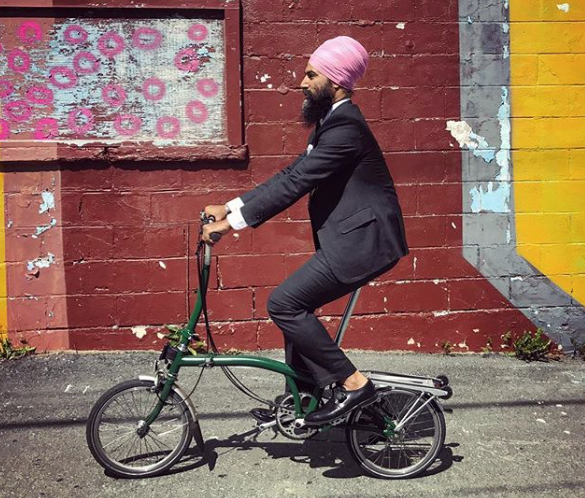
Will Jagmeet Singh ride on to victory in Burnaby-South? [Cycling Magazine]

Rt. Hon. Brian Mulroney was elected in 1983 as MP from the riding of Central Nova in Nova Scotia.  He gave the seat back to Elmer MacKay when he led the 1984 election from his hometown riding of Manicouagan in Quebec.  Rt. Hon. Stephen Harper found a seat close to home in 2002 when he re-entered the House from Preston Manning’s seat of Calgary Southwest. Rebel founder Ezra Levant had secured the nomination but was evidently persuaded to step aside for the new leader of the Canadian Alliance (this was before the Alliance and PC’s merged).  Of note, both the Liberals and the PC candidate, Jim Prentice, stepped aside to make way for Harper.  The NDP fielded a candidate.

Rt. Hon. Joe Clark made a political comeback to return as leader of the Progressive Conservative Party in 1998 and sought election to the House of Commons in early 2000 when then-PC MP Scott Brison stepped aside in Kings-Hant to make way.

As for Liberals, the longest-serving Prime Minister of all-time, Rt. Hon. William Lyon Mackenzie King, lost his seat in York North in 1925 and sought a new seat in Prince Albert, Saskatchewan, winning a by-election there in February 1926.  An interesting side note is that Rt. Hon. John Diefenbaker encouraged an independent to run against King in the by-election, then Diefenbaker himself ran unsuccessfully against King in the subsequent 1926 general election. King would continue to represent Prince Albert until the 1945 election when he lost to a CCFer.  He sought re-entry into the House via Glengarry in Ontario and retired while representing that seat.

Rt. Hon. John Turner was the newly appointed prime minister, without a seat, when he announced he would contest the 1984 election from Vancouver-Quadra.  While he had attended UBC and had a longstanding family connection to BC, he had lived in Eastern Canada for decades and did not pretend too hard that he would actually move to Vancouver.  Despite the disastrous national campaign, Turner held on to claim Quadra from the PC’s and the Liberals have held it for the past 34 years.

Jean Chrétien’s return to the House of Commons in 1990 came via the New Brunswick riding of Beausejour. He returned to his home riding of Saint-Maurice

The NDP can look back at the experience of Tommy Douglas.  Douglas was defeated in his first attempt to win election to the House of Commons from the riding of Regina-Centre in 1962.  The former Saskatchewan premier, and first elected leader of the NDP, had to find a seat out-of-province in… Burnaby.  He was elected in Burnaby-Coquitlam in 1963 and 1965.  In 1968, he contested Burnaby-Seymour (similar to MP Terry Beech’s current riding) and lost to Hon. Ray Perrault.  Perrault was a former leader of the BC Liberal Party and a gritty, grassroots politician.  While he would only serve one-term, he went on to a distinguished career in the Senate.  As for Douglas, his opportunity to regain a seat was borne from tragedy when Nanaimo-Cowichan-The Islands MP Colin Cameron (grandfather of NDP strategist Robin Sears) passed away not longer after the 1968 election.  Douglas won a 1969 by-election there and represented the seat until 1979.

Topical in the news these days is Rt. Hon. John A. Macdonald who was elected in Victoria in 1878.  I assumed it was a by-election victory, but he actually contested three separate ridings in the general election that year, and, having lost in Kingston, he chose to represent Victoria where he had defeated Liberal Amor de Cosmos (!).  Sir Wilfred Laurier also contested multiple districts and won in both Quebec-East and Saskatchewan provisional district in 1896, choosing to represent Quebec-East.

Green Party leader Elizabeth May announced on August 16th that due to  “longstanding parliamentary tradition” she would extend ‘leader’s courtesy’ to Jagmeet Singh by not fielding a Green candidate.

Longstanding tradition?  That’s a selective interpretation of history.  Here are the by-elections contested by leaders:

Screen Shot 2018-08-17 at 9.53.50 AM.png

Every leader noted above has been contested in a by-election, and since 1962, every leader has been contested by at least one other main political party.  The NDP have never extended Leader’s courtesy in a by-election.  Even the Greens contested Harper’s by-election.   And certainly on a provincial level, neither the Greens nor the NDP honoured the “longstanding parliamentary tradition” of leader’s courtesy to Hon. Christy Clark in her two by elections (Point Grey in 2011, West Kelowna in 2013).

Courtesy aside, leaders need a seat in the House and sometimes have to go far afield to find one.  When they are ‘adopted’, sometimes they stay put.  Singh says he will move to Burnaby.

But can Jagmeet Singh win Burnaby-South?  Presumably, the NDP have polled the riding and believe they can win it.  It would be a huge risk, otherwise.  It does not appear to be a slam-dunk seat for the NDP though.

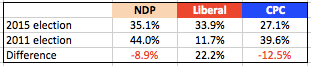
In 2015, Liberal Adam Pankratz won election day.  It was Kennedy Stewart’s margin-of-victory in the advance polls that saved his bacon.  This was a result of two factors – Liberal momentum was still building during the advance polls and the NDP had a superior GOTV machine.

Table 1: Burnaby-South in 2011 and 2015

Screen Shot 2018-08-08 at 3.11.42 PM.png

Screen Shot 2018-08-08 at 3.33.33 PM.png

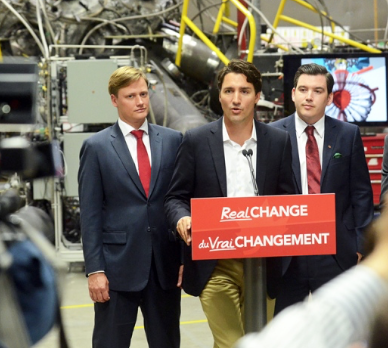
Liberal Adam Pankratz (left) with PM Trudeau and MP Terry Beech [Burnaby Now]

Liberal gains in 2015 came at the expense of both the NDP and the Conservatives.  Pankratz himself, a young, educated multilingual candidate whose father was a well-known BC Lion football player, presented well for the Liberals.

There are other variables to consider.

The federal NDP typically does not do well in British Columbia when there is an NDP government in Victoria.  The 1974 election was a disaster for the federal NDP, in the height of the Dave Barrett government.  The federal NDP were decimated in the 1993, 1997, and 2000 elections in BC while a parade of NDP premiers governed (though Svend Robinson held his Burnaby riding).  Will it be a factor this time?  At this point, I don’t think the provincial NDP have angered voters in the manner of previous NDP governments.  It’s early days.  However, being in power can demotivate activists who are accustomed to fighting the establishment rather than being a part of it.

Singh’s connection to BC is not apparently strong.  He will have recruited support during his NDP leadership run in BC, especially from the South Asian community.  But he lacks the personal ‘story’ that Mulroney had in Nova Scotia (he attended university) or Turner had in BC.  Maybe there is one that I haven’t heard yet, and it may not matter that much anyway.

Another factor is Kinder Morgan.  On the surface of it, the NDP have this field to themselves.  The NDP Mayor of Burnaby, a formidable force, strongly opposes the pipeline.  The Liberals and the Conservatives are on the other side of the debate.  Assuming the Greens can be kept at bay (a big assumption), the NDP may have room on that issue.  But is the worm turning on this issue? The protest camp has been drawing negative attention.  Are people ‘worn out’ on all of the Kinder politics? We’ll see.

Municipally in Burnaby, Mayor Derek Corrigan has ruled since 2002.  He has built a strong political machine.  For the first time in a long time, he faces a credible challenge this October.  Will that divert energies away from Singh’s campaign? Will the winds of change blow away from NDP candidates?  Opponents hope, but I know from experience that the NDP machine in Burnaby is real.  It will take a lot to defeat them.  Singh has to get the most out of the local organization.

About 46,000 residents voted in 2015.  In a by-election, the turnout is almost always lower.  GOTV will be a huge factor.  Not just the ‘machine’ but the motivation of voters to vote.  Will they turn out for Jagmeet Singh? He will have to build a connection with them.

Kennedy Stewart’s departure may be another factor.  Vancouver mayoralty candidates will be taking shots at Stewart for leaving his post as a Burnaby MP to run in another jurisdiction.  It turns out Stewart was living in Vancouver – how is that going over in Burnaby? Issues like “demovictions” are being raised in Burnaby which could make life uncomfortable for NDPers.  It may all amount to nothing and the status quo may well prevail.  We’ll see how the opposition approaches it.

Singh obviously has the most to win and lose.  A win gets him into the House while getting a weight off his back.  A loss could be curtains for him.

Some Liberals may want Singh to win, preferring his leadership to an unknown alternative that could present itself in the aftermath of a Singh by-election loss.  Liberals ought to be concerned about the Conservatives winning though.  As the 2011 results show, the Conservatives were not far off.  The Liberals could consider not running a candidate, as was the case with the Stephen Harper by-election in 2002.  This would be a bit surprising given their narrow margin of defeat in 2015.  They might also yield the seat to the Conservatives if they fail to contest it.  We will most likely see all parties in it.

It will be an interesting test of the three parties.  We have seen the Liberals steal a Conservative seat in White Rock and the Conservatives steal a Liberal seat in Chicoutimi in recent by-elections.  Local factors played a big role, but this by-election will take on more of a national dimension.

The upshot is that Singh is the favourite but there are a lot of reasons why this may not be an easy ride.  It’s not a slam dunk.  He does not have the advantages of being a sitting prime minister and not especially well-known in British Columbia. The riding was a close call in 2015.  It’s a risk, but politics often rewards the risk-takers.  Or buries them.


Pondering a Nanaimo By-election

Nanaimo NDP MLA Leonard Krog announced his candidacy for Mayor of Nanaimo on Wednesday.  If he wins, his resignation as MLA will set up a high stakes by-election that could have a major impact on the government’s razor thin margin in the House.

Nanaimo is a mess and an embarrassment.  Whatever the reasons are, the Council has failed to pull themselves together, evidenced by criminal investigations, staff departures, and chaos. The City, renowned for tasty Nanaimo bars and bathtub races, but lately for dysfunctional politics, desperately needs new leadership.

krog20at20chamber

Krog pondering the fate of British Columbia.  (Nanaimo News Now)

Leonard is a well-respected elected official who has respect from both sides of the electoral fence.  I lived in the area for 15 years and saw Leonard around town a lot – he’s present.  He’s well liked.  I like him.  He’s a good constituency MLA.

The City has a ton of potential.  It’s growing, it has an underrated university that does great things, an airport that is one of the fastest growing in Canada, and if someone would please figure out a passenger-ferry link to Vancouver, it would be very attractive for housing-stressed families that work in Vancouver area.  It’s a pretty good lifestyle on the mid-Island.  It would be even better if the City could get its act together.

It is surprising though that Leonard would seek to leave his post as MLA.  When I first heard the rumours of his mayoral candidacy, I rejected them out of hand.  Notwithstanding the need in Nanaimo, the NDP have a precarious hold on the Legislature after having endured a sixteen year time-out.  I thought there was no way that a by-election could even be contemplated.

Leonard has been serving as MLA since 2005 (and before that he was a government backbencher from 1991-1996).  He has 17 years of service, but the call to Cabinet did not come last year.  Perhaps, had it not been for Darryl Plecas, he would be Speaker today, and, thus, a central figure in a split Legislature.  That opportunity passed him by as well.  I’m not sure if any of this factored into his decision, but here we are.

If Leonard wins as mayor and resigns as MLA, the Legislature would then stand at 40 NDP, 3 Green, 42 BC Liberal, and 1 Independent until a by-election fills the seat.

If the BC Liberals win the by-election, they would then have as many MLAs as the combined NDP-Greens, with the Independent Speaker (formerly a BC Liberal) holding the tiebreaker.  We can go back a year in time to the exhaustive discussions about how the Legislature will be in gridlock if it is tied.  The recruitment of Darryl Plecas relieved that pressure, but losing the by-election makes the situation worse than it was pre-Plecas, especially when the situation would be one of the NDP’s own making.

It should be noted that there already is a strong candidate in the Nanaimo mayor’s race – Don Hubbard.  Don is a former chair of Vancouver Island University, a former chair of the Vancouver Island Health Authority, past Citizen of the Year, and an active businessperson in the Nanaimo area.  He brings a lot to the table as a mayoralty candidate.  While he does not have the profile of Leonard, Nanaimo has only elected one left-leaning mayor (Joy Leach) since the 1960s, and through much of that time, elected a free enterprise pirate.   Hubbard is more than capable to be the mayor and could save Horgan the grief of a by-election.

bc-101109-ney-statue

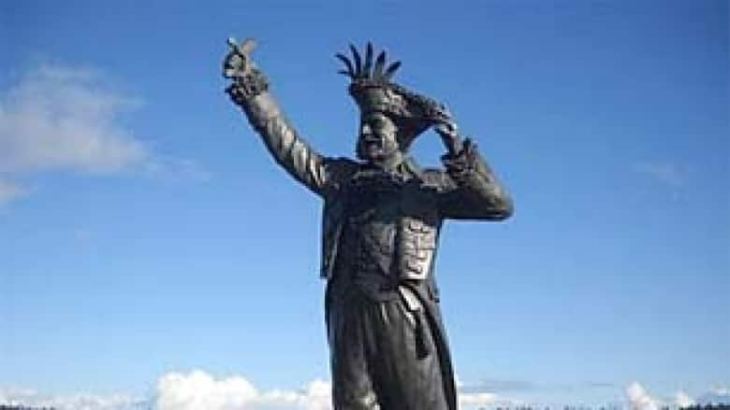
Modern-day Nanaimo Pirate: Is Leonard Krog making John Horgan walk the plank?

If Leonard does win and resign, is there a chance the NDP could lose the by-election?

There are a number of things about the Nanaimo riding to consider.

  • Nanaimo is a north-south City.  The BC Liberals are strong in the north; the NDP are very strong in the south.  A lot of North Nanaimo was previously in the Parksville-Qualicum riding when Judith Reid and Ron Cantelon were the MLAs, but the redistribution prior to 2009 pushed the core Nanaimo seat to the north.  This favoured the BC Liberals chances in Nanaimo, but they have not been able to capitalize on that shift.  Had former BC Liberal MLA Mike Hunter run on the current boundaries in 2005, he would have been very close to winning the seat.  Instead, he lost to Leonard on previous boundaries.
  • Prior to 2017, the boundaries were tweaked.  It improved the riding yet again for the BC Liberals as some polls in the tough south end were swapped over to Nanaimo-North Cowichan while some good BC Liberal polls were added in.  It didn’t help. The BC Liberals did worse in 2017 but that was for other reasons.
  • With Leonard, the NDP had a strong candidate with a strong local brand.  There is no question he added to the NDP margin.  In 2013, BC Liberal Walter Anderson was the 84th of 85 BC Liberal candidates nominated.  He was in Hawaii when the campaign started and was recruited by phone.  He did a good job and lost to Leonard by only 9.5% – not a huge margin, and won 34 polls, indicating a solid base of support.  Had the NDP not had Leonard, had the BC Liberals been more organized, and had the current boundaries been in place, it might have gone to the BC Liberals.  Coulda shoulda woulda.

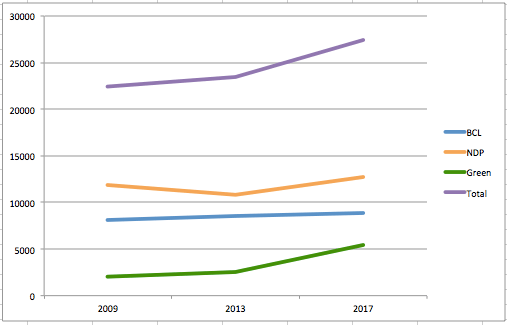
Chart 1: Total votes in Nanaimo riding by Party (2005-2017)

Screen Shot 2018-06-10 at 9.28.09 PM.png

  • In 2017, the BC Liberals performed poorly across the entire Island.  While Paris Gaudet increased the number of votes for the BC Liberals compared to 2013, turnout increased considerably with the Greens and NDP also growing.  The spread between the NDP and BC Liberals grew.  Things have changed now.  Christy Clark – who had become a lightning rod – has moved on.  Andrew Wilkinson is yet to be truly introduced to voters.  John Horgan appears strong on the Island but he will not have Leonard on the ballot this time and will have to account for government decisions over the past year.

By-elections in BC suck for governments.  Since 1981 when the Social Credit government won a by-election in Kamloops,  a sitting government has only won by-elections twice and, in both cases, the candidate’s name was Christy Clark (Point Grey and Westside-Kelowna).

The NDP never lost one of their own seats to a by-election in the 1990s, because no one resigned.  In fact, no NDP MLA resigned during the Barrett government either.  If Leonard resigns, it will be the first time in BC history that any NDP MLA has resigned his or her seat while an NDP government held power.

While they didn’t have to defend any seats in the 1990s,  the NDP were trounced in numerous by-elections, including Parksville-Qualicum in 1998 in which Leonard was a candidate.  He had been the MLA in the riding from 1991-1996 but lost in a squeaker to Parksville Mayor Paul Reitsma.  Reitmsa disgraced himself over phoney letters to the editor, and other transgressions, and resigned before he could be recalled.  What was a slim defeat for Leonard in 1996 mushroomed to a 28-point swing and blowout win for BC Liberal Judith Reid in the 1998 by-election.

One year later, in the Delta South by-election,  NDP support plunged from 26% in the previous general election to 2.44%.  This may be a record-low in Canada for an incumbent government in a by-election (which can’t be blamed on the candidate, Richard Tones, who dutifully put his name on the ballot).  Yes, Millennials, the NDP government really was that unpopular.  Is the Horgan government at the same stage as Glen Clark’s government twenty years ago?  No.  Not even close.  But stuff happens and who knows what the next 2, 3, 6 months look like?

(By-elections were not easy for the NDP in the 1990s. In the Matsqui by-election of 1994, the NDP nominated a witch.  The witch did not make it to the ballot).

The BC Liberals had their problems with by-elections too.  Despite being relatively steady in the polls, the BC Liberals lost a relatively safe seat in Coquitlam – Burke Mountain in a 2016 by-election  (a harbinger of things to come).  In 2012, during a time of trouble and turmoil early in her premiership, Christy Clark’s government lost two BC Liberal seats, in Port Moody and Chilliwack-Hope.  Chilliwack-Hope was truly a safe seat yet voters soundly rejected the government.  Is Horgan’s government in the glue as much as Christy Clark’s government was in 2012? No.  Not even close.  But the 2016 example should give them pause for thought.

Since 1981, there have been twelve by-elections were the government defended its seat and government’s record is 2 wins, 10 losses.  Or more precisely, it’s 2 wins for candidate Christy Clark, and 10 wins for the NDP Opposition, which won five by-elections against the Social Credit government between 1984-1989, and five against the BC Liberals between 2004-2016.

Table 1: BC by-elections since 1981 in government held seats

Screen Shot 2018-06-12 at 7.26.29 PM.png

The average swing against the incumbent government of the day since 1981 is 26%, ranging from a massive 59% swing in Surrey-Panorama in 2004 to a 6 point swing in favour of the government in the by-election that elected Premier Christy Clark in Westside-Kelowna in 2013, the only example where the government improved its position.

Since 2008, leaving Christy Clark out of it, the swings range from 14% to 36%.

The high-stakes Point Grey by-election of 2011, won by Christy Clark, had a 7% swing against the BC Liberal government.  In hindsight, it was a very risky move to run there.

The swing that is needed for the BC Liberals to win Nanaimo is 15%.

Therefore, the swing required for the BC Liberals to win Nanaimo is on the low end of the spectrum.

If I was an NDP strategist, I would be a little nervous about this.  The BC Liberals will be fired up for this opportunity.  There will be no shortage of volunteers and money.  If the free enterprise base can’t be motivated for a high-stakes by-election like this, then the Party has a deeper problem.  I suspect they will rally to support the local campaign, even if the odds are against them.

Finally, it comes down to candidates.  Candidates make a big difference in a local campaign.  Take Leonard away and the NDP lose support.  There is likely not a candidate who is as strong as Leonard available to the NDP.

The BC Liberals must consider carefully their approach too.  This is an opportunity and the Party should be beating the bushes, talking to local members and identifying a range of potential candidates.

The Greens say they will run a candidate.  They improved their vote in 2017 at no consequence to the NDP.  They were also a serious contender in the 2015 federal election in Nanaimo.

As of today, victory still looks like a tall order for the BC Liberals, but not impossible.  I estimate, with my gut, that the BC Liberals have a 20% chance of victory.  That’s worth fighting for, given the stakes, and given the history of swings against governments in by-elections.

Politics is full of surprises – who would have thought Rachel Notley, Justin Trudeau, Donald Trump, and Doug Ford would be where they are today?  Not to mention John Horgan – he didn’t look like a likely prospect 6-12 months before the election.

The NDP sounded confident in the Province newspaper on Sunday.  “We’re very confident we would win that by-election,” said an NDP official.

Free advice: don’t take the voters for granted.

Especially ones that travel by bathtub.♦

Screen Shot 2018-06-13 at 12.47.40 PM.png

Electoral Wipe-Outs and the Aftermath

Ontario Liberals are looking into the abyss.  This isn’t news.  Premier Kathleen Wynne said as much already when she conceded defeat, a rare admission by a campaigning incumbent Premier.

But how bad will it be?  And then what?

Screen Shot 2018-06-06 at 2.38.14 PM.png

It’s just politics.  Rt. Hon. Kim Campbell on Election Night, 1993.

We’ll know Thursday night where the Liberals will stand, but they stand to face drastic losses.  Reaching 10 seats at this point will be a triumph.  Our numbers at Pollara Strategic Insights, applied to a seat model, indicate there is a greater likelihood that they will be reduced to five or less seats.

Canadian politics provides us with several examples of tsunami elections where incumbent governments were literally washed away:

  • 1987 New Brunswick (58 Liberal, 0 PC).  Premier Richard Hatfield had governed uninterrupted since 1971, but by the mid 1980s, his government had lost its way, not to mention Hatfield’s own personal scandals.  Upstart Liberal leader Frank McKenna mobilized the electorate behind his active, youthful leadership.
  • 1993 Canada (PC’s reduced from 169 seats to 2 seats).  After two successive majority PC governments, the fallout of the Charlottetown Accord defeat, rise of Preston Manning’s Reform Party, and imposition of GST had dealt fatal blows to the Mulroney government.  Despite leadership change and the first and only female prime minister in Canadian history, the PCs were obliterated.  The Liberals had been dealt a hobbling blow themselves in 1984 -their worst outcome since Confederation.  Not only did they return with a majority under Jean Chretien in 1993, a key part of three successive wins was their utter domination of Ontario.
  • 2001 BC (77 BC Liberals, 2 NDP).  The BC NDP pulled a rabbit out of the hat in 1996 when incumbent NDP Premier Mike Harcourt gave way to one of his ministers, Glen Clark.  Clark won a majority by a thin margin.  However, Clark’s government was quickly under siege early and never recovered.  Clark resigned and Ujjal Dosanjh led the NDP into an electoral clearcut.  Gordon Campbell’s BC Liberals won the largest majority in the province’s history.

Screen Shot 2018-06-06 at 9.15.50 PM.png

There are examples where governing parties have been rendered extinct – the BC Social Credit, United Farmers of Alberta, Alberta Social Credit, Saskatchewan PCs, and Union Nationale come to mind.

The Ontario Liberals look to finish well below Richard Hatfield’s PCs and Ujjal Dosanjh’s NDP in terms of popular vote.  They have fallen below the “pitchfork line” – my newly coined phrase that I am marketing to Canada’s political science professors. It’s that line where – once crossed – a government will never recover because a critical mass of voters is so angry that the incumbent government cannot overcome that passion and intensity.

It’s hard to believe that the Ontario Liberals will become a political DoDo bird.  It’s more likely they will rise again, in due course.  Among the stages of recovery:

  • Mourning
  • Walk of humility
  • The professional class gives way to the true believers and new believers
  • New governments eventually screw up, therefore, opportunity
  • Momentum builds for a comeback
  • Time passes, change is inevitable

1987 New Brunswick – the PCs came back and won the first election after the retirement of McKenna.  It took a while to rebuild and the flash-in-the-pan Confederation of Regions Party supplanted the PCs briefly during that period.  But eventually, voters stopped punishing the PCs and Bernard Lord’s PCs returned to power in 1999. (12 year recovery)

1993 Canada – From two seats, the PCs climbed to official party status, then the merger with the Canadian Alliance, which had evolved itself from the Reform Party.  After forcing a minority in 2004, Stephen Harper won the 2006 election and governed for nine years. (13 year recovery)

2001 BC – the NDP were reduced to two of 79 seats.  They roared back in 2005 almost upsetting the Campbell government, and for the next three elections, there was a 4-point standoff between the governing BC Liberals and NDP.  After 16 years, in 2017, the NDP returned to power, with support from the Green Party.  While missing their chance at the 12 year mark, they are there now. (16 year recovery)

Whatever happens on June 7th, the Liberals will not be dead, they will just be resting.  In all likelihood, they will be back some day.  The three-party system is well-established in Ontario. Maybe it will be the 12 to 16 year range like the examples above.  Or maybe the volatility of today’s politics will expedite that process.

I will draw from my own personal experience.  My first campaign was in 1984 when as a Liberal in the Mission-Port Moody riding, I saw the pitchforks first-hand.  Voters were very angry with the Pierre Trudeau government and weren’t buying the change that John Turner offered as his replacement.  While burma-shaving on the Lougheed Highway in that summer campaign, the rage emanating from the commuters was hotter than the pavement we were standing on.  We were clobbered, going from government to 40 seats – the most humiliating defeat for the Liberal Party since Confederation.  Yet, the Party rebuilt, made a hard charge during the 1988 election, and then won a decisive majority in 1993.  A nine year recovery.

In 1988, I was on hand for Liberal Sharon Carstairs’ amazing breakthrough from one to 20 seats in Manitoba, only a few seats from governing.  Then again in 1991, for BC Liberal Gordon Wilson’s rise to Official Opposition from zero seats.  Turnarounds can be faster than people expect, especially in the social media age.  I mean, six months ago, did anyone – anyone – expect Doug Ford would be the next Premier of Ontario?  Anything can happen.

Ontario Liberals can learn from the 2011 federal election and events thereafter.  It was a humiliating loss for Michael Ignatieff’s Liberals and many touted a Liberal-NDP merger, with the NDP having the strong hand.  Until halfway through the 2015 election campaign, it looked like Tom Mulcair’s NDP were the primary opposition to Harper.  Justin Trudeau turned the tables and governs today, taking his party from third to first in probably the most dramatic comeback in Canadian political history.

A huge loss can be a good loss.  It allows for new growth and regeneration.  The Liberals will shake off “government-itis” in the face of the obvious. Voters will want to see that the Party has learned its lesson, has changed, and is offering new leadership.  Internally, the party will need to heal and unify.

Electoral wipe outs – and subsequent recoveries – speak well for our system.   There is elasticity.  Voters are in charge, punishing when they are mad, generous to parties that change and renew.  Parties that can take a punishing hit, rebuild, and contend for power are examples of parties that strive to be inclusive, rather than staying in a narrow box that only appeals to a narrow slice of voters (like the Greens, for example).  For Ontario Liberals, this phase may be over, but it will also be the beginning of something new.

Life and loss – celebrating two friends in politics

As we get older, we are faced with our own mortality, and, sadly, that of our friends.

This week, many of us were shocked to learn that Doug Eastwood had died of a heart attack during the Sun Run.  Doug made numerous contribution to public life – as a crown prosecutor, Chair of the Justice Institute, volunteer with Last Door Recovery Society, and as a campaign volunteer over the years.  It was shocking to lose someone so full of life and vibrancy as Doug, so suddenly.

Doug.jpgI first met him in 1986 when he was dispatched to BC from Ottawa by the Liberal Party of Canada to help the fledgling provincial BC Liberal campaign under the leadership of Art Lee.  The campaign didn’t succeed, but presumably Doug liked what he saw as he came west to study law at UBC.
I had not known Doug that well until he volunteered on Christy Clark’s leadership campaign in 2010.  He showed up to that campaign with passion and intensity.  It was a campaign driven by volunteers and he was instrumental in recruiting them and tending to them.  He brought a spirit and positivity that was infectious.  Talking to Doug always left one in a happier place.

During Christy’s first term, Shirley Bond was appointed Attorney-General, combining that role with Solicitor-General.  The “General” was not a lawyer, therefore, we sought a legal resource to provide her with day-to-day advice in the Minister’s Office.  Doug agreed to be seconded to work with the General.  He was invaluable and Shirley got a lot done as A-G.

He would have been a fantastic candidate for office.  I certainly asked him, as did others. He would have been a great Attorney-General, with his extensive legal knowledge and reservoirs of compassion.

Earlier this year, another friend and political volunteer succumbed to heart failure as well – John Aisenstat.

Like Doug, John was much-loved.  While Doug was a lifelong federal Liberal, John was a lifelong Conservative.  Both in their 50s when they passed, they had worked their way up on separate tracks in politics in the 1980s.

Screen Shot 2018-04-24 at 10.56.50 AM.pngJohn was a veteran of the 1983 Mulroney leadership campaign, where many young (Progressive) Conservatives of that era had their political futures forged from the heat and intensity of that race.  John became known as an expert in Leader’s Tour – the peculiar mix of news and entertainment, politics and show business.  Underpinning his expertise was his mastery of logistics.
He could tell you where every landing strip for every type of plane was located, or where to get cold beer for the tour bus. He knew the shorthand for every one-horse town in BC and probably all of Canada.  He managed tours for Brian Mulroney and he led the 1996 Gordon Campbell tour.  It was a different time back then when there was a considerable working media who had to be mollycoddled on the bus, then taken on desperate dashes to file their stories.  This was also a time before blackberries, iPhones and reliable cell phone coverage.  It was a logistical puzzle and John was the puzzle master.  His logistical superiority was secondary, however, to his strategic mind and political knowledge.

John was beloved for his wit and sense of humour.  Like Doug, he did not view politics as a career.  It was a hobby, and he was good at it.  He volunteered in politics his entire life.  He always stepped up.

I am very saddened that the first half of 2018 has seen the loss of these two thoughtful, generous, warm individuals who didn’t ask anything from politics, but rather gave of themselves considerably.  They are both a great advertisement for the political adventure and the great people you meet along the way.  Those who have had the experience of volunteering and working in politics know that we are blessed to work with people like Doug and John.  This is why losing brothers-in-arm like them is particularly hard.  Two guys with the biggest hearts had their hearts give out.  RIP both.

Note: Doug’s obituary is here

It’s no time to change time change

By Jay Denney

It’s one of the longest ongoing debates in the public sphere – should we keep changing our clocks twice a year, or not? For as long as anyone can remember, it is an issue that pops up twice a year, gets debated for a week or so, and then the sun sets on the conversation yet again (either an hour earlier or later than when the debate started).

131118_e209h_rci-fleming-1879_sn635.jpg

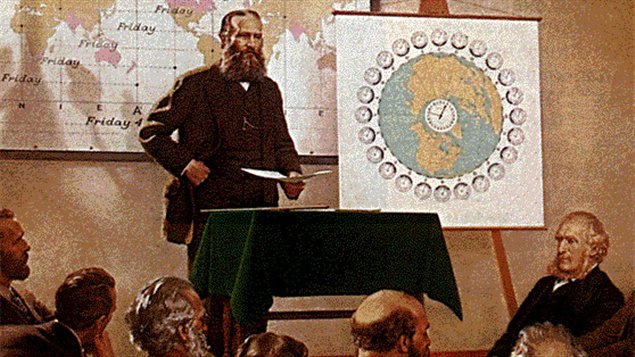
At a Toronto meeting in 1879, Sandford Fleming proposes international Greenwich time, dividing the world into 24- one hour zones. starting at the Greenwich meridian. (Radio Canada International)

2017, however, has been different. The Alberta Legislature recently studied the matter, and ultimately voted to keep observing Daylight Saving Time (DST). And in B.C., MLA Linda Larson has introduced a Private Member’s Bill to scrap DST province-wide. The argument in favour of keeping clocks the same year-round tends to focus on the first two three days after the spring ahead or fall back, mainly on the effects on health and increased auto and workplace accidents.

But what about the impact on the B.C. business community? Currently, B.C. maintains the same local time year-round with the US West Coast, which is a benefit to our burgeoning tech sector, who frequently interacts with other tech hubs in Seattle and Silicon Valley, just as the TV and film production sector does with Hollywood. They also maintain a permanent one-hour time difference with their Alberta neighbours, and a three-hour time difference with the major financial networks in Toronto and New York.   Affixing to either Standard or Daylight Savings Time would throw all of those time relationships off-kilter for part of the year (see Fig.2).   Could that be harmful to business development? Would U.S. based tech firms choose to grow their businesses state-side, thus slowing their recent expansions in B.C.? Would it impact where resource companies choose to locate their offices? Would it have an impact on jobs and opportunities in the financial sector?

One area it would certainly have an impact on would be transportation. Take for example, direct flights from Vancouver to Toronto, one of the busiest routes in the country. Currently, a flight leaving Vancouver lands in Toronto roughly 7.5 hours later (4.5 hours flying time plus 3 hour time change). If B.C. were to affix to a single time, that schedule goes off by an hour for half of the year, impacting connections, crew scheduling and ground operations, particularly with the first and last flights of each day. This could prompt Air Canada and WestJet to re-evaluate flight frequencies into and out of B.C. communities. In fact, WestJet was quite vocal during the Alberta Legislature’s study of the matter, and had projected a negative impact on air travel and connections in Calgary and Edmonton.

Further, while many people think changing the clocks is an outdated practice, there is less agreement as to which should be made permanent.   Keeping standard time year round would mean an earlier sunrise and sunset in the spring and summer, while fixing to daylight savings time would keep the late summer evenings we are used to, but mean darker morning and later sunsets in the winter.   Whatever choice is made, again it would have economic impacts. Take seasonal summer businesses for example. Many of them, such as boat and bike rental companies, and golf courses, rely on the late evening daylight to generate revenue. Would the business they lose from an earlier sunset be offset by having daylight at 3:45 in the morning? Not likely.

Most people can agree that the first few days after a time change are annoying, either because we’ve lost an hour of sleep in the spring, or because it is dark out by 4:00 pm in the fall. And we get cranky and say we just stop doing this already. But we shouldn’t be so quick to make that switch without thoroughly studying its full impact. At the very least, we should sleep on it… preferably for an extra hour in the fall.

Jay Denney is a long-time political advisor, with past experience as a Ministerial Chief of Staff in the BC Government, and as Director of Communications to former federal Cabinet Minister Stockwell Day.

Three lessons for Ontario from B.C. and the world of outrageous politics

Published in Globe & Mail, March 2 / 2018

As Ontario PC members and interested observers brace for the finale of an unanticipated and compressed leadership race, they may wish to take note of how BC Liberals recently selected Christy Clark’s successor using basically the same voting system. Instead of outrageous politics, the boring math will decide the next PC leader, and maybe the next Ontario Premier.

Three key points:

1) Some votes count more than others: In British Columbia, Andrew Wilkinson prevailed in the six-candidate race despite having the fifth-highest number of votes on the first count. How did he win?

It’s a weighted ballot. Every riding is created equally. A riding is worth 100 points, and points are allocated according to the percentage of votes received by each candidate. In Mr. Wilkinson’s case, while he had the fifth-highest number of raw votes on the first count, he had the third-highest number of points because he did well in ridings that had low membership levels (mainly in B.C.’s Interior) where his supporters had higher impact.

 Another candidate, Michael Lee, had more votes than anyone in the race but finished third because his support was concentrated in ridings with big membership lists.


2) First choices are important, but second and third choices will decide: It’s a preferential ballot, meaning that you only vote once and you have the opportunity to rank your choices. In the Ontario PC race, there are four candidates.

Mr. Wilkinson started third on the first ballot with only 18 per cent of the weighted votes, but he won. He made huge progress on the third count, and by the fourth count he was second, ultimately winning on the fifth and final count. He climbed throughout the counting process because he accumulated more second and third choices than any other candidate. He especially gained from former finance minister Michael de Jong, with whom he had a formal alliance to support each other as second choice, and from Mr. Lee, whose supporters decisively preferred Mr. Wilkinson over his final-ballot rival, Dianne Watts.

3) Not every voting member stays in the “convention hall” to the end: In the old days, delegates voted on the first ballot, heard the result, then lined up and voted again, and kept doing so until one candidate had a majority. In the Ontario PC system (as was the case in B.C.), members do all of their voting in advance, which means ranking their candidates from 1 to 4. However, they do not have to rank all of the candidates. They can just vote for their first choice if they want, but they might find that their ballot won’t count when it comes down to the final two candidates.

In the BC Liberal race, about one-quarter of the voters who cast a vote on the first count did not have their ballots considered on the final count. They had essentially “walked out of the convention hall” as they did not express a preference for either Mr. Wilkinson or the runner-up, Ms. Watts. Since they had only voted for candidates already eliminated, their ballots were removed from the counting process. Smart candidates will plead for second and third choices from voters who might otherwise “leave the hall.”

 The outcome in B.C. was certainly unpredictable. When it comes down to who wins, the next Leader of the Ontario PCs may be the one who is the best at math.

Ben there, done that

Ben Stewart made way for Premier Christy Clark in 2013 and, last night, the voters of Kelowna West returned him to the BC Legislature to continue his career as MLA.

ben-stewart.jpg

Kelowna West MLA-elect Ben Stewart.

Someone had to open up a seat for Premier Christy Clark in 2013 when she was unseated in Vancouver-Pt. Grey despite winning a majority government.  Ben stepped up and, now, he has returned to where he has always truly wanted to be – serving his constituents in the BC Legislature.

Making way for defeated leaders has happened from time to time throughout Canadian history.  Canada’s longest serving prime minister, Rt. Hon. William Lyon Mackenzie King, lost his seat in York North in 1925.  A seat was made available in Prince Albert, Saskatchewan in 1926 which he won.  He stayed put in Prince Albert until 1945 when he lost his seat again and returned to run in a by-election in Glengarry, Ontario for his final term.  During that 19 year stretch in Prince Albert, he even managed to defeat a young, upstart named John Diefenbaker (the only time two people who served as prime ministers faced each other in an election?).

Ben Stewart’s resignation and return is not the first time this has happened in modern BC political times.  In 1975, NDP Premier Dave Barrett rushed to an election, in part to head off the revival of the Social Credit Party under Bill Bennett.  It didn’t work.  Bennett rallied the forces opposed to the NDP and vanquished the Barrett government, including Barrett himself who lost his seat in Coquitlam to Socred George Kerster by 18 votes.  Vancouver East MLA Bob Williams made way for Barrett, triggering a 1976 by-election that Barrett easily won.  After Barrett’s third successive defeat to Bennett in 1983, he retired and returned the seat to Bob Williams who was elected in a 1984 by-election. Williams had the additional task of fending off newly elected BC Liberal leader Art Lee, the first and only Chinese Canadian political leader of a major party in BC history.  Williams easily won and served until 1991.

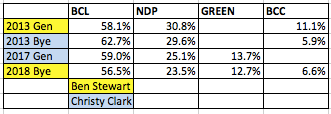
As for the significance of the Kelowna-West by-election, here are the results for the last four times those voters went to the polls:

Table 1: Westside-Kelowna (2013) and Kelowna West (2017-8) results

Screen Shot 2018-02-15 at 9.10.54 AM.png

The 2017 by-election was the first time in four elections since 2013 (two by-elections and two general elections) that four parties had contested the seat.  (The name of the riding changed but the boundaries are identical).

No one party can claim any type of breakthrough.   The BC Liberals held their support, and given that there were two minor parties this time, losing a couple of points compared to previous efforts was bound to happen. (The final by-election results will not be available for a couple of weeks as Section 98-106 votes have not yet been counted.  It likely won’t change much.)

The NDP have slid in the riding since the 2013 general election, which reflects the move away from the NDP in the Interior in the 2017 election, but moreso, it’s the impact of the Greens showing up on the ballot in 2017 and 2018, splitting their vote a bit.  I wouldn’t be too fussed by this result if I was John Horgan.  They didn’t expect to win this and, in the 1990s, when they were deeply unpopular, they would be obliterated in such by-elections.   That wasn’t the case here.

The BC Conservatives returned to the ballot in the 2018 by-election but had a very similar result to the 2013 by-election and much less than 2013 general election.  In 1973, the BC Conservatives had stress tested the then Coalition party (the Socreds) in a by-election in South Okanagan to replace the retiring WAC Bennett.  BC Conservative leader Derrill Warren challenged WAC’s son, Bill Bennett.  The younger Bennett (39%) defeated Warren (24%), settling the issue.  This was significant as, arguably, Warren’s performance in the 1972 general election was a key factor in defeating the Socred government and electing the NDP.  After the ’73 by-election, Warren left BC politics, senior Conservatives joined the Socreds, and Bennett went on to be premier.  The Kelowna West by-election yesterday was decidedly uneventful by comparison.

It’s the Greens that should be down in the mouth.  Despite the controversy over the PipeWine dispute, the NDP held its second place standing comfortably over the bronze Greens.  If anything, it may show that as long as the NDP and Greens are in cahoots, it will be difficult for the Greens to make a relative gain against their Coalition partners.  Maybe they’re happy playing second fiddle.

For new BC Liberal leader Andrew Wilkinson, he gets a win under his belt, even if it was gift-wrapped.  His team is back to 42 seats in the Legislature with no nasty surprises.

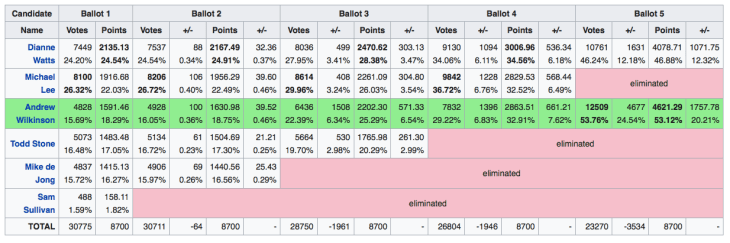
Wilkinson Win by the Numbers

The BC Liberal leadership election reached an exciting conclusion on February 3rd.  Five professional campaigns believed they had a pathway to victory and it was a night where the slightest breeze could have blown the math in another direction.

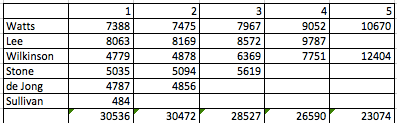
After gaming out the scenarios about infinity times, I could only come up with a few predictions – Dianne Watts would lead on the first count, Sam Sullivan would be sixth, and the race would go down to the fifth count.  What order would the candidates be from two to five?  Everyone had an opinion.  Of those four caucus contenders jockeying for position, certainly none were volunteering that they were fifth! If there was a prevailing theory about who was fifth, it often mentioned Wilkinson – and that theory wasn’t really wrong.  Wilkinson was fifth in terms of raw votes on the first count, but more importantly, third in terms of weighted votes (points), and that’s what matters.

andrew-wilkinson-b-c-liberals-election-night

BC Liberal Leader Andrew Wilkinson (CBC.ca)

I only knew one other thing for sure – that I was bound to be surprised.  Some candidates would fall short of expectations and some would exceed them.  You wouldn’t know until you saw it.

If you are wondering about how the votes get counted in this preferential ballot, regionally-weighted system, see my blog post on how it works.

The only way to look at this is one count at a time.

Table 1: Results by ballot (weighted)

Screen Shot 2018-02-12 at 8.44.41 PM.png

Source: Wikipedia.  Note: this graphic was updated.  Original contained minor errors. 

Count 1

There was a feeling among many members I talked to that Dianne Watts would have a challenge growing her support as the counts progressed.  While well-known as Mayor of Surrey and enjoying the outsider mantle, she did not have deep personal connections throughout the province with Party members as Christy Clark had in 2011.    It was clear that she would need to start off strong in the high 20s and that there be a gap between her and the second and third  place candidates.  Her first count result (24.54%) fell short and the gap between her and her rivals too narrow.

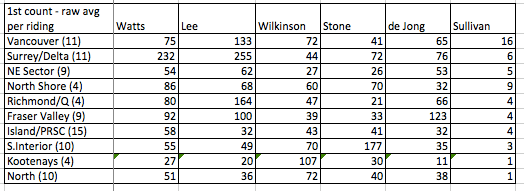
Michael Lee’s second place showing on the first count (22.03%) was impressive for a rookie MLA that had just begun to raise his profile in the Party.  Lee pulled together a veteran campaign team and a strong group of supporters, with prowess in recruiting new members, particularly in the South Asian and Chinese-Canadian communities.  In fact, Lee had the most actual votes of any candidate in the first four counts.

Table 2: Raw votes by Ballot

Screen Shot 2018-02-06 at 1.22.22 PM.png

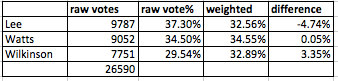
So, how you can get more votes and less points? Under the regional weighting system, every riding is treated equally.  A riding with 800 voting members is worth the same as a riding with 200 voting members.  While Lee had the highest number of casted votes, by a margin of more than 600 over Watts, many of them were in ridings with high membership totals.  On the other hand, Wilkinson had the fifth highest number of votes on the first count, but because he had strength in ridings with lower membership (eg. rural BC), he finished third in terms of points, which was critical.

Table 3: Vote efficiency (1st count)

Screen Shot 2018-02-06 at 1.24.09 PM.png

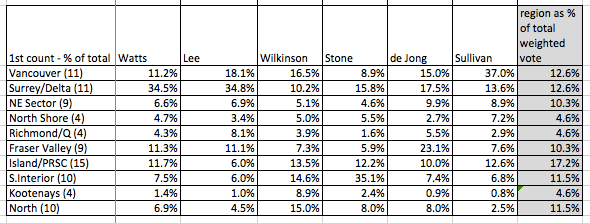
The table above shows that every candidate, but Lee, had a higher percentage of points compared to raw votes.  This is basically a reflection of Lee’s sign-up success in those high-member ridings.  Of the five ridings with the highest number of voters – Surrey Panorama, Abbotsford West, Surrey Newton, Vancouver Quilchena and Surrey Green Timbers –  Lee won four and was a strong second in the fifth.  He was second in Mike de Jong’s riding (Abbotsford West) which means Lee won Quilchena, Wilkinson’s riding (39% to 33%).

Notwithstanding the points system working against Lee, his second place finish put him in a strong position to win given that Watts was sub-25%.

Watts and Lee shared one trait in common – they were newcomers who did not have a Caucus endorsement between them.  They were banking on the Party members wanting to go in a different direction than what was being put forward by the three veteran ex-cabinet ministers in the race.

Those three ex-ministers – Wilkinson, Stone, de Jong – accounted for just about 52% of the points on the first count.  Only two percentage points separated third (Wilkinson) from fifth (de Jong).

Wilkinson and de Jong had announced their deWilkinson deal a couple of weeks ago where they recommended each other to their supporters for second choice.  It was an ideal scenario for Wilkinson to have placed ahead of de Jong and receive the hoped-for benefits of that deal.  Stone, stuck in the middle between Wilkinson and de Jong, could only hope for divine providence once de Jong dropped off the ballot.

Now that we know where everyone stood at the end the first count, where did the points come from?

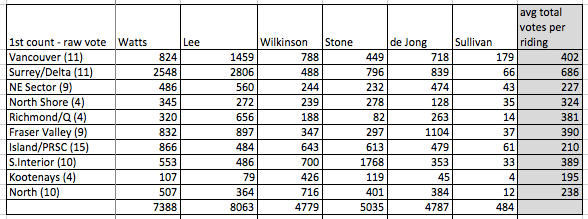
Table 4: First count by region (weighted vote)

Screen Shot 2018-02-06 at 1.26.43 PM.png

Breaking down the Province into only three regions is a limited form of analysis, but it does show some key storylines.

Watts led the Island, and was second in the Lower Mainland, but slipped to third in the Interior.  While there are twice as many ridings in the Lower Mainland than the Interior, the weakness up country slowed down her first count support.

Michael Lee showed a lot of strength in the Lower Mainland, taking 29% of the points, eclipsing Wilkinson and Stone.  However, his support was less than half of that on the Island and in the Interior where he is not well known.

For a Vancouver guy, Andrew Wilkinson did not do well on the first count in the Lower Mainland.  But he did very well in the Interior.  When looking at his support and Stone’s, you can see that the profile of their vote, regionally, was very similar except that Wilkinson did just enough to keep ahead of him.

Wilkinson’s weakness in the Lower Mainland would be mitigated on subsequent counts by second, third, and fourth choices.

Mike de Jong showed well in the Lower Mainland, but could not generate enough support in the regions.

In terms of specific ridings, the table below shows the Top 5 ridings for each of the five main contenders:

Table 5: Top 5 ridings of leadership contenders on 1st count

Screen Shot 2018-02-05 at 10.53.19 PM.png

Watts’ top finishes were close to home, in South Surrey and the adjacent Langleys.  Lee drew on strong support in Surrey and Richmond, as well as his own riding in Vancouver. These ridings reflected his sign-up strength.  Wilkinson’s top 5 were all in the Interior and were all ridings held by caucus endorsers.  Stone dominated his riding of Kamloops-South Thompson (90.3%) and Kamloops North-Thompson (82.3). No other candidate received more than 67% on the first count in any given riding, so Stone’s Kamloops base really delivered.  Nearby Shuswap and Fraser Nicola also gave him majority tallies on the first count while North Van Seymour was his best showing in the Lower Mainland.  de Jong’s best result was in Peace South.  MLA Mike Bernier dropped out of the race early to endorse de Jong.  de Jong drew strength from the three Abbotsford ridings though did not gain majorities there.

Overall, what was interesting was how candidates did very well in some ridings and very poorly in others.  Wilkinson had 67.8% in Kootenay East but only 1.6% in Abbotsford South.  He was below 10% in 25 ridings on the first count.  Watts was stronger in more ridings than anyone with only five ridings where she had less than 10%, but she didn’t really crush it in enough ridings.  Stone had 31 ridings where he could not garner 10%, and his lowest five ridings were in Richmond, East Van, and Burnaby.  de Jong’s lowest five were all in the Interior where Stone and Wilkinson did well.  Similarly, Lee’s bottom five were in the Interior.

The ‘lumpiness’ of the voting results demonstrated the opportunity for candidates down the ballot to make big gains.  If you are at less than 2 points in a riding and end up with over 60 points by the fifth ballot, that’s a huge gain over the course of five ballots.  Thus the importance of second, third, and fourth choices.

Sam Sullivan’s support (1.82%) was not enough to trigger a realignment on the second count, so the next major move takes place on the third count.

Count 3

The results of the third count were dramatic, if you are a political nerd like me.

At this point, over 93% of the ballots were still in play.  That means 7% of the voters – those who voted for either Sullivan or de Jong – did not put second choices on their ballots and therefore their ballots were removed from the count.

With Mike de Jong eliminated on the second count, the question was where would de Jong’s second choices go.  A significant plurality went to Wilkinson.

de Jong finished the second count with 16.51% of the points.  Wilkinson took almost 40% of de Jong’s points.  He boosted his total from 18.74% to 25.29% – an increase of 6.55%.

The next closest gain was Dianne Watts who gained 3.5%, increasing to 28.38%.  Lee kept pace with Watts, gaining 3.45% but did not gain any ground.  Rather, he had Wilkinson breathing down his neck.  Stone had the least amount of de Jong’s points and given that he was already in fourth place, he dropped off the ballot.

Wilkinson went from 1.62% in Abbotsford South to 29%, from 2.55% in Abbotsford West to 23.98%, from 2.91% in Surrey Whalley to 18.58%, from 10.99% in Peace South to 39.51%.  Making gains in de Jong’s stronger ridings gave him that critical three point advantage on the third count.  Now, he was less than 1% behind Lee.

Stone exited the third count with 20.29%, a significant amount considering how close the top three candidates were between each other, only separated by 3.9%.

Count 4

The fourth count decided who would be on the final ballot with Dianne Watts.  Wilkinson was making a strong run up the ballot, but would it be enough?  That’s what many were thinking.

At this point, the total amount of votes being counted was about 87% of the original pile. Watts, Lee, and Wilkinson would see their points rise on the basis of attrition but it was the remaining votes that would make the difference. (It’s worth noting that the Stone ‘votes’ also included those de Jong and Sullivan voters who went to Stone on the second and third counts)

Where would Stone’s points be allocated?

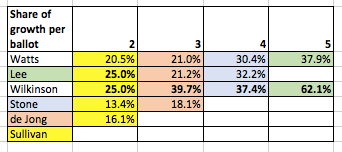
It turned out that they were competitively allocated between the three candidates with Wilkinson gaining 37.4% of Stone’s points, Lee 32.2%, and Watts 30.4%.  And by the slimmest of margins, Wilkinson’s advantage over Lee made all of the difference.

The table below shows a regional breakdown of the fourth count and, below it, where the Stone votes went by region:

Table 6: (a) 4th count by region; (b) Growth from 3rd count to 4th count

Screen Shot 2018-02-06 at 1.35.51 PM.png

On the fourth count, Watts had the most balance between the regions ranging from about 30% in the Interior to 38% on the Island, but she did not have a dominant base.

Lee’s strength was in the Lower Mainland where his support now stood at over 40% of points – in the largest region (48 seats).  But his support on the Island and Interior was just over half of that.  Wilkinson was opposite, weak in the Lower Mainland, but strong outside – and very strong in the Interior (47%) – and he made larger gains in these regions while not falling much further behind Lee in the Lower Mainland

On a points basis overall, it was a measly difference of 0.33% between Wilkinson and Lee.  One third of one-percent.  If Lee had pulled ahead, he would most likely be the Leader now.

Lee is dropped off the ballot despite leading Wilkinson by over 2000 raw votes.  The table below shows the striking difference in the efficiency of the Lee and Wilkinson votes.  There was an 8 point swing from Lee to Wilkinson based on the weighted points system. Watts was about on the mark when her raw vote and weighted was compared.

Table 7: Raw votes (%) on 4th count compared to weighted vote

Screen Shot 2018-02-06 at 1.28.31 PM.png

Count 5

With Michael Lee eliminated, a few questions remained.  Theories abounded. Where would his sizeable support among the South Asian community, Chinese community, and some who identify with his conservative background gravitate toward?  Lee was winning Surrey – would those members opt for the former Mayor, Dianne Watts?  In Vancouver, would Lee’s strength near his home riding (and in Quilchena) naturally gravitate toward Wilkinson?

Overall, the answer was clear – overwhelmingly to Wilkinson.

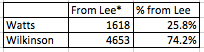
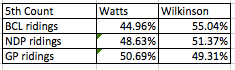
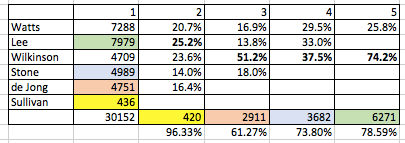
Of the remaining 6271 raw votes coming from Lee’s fourth count, they broke decisively toward Wilkinson – about 75% of Lee’s support went to Wilkinson (which is mainly Lee first choice support but there would be some first count Stone, de Jong, and Sullivan support in there too).

On the fourth count, Lee had 9787 raw votes, the most of any candidate.  About 64% of those votes migrated to the fifth and final count, while 36% of Lee’s voters were removed as they did not indicate a choice of either Wilkinson or Watts.

Table 8: Distribution of Lee votes on 5th Count (raw votes)

Screen Shot 2018-02-06 at 1.43.33 PM.png

(The * above recognizes that an estimated 82% or more of that total was Lee-first count support and the balance from de Jong, Stone, and Sullivan who went to Lee before moving on to Watts or Wilkinson)

Taking a look at Lee’s top 10 ridings on the fourth count, the migration in those ridings in terms of raw votes and points was significantly higher to Wilkinson.  In Watts’ home base of Surrey, the Lee voters stampeded to Wilkinson, by a factor of 10 to 1 in some cases.  The shift in the Surrey ridings below, and Delta North, was almost entirely from South Asian members (This shift was not replicated to same extent among Lee members in Richmond or Vancouver). The overall shift from Lee to Wilkinson allowed Wilkinson to rise from the basement in terms of support in the Lower Mainland to basically tie Watts in that region.

Table 9: Movement on 5th count in Lee’s top 10 ridings

Screen Shot 2018-02-06 at 8.57.58 AM.png

This was the story of Wilkinson’s day.  He, by far, had the lowest amount of first-count support as a percentage of final count support.  Looking at raw votes, Wilkinson’s final count was made up only 38.5% of his first count support.

Table 10: First count as percentage of final count (raw votes)

Screen Shot 2018-02-06 at 1.45.04 PM.png

Up until the fourth count, his growth from de Jong, Stone, and Sullivan was also significantly higher than Lee.  On the fourth count, only 61.7% of his votes were his first choice votes, while Lee and Watts were at 82%.  Wilkinson’s growth rate was twice the rate of the others, which is why he caught up.  This was mainly attributable to de Jong’s second choices, but Stone’s second choices (which included some de Jong) also pitched in.

Table 11: Percentage of 1st, 2nd, and 3rd count support as % of 4th count support, and growth between 1st and 4th count

Screen Shot 2018-02-06 at 1.46.44 PM.png

This series of tables above is based on raw votes to show how actual people moved.  However, the actual results are based on weighted votes (points).  Wilkinson almost tripled from the first count result while Watts almost doubled.  Again, it was Wilkinson’s growth that was the key.

Table 12: First count votes as percentage of final count votes (weighted vote)

Screen Shot 2018-02-06 at 8.43.37 AM.png

A further aspect of Wilkinson’s support was from his Caucus endorsers.  He had the most compared to any other candidate.  On the first count, he had about 37% support in his Caucus endorser ridings.  To be specific, it was the Interior ridings where the Caucus endorsement seemed to make a difference, such as Kootenay East (68%) and Cariboo Chilcotin (59%).  On the final count, that support in Caucus ridings grew to over 60%.

Perhaps it’s the fourth count where it is noteworthy.

In the 14 ridings where he had an endorsement (including his own), he had 47% of the points compared to Watts (27%) and Lee (19%).  The difference between Wilkinson and Lee in these ridings was about 390 points.  Wilkinson edged Lee by 30 points.

Yes, you can say the opposite.  Lee had a considerable advantage in the Lower Mainland area compared to Wilkinson and had he edged him, we would be talking about that.  We would be talking about Michael Lee (or Dianne Watts) who won the leadership despite any caucus endorsements.  That’s true, but Wilkinson won and that’s, in part, how he did it.  That was particularly the case from his endorsers in the Interior.  In the Lower Mainland, Wilkinson won 2 of 5 ridings on the fourth count where he was endorsed (Coquitlam-Burke Mountain and Chilliwack-Kent).

Regionally, on the final count, Wilkinson would be strongest in the Interior (61.8%) but he grew in all regions as the counts unfolded, especially in the Lower Mainland. Starting at 12.1% on the first count, he had nowhere to go but up and finished in a near-tie with Watts in the region.  He overtook Watts on the Island, while Watts never got close in the Interior.

Table 13: (a) Final count by region, (b) Growth from 1st count to final by region

Screen Shot 2018-02-07 at 11.42.03 AM.png

What role did attrition play in the final result?  Only three-quarters of voters who cast a a first choice vote had their ballot count on the final ballot.  That’s akin to a quarter of the voters walking out of the room after their candidate was eliminated to, yes, have a cheeseburger.

With a smaller pile of votes in play, Watts’ first choice votes actually amounted to about 33% on the final count (her original first count vote divided by the remaining votes).  Wilkinson’s first choice votes amounted to almost 25%.  In order for Watts to win, she needed growth and shrinkage – growth from her rivals at the same time voter attrition made her original support higher.  It wasn’t enough.  Wilkinson’s growth from Lee on the final count overwhelmed the benefits of the shrinking pile.

Keys to Victory

After that laborious review of the numbers, what are the takeaways?

  • Efficiency

The Wilkinson support was very efficient, meaning that they had a higher degree of support in lower-member ridings where votes had more impact.  Strategy is often borne from necessity and Wilkinson made the most of his support.

  • Interior Base

Wilkinson built a base of strong support in the Interior, which may seem counter-intuitive to casual observers given some try to brand him as a West-side elite. The Interior base was instrumental in getting him to third place on the ballot.

  • deWilkinson deal

Once in third, Wilkinson could reap the rewards of the deWilkinson deal.  Whether the deal made the difference, or it was just the nature of the deJong supporters to lean toward Wilkinson on their second choices will never be truly known.  But one thing is clear – de Jong’s seconds put him in a position to springboard to second place. Even if Wilkinson had finished fourth on the first count, he may still have leapt ahead of Stone given the strength of deJong voters’ support for him.  In 2011, de Jong’s second choices leaned heavily to Christy Clark and helped elect her Leader.

  • Wilkinson was a Stone’s throw to second

Again, Wilkinson drew on down ballot support, not to the extent of deJong’s support, but enough that he could make it to second place. Wilkinson made important gains on the Island and Interior from Stone, but also kept pace in the Lower Mainland with Watts and Lee.  The result was a bare 30 point edge over Lee to make it to second.  To put that margin in perspective, had 13 voters in Peace River South switched from Wilkinson to Lee, Lee would have made it to the final ballot and likely have defeated Watts.  It was that close. Slight changes in low-member ridings would have tipped the balance.

  • No Lee-way for Watts

Watts needed 47% of Lee’s points to win.  She only received 38% to Wilkinson’s 62%.  It was a decisive move by (primarily) Lee voters to elect Wilkinson, and especially from Lee’s supporters in Surrey and North Delta.


In a race this close, there is no one reason why a candidate won or lost.  There are a multitude. Yet we know that there is only one winner.  Despite having the fifth highest number of raw votes on the first count, Wilkinson parlayed regional strength into a third place finish, allowing him to receive down ballot support from de Jong and Stone.   He is not the first leader to trail on all ballots and win on the last – Andrew Scheer did it last year, trailing on 13 ballots before winning the 14th.

Wilkinson and his supporters will need to remember (as I’m sure they do) that they started off with 18.3% while 81.7% of the points were tied to another first choice.  This makes his task all the more important in terms of reaching out, mending relationships, healing divisions, and ensuring rivals and their teams play important roles going forward.  Dianne Watts came very close to winning and has a strong following throughout BC.  Her strength in suburban swing ridings during this process should gain the attention of the backroom.  Michael Lee has established himself as a force and emerging star on the provincial scene, adding to the depth that the new Leader has with Stone, de Jong, Sullivan, and the balance of Caucus.  Wilkinson has the largest Opposition Caucus in history at his disposal, an electoral referendum to fight, and a general election that could happen anytime.

Congratulations to Andrew Wilkinson and his team.   Moving from 18% to 53% over the course of five ballots does show one thing – just when we thought the Doctor-Lawyer-Rhodes Scholar could not be more educated, we may now have to add Mathematician to the list.

** There’s bound to be mistakes in this post somewhere.  Errors all mine.

Addenda

Update: February 7

I have added some numbers.  How did the leadership candidates do according to held seats and non-held seats?

Dianne Watts and Michael Lee had a combined 50.7% of the points in forty-one NDP ridings compared to a combined 43% in forty-three BC Liberal ridings (which includes Abbotsford South and Kelowna West for this analysis).  This is similar to the 2011 result where Christy Clark did much better on non-held than held seats.  The outsider candidates did not do as well in incumbent ridings.

Andrew Wilkinson and Todd Stone were stronger in BC Liberal ridings, Wilkinson especially so.  Wilkinson was 2nd in BC Liberal ridings and 4th in NDP ridings.  There are only three Green ridings so Watts’ advantage was not as important though Todd Stone wishes it was the case – it does reflect that Stone had some strength on the Island.

Table 14: First count leadership vote by BC Liberal, NDP, and Green ridings 

Screen Shot 2018-02-07 at 11.55.20 AM.png

On the fifth count, Wilkinson led in BC Liberal and NDP ridings, but moreso in the held seats.  Watts held her advantage in the three Green ridings.

Table 15: Fifth count leadership vote by BC Liberal, NDP, and Green ridings

Screen Shot 2018-02-07 at 11.47.48 AM.png

Update: February 8

Some more calculations to add to the mix.

Table 16: First count, raw vote by sub-region

Screen Shot 2018-02-08 at 10.24.31 PM.png

Table 16 shows the raw vote in each sub-region.  In the left-hand column, the number of ridings in that region is included for reference.  The most votes cast overall were in the Surrey-Delta area (686 per riding) followed by Vancouver (402) and then three regions that were very close together: Fraser Valley (390), Southern Interior (389), and Richmond (381).

Table 17: First count – Candidate raw votes in each sub-region as a percentage of each candidate’s province-wide vote. 

Screen Shot 2018-02-08 at 10.24.59 PM.png

Okay, let me explain.  This table shows what percentage of each candidate’s support came from each sub-region as a percentage of that candidate’s province-wide vote.  Of all the people that voted for Watts, 35% came from Surrey-Delta’s 11 ridings – the same as Michael Lee.  Stone had 35.1% of his province-wide raw vote come from the Southern Interior (and, actually, extremely high in Kamloops area).  For reference, the right hand column shows what percentage of the weighted vote each sub-region made up as part of province-wide total.  De Jong’s best region was the Fraser Valley (23.1% of all of his votes in BC), and that sub-region only accounted for 10.3% of the weighted vote so, yes, de Jong did quite well there.  As I write this, I’m yawning.  This is borderline pointless but I will leave it for the die hards.

Table 18: First count – Average raw vote per riding, by sub-region

Screen Shot 2018-02-08 at 10.24.47 PM.png

This is more straightforward.  Here are the raw votes per riding in each sub-region.  You can see here where a little could make a lot of difference.  Watts was 1st, 2nd, or 3rd in each region.  Lee led four Metro Vancouver regions (Vancouver, Surrey, Richmond, North East sector), but was fourth or fifth outside the Lower Mainland.  Wilkinson won the North, Kootenays, and was second in the Southern Interior and Island, while he did no better than third in the Lower Mainland sub-regions.

Table 19: Candidate raw vote increase per ballot

Screen Shot 2018-02-12 at 8.58.34 PM.png

This table shows the distribution of raw votes per ballot and which candidate had the most members migrating in their direction.  On the second ballot, Michael Lee had the most Sam Sullivan supporters choosing him as their second choice (25.2%) with Andrew Wilkinson close behind.  On the third ballot, over half of the redistributed ballots went to Wilkinson, almost all from de Jong (though there were some Sullivan third choices who came to him via de Jong).  On the fourth ballot, Wilkinson also gained the most in terms of raw votes, edging Lee.  On the fifth ballot, almost three-quarters of redistributed raw votes chose Wilkinson.   Another aspect of Table 19 is how many ballots were retained through each count.  Over 96% of Sullivan voters carried on to the second count.  On the third count, on 61% of de Jong voters stuck around.  When Todd Stone dropped off, almost three-quarters (74%) carried on to a further choice and, on the fifth count, almost 80% carried on to provide another choice.

Table 20: Candidate share of point increase per ballot

Screen Shot 2018-02-12 at 8.56.46 PM.png

Table 20 shows the distribution of points to each candidate following the removal of a candidate.  Like Table 19, it shows Wilkinson’s growth.  What’s interesting is that Wilkinson actually had more movement in terms of raw votes as he grew through the third, fourth, and fifth ballots than he did in terms of points.  He had over half of the redistributed raw votes in round 3 but only 40% of the points.  In round 5, he had almost 75% of redistributed raw votes but only 62% of redistributed points.  Wilkinson had started out with a high efficiency on the first count, but became less efficient as the ballots wore on.  This is basically a math issue where the support he was receiving on second and third choices were, in many cases, from members in high-member ridings.